
Last Updated: November 22, 2026
Most posture correctors are sized for a narrow band of bodies. The common one-size straps top out around a 43 or 44 inch chest, and many so-called large sizes stop well short of the measurements they imply. If your waist sits above those ranges, the straps dig in, the belt will not close, and the corrector ends up in a drawer. This guide only includes correctors that publish a real size chart in inches and reach genuinely extended sizes. Every pick below is sized by waist and prints a chart reaching at least 48 inches at the top end, and the widest reaches 60 inches. That published-chart rule is the gate for this list: a corrector that only says “plus size” in its title, without numbers you can measure against, did not make the cut. None of these is a medical treatment, and none replaces advice from a clinician about scoliosis, disc problems or persistent pain. They are training aids: short daily sessions that remind your shoulders where straight is, while you build the habit of standing taller on your own.
As an Amazon Associate, we earn from qualifying purchases.
Quick answer
Measure your waist where the belt of the corrector will sit, then match it to a printed chart, not a letter size. The Copper Fit Max reaches the widest waists, up to 60 inches in its 2XL/3XL. The Selbite BB-001 covers 26 to 52 inches across six sizes with a printed start-up schedule. Fitsupport and DIANMEI reach about 49 inches, and Fit Geno tops out at 48 inches.
Copper Fit Max Back Posture Support

The Copper Fit Max is the widest-fitting corrector in this guide, and that range is the main reason to start here if smaller braces have failed you. Its chart is printed by waist, measured around the belly button: the S/M covers 28 to 34 inches, the L/XL covers 34 to 48 inches, and the 2XL/3XL covers 48 to 60 inches. No other pick here reaches a 60 inch waist. The design follows the brand’s X-Back pattern: a Power X adjustable strap system, reinforced support panels and breathable mesh. A removable lumbar panel slides into an opening at the low back, so you can add or remove the pad. Copper Fit advises sizing up between sizes. The listing prints no daily wear schedule, so build up gradually. One caveat: this is a newer listing with a thinner track record than the picks below, so check the chart on the listing itself before ordering.
Specs
- Size range: S/M, L/XL and 2XL/3XL, sized by waist at belly-button level
- Published waist chart: S/M 28–34, L/XL 34–48, 2XL/3XL 48–60 in
- Design: full-back corrector, Power X straps, reinforced panels, removable lumbar panel
- Material: copper-infused breathable mesh, per brand materials
- Wear schedule printed on listing: not stated
Selbite Posture Corrector (BB-001)
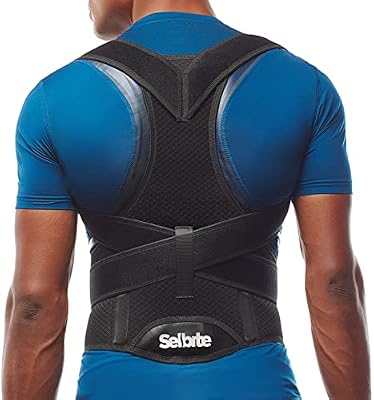
The Selbite BB-001 is the most size-granular pick here, with six sizes stepping from an XS at a 26 inch waist to an XXL at 52 inches, measured at the navel. Two shoulder straps fasten to a wide waist belt, and a breathable mesh back panel keeps the design from feeling like a solid slab. Straps and belt both adjust with hook-and-loop fasteners, so you can set the belt first and then dial in the shoulder pull. Selbite is also the only maker here that prints a start-up schedule: begin with 20 to 30 minutes a day for the first week, add up to 20 minutes a day as it gets comfortable, and wear it for up to two hours at a time. That ramp matters: wearing a corrector all day from the start is the most common mistake. The brand suggests wearing it over an undershirt or under loose clothes, and taking the larger size when sizes overlap, which they do at several steps.
Specs
- Size range: XS, S, M, L, XL and XXL, sized by waist at the navel
- Published waist chart: XS 26–32, S 30–36, M 34–40, L 38–44, XL 42–48, XXL 46–52 in
- Design: two shoulder straps fastened to a wide waist belt, breathable mesh back panel
- Closures: hook-and-loop on straps and belt
- Printed wear schedule: 20 to 30 minutes a day to start, building to sessions of up to 2 hours
- Item model number: BB-001
Fitsupport Back Brace Posture Corrector

Fitsupport’s corrector has been sold since 2019, making it one of the longest-running designs in this category. It is a full-back brace combining shoulder straps with lumbar support, sized by waist in five steps from S at 26 to 31.5 inches up to XXL at 43.5 to 49.5 inches. That 49.5 inch top end clears the gate for this guide with room to spare. Its stated wear guidance is one to six hours a day, a longer window than most makers print; treat that as a ceiling to work toward over weeks, not a starting point. The brace body is neoprene, per the listing specifications, giving it a firmer, warmer feel than the mesh designs, worth knowing if you run hot. Measure where the belt will sit, and size up between steps.
Specs
- Size range: S, M, L, XL and XXL, sized by waist
- Published waist chart: S 26–31.5, M 31–35.5, L 35.5–39.5, XL 39.5–43.5, XXL 43.5–49.5 in
- Design: full-back corrector, adjustable shoulder straps, lumbar support
- Material: neoprene, per listing specifications
- Stated wear guidance: 1 to 6 hours a day
- Item model number: HEA-1
DIANMEI Back Brace Posture Corrector

The DIANMEI corrector is another full-back design with a published five-size chart, running from S at a 26 to 30 inch waist up to XXL at 43 to 49 inches. One detail sets its chart apart: DIANMEI tells you to measure your waistline above the belly button, not at it, so follow that instruction rather than the navel measurement the other brands use, or you may land a size off. The XXL variant is the one verified for this guide, and its chart position makes this a genuine extended size rather than a relabeled regular one. The straps should feel like a firm reminder, not a squeeze: if your hands tingle or the edges bite into your underarms, loosen the shoulder straps before you give up on it.
Specs
- Size range: S, M, L, XL and XXL, sized by waist measured above the belly button
- Published waist chart: S 26–30, M 30–35.5, L 35.3–39.5, XL 39.5–43, XXL 43–49 in
- Design: full-back corrector, adjustable shoulder and waist straps, instruction sheet included
- Material: not stated
- Item model number: GJACK001XXL (XXL variant)
Fit Geno Back Brace Posture Corrector

Fit Geno’s full-back corrector is the most established name in this group, and it takes a different construction route: four lightweight fiberglass support stays run down the back panel, with dual adjustable shoulder straps and a waist belt to set the fit. Its published chart, though, is the shallowest in this guide. The listing chart sizes it by waist in three steps: Small for 25 to 33 inches, Medium/Large for 33 to 40 inches, and Large/X-Large for 41 to 48 inches. A 48 inch top end passes the gate for this list, but only just, and it is stated plainly here so nobody orders it expecting the 52 to 60 inch reach of the picks above. Within its range, the brand’s fitting advice is to tighten the lower strap first if the brace rides up, and to size up between sizes, because the sizing is widely reported to run slightly small. If your waist measures 46 inches or under, it is a solid, proven option; above that, start with the Copper Fit Max or the Selbite.
Specs
- Size range: Small, Medium/Large and Large/X-Large, sized by waist
- Published waist chart: S 25–33, M/L 33–40, L/XL 41–48 in
- Design: full-back corrector, four fiberglass support stays, shoulder straps, waist belt
- Material: breathable, soft, lightweight fabric, per listing
- Fit note from the brand: tighten the lower strap first if it rides up; size up between sizes
- UPC: 860008380456
How to choose
Start with a tape measure, not your clothing size. Every pick here is sized by waist, but the measuring point differs: Selbite and Fitsupport use the waist or navel, Copper Fit specifies belly-button level, and DIANMEI asks for the waistline above the belly button. Measure at the point the brand names, standing relaxed, and match the number to the printed chart. Between sizes, most of these makers advise taking the larger size and tensioning the straps down. Next, choose the build: full-back designs with panels, stays or a lumbar pad give the firmest cue and the most lower-back support, while slimmer builds sit flatter under clothes. Then plan your wear time: start with the shortest printed schedule, 20 to 30 minutes a day, and build up over weeks. A corrector should never cause numbness, tingling, breathing restriction or sharp pain; if it does, loosen it or stop. Treat any scoliosis, disc or post-surgery situation as a conversation with your clinician first.
Who should skip
Skip this category if a clinician has told you not to wear a brace, if you are recovering from back or shoulder surgery without clearance, or if your pain is sharp, radiating or paired with numbness in the arms or hands, since those symptoms need assessment first. Skip the Fit Geno if your waist measures above 48 inches, because its chart stops there; the Copper Fit Max, reaching 60 inches, and the Selbite, reaching 52 inches, are the honest alternatives. Skip the Fitsupport if you cannot tolerate neoprene or run very warm, since its brace body is neoprene rather than mesh. And skip every pick here if you want an all-day garment: no corrector in this guide is designed for morning-to-night wear, and wearing one too long can leave your back muscles doing less work, not more.
FAQ
How do I know which size posture corrector to order?
Measure your waist at the point the brand specifies, usually the navel or belly-button level, and match the number to the printed chart on the listing. Letter sizes are not consistent between brands: one maker’s XXL covers 46 to 52 inches, while another’s stops at 49. Between sizes, most brands advise taking the larger size and adjusting the straps down.
How long should I wear a posture corrector each day?
Start short. The clearest printed schedule in this guide, from Selbite, begins at 20 to 30 minutes a day for the first week and builds toward sessions of up to two hours. Fitsupport states one to six hours a day, but treat that as a long-term ceiling. The goal is a reminder your muscles learn from, not a brace you depend on all day.
Can I wear a posture corrector under my clothes?
Yes, most people wear these over a thin undershirt and under loose clothing. Full-back designs with panels and lumbar pads are bulkier and can show through fitted tops, so if discretion matters most, choose a slimmer design and expect a lighter cue. Avoid wearing any corrector against broken or irritated skin.
Will a posture corrector fix my scoliosis or back pain?
No corrector in this guide is a treatment for scoliosis, disc problems or chronic pain, and none is marketed as one. These braces cue your shoulders and support your back during short daily sessions, which can help you build a straighter sitting and standing habit. If you have a diagnosed spinal condition or ongoing pain, ask your clinician first, and stop if it worsens symptoms.
Final verdict
For the widest waists, the Copper Fit Max is the standout, with a published chart reaching 60 inches and a removable lumbar panel. The Selbite BB-001 is the most carefully sized option, with six sizes to 52 inches and the only printed start-up schedule. Fitsupport and DIANMEI are dependable mid-range reaches at about 49 inches, and the Fit Geno is a proven design whose 48 inch ceiling is stated plainly. Whichever you choose, measure first, match the chart, and build your wear time up slowly.
Product and ASIN Reference
| Product | ASIN |
|---|---|
| Copper Fit Max Back Posture Support | B0H37W8FZZ |
| Selbite Posture Corrector (BB-001) | B09JKWDTVH |
| Fitsupport Back Brace Posture Corrector | B07Q494CNM |
| DIANMEI Back Brace Posture Corrector | B07796NJJ5 |
| Fit Geno Back Brace Posture Corrector | B09ZQ2QSXS |
Related Reviews & Guides



6 Best Maternity Wears For Plus Size Women 2026

Pedal drive kayaks for plus size paddlers in 2026