

Last Updated: October 8, 2026
The best stackable wine racks are modular steel cube racks for maximum vertical capacity, solid-wood racks for a warmer cabinet or pantry setup, and compact countertop racks when stability and easy access matter more than expansion.
Quick answer: For most people in 2026, the best stackable wine racks is the Small countertop with frequent access — our #1 rated choice. See the full ranked comparison, alternatives and buying advice below.
Best stackable wine racks by situation
| Situation | Best choice | Typical capacity | Why it fits |
|---|---|---|---|
| Small countertop with frequent access | Two- or three-bottle metal countertop rack | 2–3 bottles | Small footprint, light weight, and no tall tower to knock over |
| Pantry or cabinet storage | Stackable wooden modular rack | 6–12 bottles per module | Stable horizontal storage and a finish that suits enclosed shelving |
| Growing collection on a budget | Stackable metal cube rack | 6–12 bottles per unit | Usually the lowest cost per bottle and simple vertical expansion |
| Uneven floor or taller installation | Interlocking or rack-mounted modular system | 12–24 bottles | Better resistance to shifting than loose units placed one on another |
| Mixed bottle shapes | Wide-slot rack with generous openings | 6–9 standard bottles | More forgiving of Champagne-style, Burgundy, or unusually broad bottles |
Head-to-head: the three main rack designs
1. Stackable metal cube racks: best for capacity and expansion
Metal cube racks generally offer the clearest route from six bottles to 12, 18, or more. Each cube commonly holds six standard 750 ml bottles in horizontal positions, while a two-cube configuration is approximately 12 inches wide, 8 to 10 inches deep, and 16 to 18 inches high. Exact dimensions vary, so measure the available space rather than assuming cubes from different manufacturers will interlock.
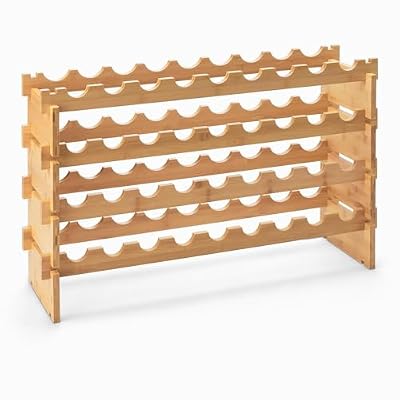
Amazon Basics Stackable Bamboo Wine Rack, 36 Bottle Capacity, Easy to Assemble
Included for 'Best Stackable Wine Racks' because the listing specifies 36 Bottle Capacity and Easy to Assemble, details this guide uses to compare options.
View on Amazon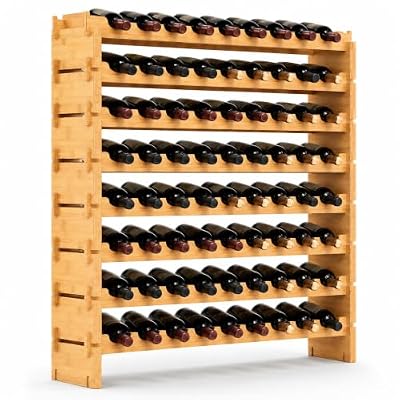
Nutrichef 72 Bottle Wine Rack Stackable Bamboo Freestanding, 8-Tier Modular Shelf, Sturdy Wobble Free, Upgraded 2026 Design, Easy No-Tool Assembly for Kitchen, Cellar or Bar Storage 33.5" x 10" x 41"
Included for 'Best Stackable Wine Racks' because the listing specifies 8-Tier Modular Shelf and Sturdy Wobble Free, details this guide uses to compare options.
View on Amazon
VEVOR 8-Tier 72 Bottles Stackable Modular Wine Rack, Freestanding Wines Holder Display Shelf, Solid Bamboo Wood Storage Racks, Wobble-Free Shelves for Kitchens, Dining Rooms, Cellars, Natural Color
Included for 'Best Stackable Wine Racks' because the listing specifies Freestanding Wines Holder Display Shelf and Solid Bamboo Wood Storage Racks, details this guide uses to compare options.
View on Amazon
VEVOR 96 Bottle Stackable Modular Wine Rack, 8-Tier Wine Bottle Holder,Solid Wood Floor Freestanding Wine Storage Rack for Pinot Noir Bottles,for Kitchen, Cellar, and Bar, Natural
Included for 'Best Stackable Wine Racks' because the listing specifies 8-Tier Wine Bottle Holder and for Kitchen, details this guide uses to compare options.
View on AmazonThe strongest versions use powder-coated steel, welded joints, and a positive connection between tiers. Lightweight wire cubes can work well on a level pantry shelf, but they are less reassuring as a tall, freestanding tower. Look for nonslip feet, locking clips, or a supplied wall strap when stacking above two tiers.
- Stack stability: Good when clipped or interlocked; moderate when simply balanced.
- Bottle capacity: Usually six standard bottles per cube.
- Footprint: Efficient, often about 8–10 inches deep.
- Expansion: Excellent, provided replacement modules use the same connection system.
- Best location: Pantry, cabinet, utility shelf, or a countertop with a low two-tier arrangement.
The ownership drawback is that thin wire can bend if a heavy bottle is dropped into a slot. Powder coating may also chip at contact points, especially where metal modules rub together. Inspect the joints when adding a new tier instead of treating a stack as permanently self-supporting.
2. Stackable wooden racks: best for cabinet and pantry organization
Wooden modular racks usually feel more substantial than wire designs and can be easier to align on a pantry shelf. A typical six-bottle module measures roughly 16 to 18 inches wide, 8 to 10 inches deep, and 8 to 9 inches high. Two modules may be placed side by side or stacked, creating 12-bottle storage without a large increase in depth.
Wood is particularly useful when the rack will remain in a cabinet or pantry. It produces less metal-on-glass noise and is less likely to scratch a finished shelf. Beech, pine, bamboo, and rubberwood are common materials; the important details are smooth bottle supports, strong glued or screwed joints, and feet that do not slide.
- Stack stability: Very good for low stacks; variable for tall, unsecured towers.
- Bottle capacity: Commonly six bottles per module.
- Footprint: Wider than many wire cubes, often 16–18 inches per module.
- Expansion: Good horizontally; vertical expansion should usually stop at two modules unless secured.
- Best location: Cabinet, pantry, sideboard, or a broad countertop.
Wood needs more care around spills. Wipe wine immediately, keep the rack dry, and avoid soaking it in a sink. A damp cloth followed by thorough drying is safer than harsh disinfectants, which can dull the finish or weaken some adhesives.
3. Compact countertop racks: best for a small active selection
Countertop racks are the practical choice when you want three to six bottles within reach rather than a large reserve. Metal wave racks, small wooden cradles, and narrow vertical holders are common. A six-bottle model may occupy about 12–15 inches of width and 6–9 inches of depth, but the vertical styles can be 14–20 inches high.
These racks are not automatically stackable just because they have a flat top. Only stack units that are designed to connect or have a broad, recessed base. A tall unconnected tower is vulnerable to a sideways bump, particularly on a busy kitchen counter.
- Stack stability: Excellent as a single low unit; poor if improvised into a tower.
- Bottle capacity: Two to six bottles per unit.
- Footprint: Usually the smallest overall.
- Expansion: Limited unless the design includes connectors.
- Best location: Countertop, bar cabinet, or a low open shelf.
What to compare before buying
Capacity versus bottle shape
Advertised capacity normally assumes standard Bordeaux-style bottles. Burgundy bottles, sparkling-wine bottles, and some heavier natural-wine bottles have wider bodies and may occupy adjacent space. Measure the widest bottle in your collection. A slot opening of around 3.5 inches is more accommodating than a tightly fitted 3-inch opening, although it also reduces the number of bottles that fit across a given width.
Vertical expansion and center of gravity
For a freestanding rack, a low, wide arrangement is safer than a narrow tower. As a practical rule, keep an unsecured stack to two modules high. For three or more tiers, choose a system with interlocking parts or attach it to a wall according to the manufacturer’s instructions. Put heavier bottles on the lowest tier and leave the upper tier empty while assembling or repositioning the rack.
Footprint and shelf clearance
Measure three dimensions: usable width, front-to-back depth, and the clearance above the rack. Add at least 1 inch of side clearance if you need to remove bottles without scraping neighboring surfaces. For a cabinet, also check the door hinge and opening angle. A rack that fits inside the cabinet may still prevent the door from closing.
Materials and finish
Powder-coated steel is usually the easiest material to wipe clean and handles minor humidity well. Chrome-plated wire can look bright but may show rust if the coating is damaged. Solid wood is quiet and attractive, while bamboo is light and often affordable; neither should be left where repeated spills or standing moisture can reach the joints.
A simple capacity calculation
Suppose a pantry shelf is 34 inches wide, 11 inches deep, and 20 inches high. Two six-bottle wooden modules that are each 17 inches wide can fit side by side, giving 12 bottles on one level. If the modules are 9 inches high and the shelf has 20 inches of clearance, stacking them would require 18 inches of height, but the top clearance may be too tight for comfortable bottle removal. In this case, side-by-side storage is more usable than forcing a vertical stack.
For a cube rack measuring 9 inches wide and six bottles per cube, three cubes across would use about 27 inches of width and hold 18 bottles. Leave the remaining width for hand clearance or a divider rather than filling the shelf edge to edge.
Setup and maintenance that improve stability
- Level the surface. A rack on a sloping shelf can slowly shift as bottles are added.
- Install the lowest tier first. Confirm that every foot or corner touches the surface before adding another module.
- Connect or secure tiers. Use the supplied clips, pegs, screws, or wall strap; do not substitute loose objects as shims.
- Load from the bottom upward. Place the heaviest and widest bottles low, then check for movement.
- Keep bottles horizontal where appropriate. This is useful for cork-closed bottles because it helps keep the cork from drying; follow the storage guidance appropriate to the closure and wine.
- Clean without soaking. Remove bottles, wipe with a lightly damp cloth, dry completely, and inspect for loose joints or chipped coating.
How much should you spend?
Basic two- to six-bottle countertop racks commonly fall in the general market range of $15–$35. Six-bottle modular metal or wooden units are often about $25–$60 each, while sturdier interlocking systems and larger 12-bottle modules may cost roughly $60–$150 or more. Compare the price per usable bottle, not only the price of the first module. A $45 rack holding six bottles costs $7.50 per position initially; adding a compatible $35 expansion module reduces the two-module average to about $6.67 per position.
Final recommendation
Choose a clipped steel cube system if your collection is growing and vertical expansion is the priority. Choose modular wood if the rack will live in a pantry or cabinet and you prefer quiet, substantial storage. Choose a small countertop rack if you rotate only a few bottles and want the lowest footprint. Whichever design you select, prioritize positive connections, a level base, enough slot width for your largest bottle, and a configuration you can safely reach without moving the entire stack.
Ready to decide? Our #1 pick for 2026 is the Small countertop with frequent access.
Live price & availability on Amazon.
Related Reviews & Guides


Buy Ears on Amazon: 6 Picks Worth Ordering (2026)

Best Ereader 2026 in 2026: Buying Guide