Last Updated: September 1, 2026
TL;DR: Resistance bands are one of the most body-size-inclusive fitness tools available — they provide scalable resistance for strength training, mobility work, and physical therapy without requiring any particular body type, fitness level, or gym membership. The right set for plus-size home workouts includes a range of resistance levels and full-length loop options. Best pick: ASIN B0D54BLSC1.
Best Resistance Bands for Plus Size Home Workouts in 2026: Strength Training That Works for Every Body
Resistance bands might be the most democratically designed fitness tool in existence. They do not care what you weigh, how tall you are, or what your current fitness level is. They provide adjustable resistance that scales with the movement — lighter at the start of a range of motion, heavier at the end — in a way that is genuinely joint-friendly and accessible at any starting point. For plus-size bodies beginning or returning to strength training, resistance bands remove nearly every logistical and comfort barrier that makes traditional gym equipment intimidating.
As an Amazon Associate we earn from qualifying purchases.


A quality resistance band set for plus-size home workouts covers the full range of training needs: light bands for mobility and physical therapy work, medium bands for upper body exercises and activation, and heavy bands for lower body strength training where plus-size bodies are often naturally stronger. This guide covers what to look for, which sets deliver genuine workout range, and how to use bands effectively for progressive strength training at home.
🛒 Best Price Today on Amazon
Prime members get fast, free shipping on everything above, plus member-only deals. New members get a 30-day free trial — cancel anytime.
Start 30-Day Prime Free Trial →See Today’s Amazon DealsTop Pick: Resistance Bands for Plus Size Workouts

WOQQW Heavy Resistance Bands for Working Out, 350lbs/450lbs Exercise Bands with Handles, Workout Bands Set for Men, Fitness Weight Bands for Muscle Strength Training,Stretching,Slim,Home Gym Equipment


As an Amazon Associate we earn from qualifying purchases. Product prices and availability are accurate as of the date/time indicated.

Fit Simplify Resistance Loop Exercise Bands with Instruction Guide and Carry Bag, Set of 5


As an Amazon Associate we earn from qualifying purchases. Product prices and availability are accurate as of the date/time indicated.
WOQQW Heavy Resistance Bands for Working Out, 350lbs/450lbs Exercise Bands with Handles, Workout Bands Set for Men, Fitness Weight Bands for Muscle Strength Training,Stretching,Slim,Home Gym Equipment
As an Amazon Associate we earn from qualifying purchases. Product prices and availability are accurate as of the date/time indicated.
Types of Resistance Bands: Which Works Best for Plus-Size Training?
Resistance bands come in several distinct formats, each with different strengths for different training goals:
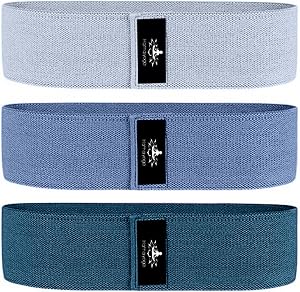
Loop bands (mini bands / booty bands): Short, flat loops typically 9–12 inches in diameter. Primarily used for lower body work — glute bridges, clamshells, lateral walks, squats. These are among the most useful tools for plus-size lower body training because they provide targeted hip and glute activation without any equipment that must support body weight. The Fit Simplify 5-pack (B0D54BLSC1) is this format.
Long loop bands (pull-up bands): Full-length flat loops 40–48 inches in diameter. Versatile for both upper and lower body training — can anchor to a door or post for rows, presses, and pull-down movements. Also used for assisted pull-up training. Heavier resistance levels in this format provide sufficient loading for lower body exercises in stronger individuals.
Tube bands with handles: Rubber tubing with plastic or foam handles at each end. Best for upper body exercises that mimic dumbbell or cable machine movements — curls, shoulder presses, rows, chest presses. The handles make them easier to grip than flat loop bands for pushing and pulling movements.
Therapy / flat bands: Long, flat strips without loops. Used primarily in physical therapy and rehabilitation contexts. Highly adjustable in length and resistance but require tying or holding the ends, which limits some exercises.
Resistance Band Specifications for Plus-Size Strength Training
| Feature | What to Look For | Why It Matters |
|---|---|---|
| Resistance range | Set covering 5 lbs to 35+ lbs equivalent | Plus-size bodies are often stronger in lower body movements than standard starter sets assume; heavy options prevent early plateau |
| Material | 100% natural latex preferred | Natural latex has better elasticity and snap-back than synthetic rubber; longer lifespan and more consistent resistance throughout range of motion |
| Width (loop bands) | 2–3 inches for lower body bands | Wider bands distribute pressure across more skin surface area — important for comfort on larger thighs where narrow bands can cut in |
| Number of bands | 5-pack minimum covering full resistance spectrum | Different exercises and muscle groups require different resistance levels; a single band is limiting for a complete home workout |
| Length (loop bands) | 12 inches unstretched (mini bands) | 12-inch loops work for a wider range of hip widths without requiring excessive tension just to position the band |
| Texture | Non-slip surface treatment preferred | Smooth latex rolls up during exercises — non-slip coating keeps the band in position during glute bridges and lateral walks |
| Included accessories | Storage bag; exercise guide | Not essential but adds practical value for home use organization |
A Starter Resistance Band Workout for Plus-Size Bodies
The following routine uses loop bands and requires no other equipment. It covers the primary lower body and core movements that build the strength base most useful for everyday function. Start with the light band and progress to heavier resistance as each movement becomes easy at 15 repetitions.
- Glute bridge with band above knees: Lying on your back, feet flat, band just above the knee. Drive hips upward, pressing knees outward against band resistance. Hold 1 second at top. 3 sets of 12–15. Targets glutes and hip stabilizers — foundational for knee health and lower back support.
- Seated clamshell: Sitting in a chair with band above knees, feet together. Open knees outward against band resistance, hold 2 seconds, return. 3 sets of 15 per side. Activates hip external rotators — often underactivated in plus-size bodies that spend extended time seated.
- Standing lateral walk: Band above knees, slight squat position. Step sideways 10 steps, return. 3 sets. Builds hip abductor strength that supports knee alignment during walking and stair-climbing.
- Banded squat: Band above knees, feet hip-width. Squat to comfortable depth, pressing knees outward against band. 3 sets of 10–12. Use a chair behind you as a depth guide and safety net until comfortable with the movement.
- Standing hip extension: Band around ankles, holding a chair or wall for balance. Extend one leg backward, engaging glute. 3 sets of 12 per side. Isolated glute work without floor exercises — good option when getting up and down from the floor is difficult.
Resistance band training pairs naturally with recovery and mobility work. Our guide to the best plus-size gardening knee pads and kneelers covers products that make floor-based activity more comfortable. For full recovery days, our review of the best plus-size power recliners with heat and massage covers the comfort equipment that makes rest days genuinely restorative.
Related Guides
- Quick Picks: Best Plus-Size Maternity Swimsuits — One…
- Plus Size Tummy Control Leggings Review
- Quick Picks: Best Plus-Size Maternity Leggings
- Quick Picks: Best Plus-Size Gym Bags and Duffle Bags for…
- Plus Size High Waist Yoga Leggings Review
Frequently Asked Questions
Are resistance bands effective for plus-size strength training or do I need weights?
Resistance bands are genuinely effective for building strength, particularly for beginners and intermediate trainees. The progressive overload principle — gradually increasing resistance — applies equally to bands and weights. Bands have a distinct advantage for plus-size beginners: they scale resistance with joint angle, loading heaviest at the strongest point in the range of motion and lightest at the most vulnerable point, which is more joint-friendly than fixed-weight dumbbells during the learning phase. As strength develops, heavier bands extend the progression further than most people expect before free weights become necessary.
Will resistance bands break or snap during use by a plus-size person?
Band breakage is a function of material quality and usage habits, not the user’s body weight. Bands fail from UV exposure, contact with sharp edges, being left on hard stretch for extended periods, and manufacturing defects — not from the resistance load placed on them during normal exercise. Quality natural latex bands from reputable brands hold their elasticity and resistance level for years of regular use. Always inspect bands before each use for any visible cracks, discoloration, or surface degradation, and replace bands showing these signs before they fail during a workout.
What resistance level should I start with as a plus-size beginner?
The right starting resistance depends more on the specific exercise than on body size. For glute bridges and squats, plus-size bodies are often stronger than the lightest bands challenge — starting at medium resistance (15–20 lb equivalent) for these movements is common. For shoulder and arm exercises, lighter bands (5–10 lb equivalent) are appropriate starting points. A 5-band set allows you to match resistance to each exercise’s demand rather than compromising — using a too-heavy band with poor form or a too-light band with no challenge. Starting with the set and experimenting per exercise is the practical approach.
Do resistance bands roll up or cut into skin on plus-size thighs?
This is a legitimate concern with narrow or smooth bands. Narrow bands (under 1.5 inches wide) on a fuller thigh can roll up during exercises and create a localized pressure line that is uncomfortable and interrupts the workout. Wider bands (2–3 inches) distribute pressure across a larger surface area and are far less prone to rolling. Non-slip textured surface treatments also help bands stay in place. For most plus-size users, the wide-band mini loops in a 5-pack set are the most comfortable format for lower body work.
Can I use resistance bands if I have knee or hip pain?
Resistance bands are among the tools most frequently recommended by physical therapists for knee and hip rehabilitation precisely because they allow gentle, progressive loading without the impact stress of bodyweight or weighted exercises. However, specific exercise selection matters — some band exercises are appropriate for certain injuries and counterproductive for others. If you have a diagnosed knee or hip condition, consult a physical therapist before starting band training to identify which exercises are appropriate for your specific situation. The tools are generally safe and beneficial; the program must match the individual.
Bottom Line
Resistance bands for plus-size home workouts deliver genuine strength training value in a format that is accessible, affordable, and completely adaptable to your starting point. A quality 5-band set covering the full resistance spectrum gives you everything needed for a complete lower and upper body training program without a single piece of equipment that requires a particular body size to use correctly. Start where you are, progress at your own pace, and let the bands scale with your growing strength — because your body is capable of building exactly that.
Ready to decide? Our #1 pick for 2026 is the Resistance range.
Live price & availability on Amazon.
Related Reviews & Guides

11 Best Plus Size Swimsuit Cover UPS for Beach Confidence
Quick Picks: Best Plus-Size Maternity Leggings