
Last Updated: September 12, 2026
- Why So Many Women Wear the Wrong Size
- What You Need to Measure
- Step-by-Step: Measuring Your Band and Cup
- Cup Size Reference Chart
- The Sister-Size Trick
- How a Correctly Fitting Bra Should Feel
- Troubleshooting Common Fit Problems
- Caring for Your Bras to Keep the Fit
- Top-Rated Picks
- Frequently Asked Questions
- Conclusion
- Related Articles
- Related Guides
⚡ Key Takeaways
- Most people guess their bra size, stick with a number they were told years ago, or shop in the limited range a single store carries.
- Gather a soft measuring tape and wear a non-padded, unlined bra that fits reasonably well.
- The difference between your bust and band measurements determines your cup size.
- If your calculated size is unavailable or fits imperfectly, sister sizing helps you find an equivalent.
Understanding how to find bra size correctly is the foundation of a comfortable wardrobe and good posture, yet studies repeatedly suggest that most women wear the wrong size. An ill-fitting bra causes back pain, digging straps, spillage, and clothes that never sit quite right, while the correct size feels like instant support you barely notice. The encouraging news is that finding your true size is straightforward once you know how to measure and how to read the fit signs. This guide walks you through the full process step by step, including the sister-size trick and how to troubleshoot a fit that feels off.
As an Amazon Associate we earn from qualifying purchases at no extra cost to you.



🛒 Best Price Today on Amazon
Prime members get fast, free shipping on everything above, plus member-only deals. New members get a 30-day free trial — cancel anytime.
Why So Many Women Wear the Wrong Size
Most people guess their bra size, stick with a number they were told years ago, or shop in the limited range a single store carries. Bodies change with weight, age, hormones, and pregnancy, so a size that fit once may be wrong now. Bra sizing also confuses many because the band and cup work together: change one and the other must change too. Once you understand how the two measurements combine, the whole system makes sense and re-measuring becomes a quick, empowering routine.
What You Need to Measure
Gather a soft measuring tape and wear a non-padded, unlined bra that fits reasonably well. You will take two measurements: your band and your bust. Stand upright in front of a mirror so you can keep the tape level all the way around.
Step-by-Step: Measuring Your Band and Cup
- Measure your band: Wrap the tape snugly around your ribcage directly under your bust, where the band of your bra sits. Keep it level and firm but not tight. Round to the nearest whole inch. If you land on an odd number, you can size to the nearest even number for the band.
- Measure your bust: Wrap the tape around the fullest part of your bust, usually across the nipples, keeping it level across your back. Do not pull tight; let it rest naturally. Round to the nearest whole inch.
- Find your band size: Use your underbust measurement as your band size (for example, 34 inches equals a 34 band). Some methods add inches, but starting with your true underbust and adjusting by fit is most reliable.
- Calculate your cup: Subtract your band measurement from your bust measurement. The difference in inches gives your cup size, as shown in the table below.
Cup Size Reference Chart
The difference between your bust and band measurements determines your cup size. Use this chart to translate the numbers.
| Bust minus Band (inches) | Cup Size |
|---|---|
| 1 | A |
| 2 | B |
| 3 | C |
| 4 | D |
| 5 | DD / E |
| 6 | DDD / F |
| 7 | G |
| 8 | H |
For example, a 36-inch band and a 41-inch bust gives a 5-inch difference, which is a 36DD. Cup labels vary slightly between brands and countries, so always check the brand’s own chart too.
The Sister-Size Trick
If your calculated size is unavailable or fits imperfectly, sister sizing helps you find an equivalent. The cup volume stays the same when you go up a band and down a cup, or down a band and up a cup. For instance, a 36C shares cup volume with a 34D (smaller band, larger cup) and a 38B (larger band, smaller cup). If your band feels too loose, try the next band down with a cup up; if it feels too tight, go a band up and a cup down. This trick rescues fits and widens your options across brands.
How a Correctly Fitting Bra Should Feel
Numbers get you close, but the mirror confirms the fit. A well-fitting bra meets all of these signs.
- The band is level and snug. It should sit straight across your back, not riding up, and stay put on the loosest hook so you can tighten as it stretches over time.
- The cups fully contain the breast. No spillage over the top or sides, and no wrinkling or gaping fabric, which signals the cup is too big.
- The center gore lies flat. The fabric between the cups should rest against your sternum.
- The straps support without digging. Most support comes from the band, not the straps; you should fit two fingers under a strap comfortably.
- The underwire surrounds the breast. It should sit on your ribcage, encircling the breast tissue, never resting on it.
Troubleshooting Common Fit Problems
If something feels off, the cause is usually a simple band or cup adjustment.
- Band rides up in back: The band is too big. Go down a band size and up a cup to keep volume.
- Spillage over the cups: The cup is too small. Go up a cup size.
- Wrinkled or gaping cups: The cup is too big. Go down a cup size.
- Straps dig into shoulders: The band is not providing enough support; tighten the band or size down.
- Underwire pokes or sits on breast tissue: The cup is too small; size up so the wire encircles the breast.
A correctly fitting bra is the invisible foundation of every outfit. It changes how tops sit, how dresses fall, and how confident you feel, making it just as important as the right layering pieces or a flattering formal dress in your wardrobe.
Caring for Your Bras to Keep the Fit
A well-fitting bra only stays that way if you care for it properly, since the band and elastic do the heavy lifting and wear out fastest. Hand wash your bras in cool water with a gentle detergent, or use a lingerie bag on a delicate machine cycle, and always air dry them. The dryer’s heat destroys elastane and warps underwires, which is the quickest way to ruin a good fit. Rotate between several bras rather than wearing the same one daily, giving the elastic time to recover between wears so it keeps its supportive snap.
Even with great care, bras have a lifespan. When the band rides up no matter which hook you use, the cups have lost their shape, or the underwire pokes through, it is time to replace them. Because most support comes from the band, a stretched-out band is the clearest sign a bra is past its prime. Re-measuring when you replace worn bras is the perfect moment to confirm your size has not changed, ensuring your new pieces support you as well as the day you bought your last good fit.
Top-Rated Picks


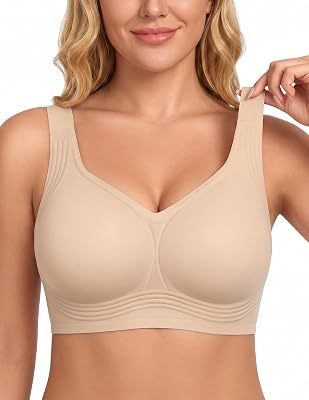

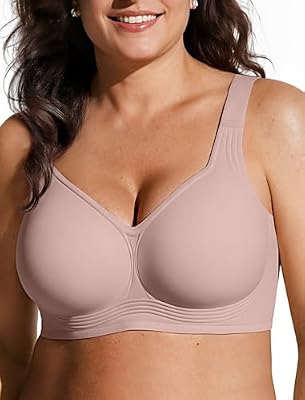
| Product | Brand | Rating | Reviews | Price |
|---|---|---|---|---|
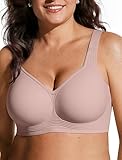
| Playtex Women's Wireless Bra, 18 Hour Plus-Size Bras … | Playtex | ★ 4.3 | 80.8k | $18.56 |
| LetsJoli Bras for Women Supportive Wireless Push Up B… | Letsjoli | ★ 4.1 | 15.2k | $19.99 |
| PoseFree Jelly Bras for Women No Underwire, Supportiv… | PoseFree | ★ 4.0 | 15.5k | $19.99 |
| OEAK Womens Wireless Jelly Bra Plus Size Supportive S… | OEAK | ★ 4.1 | 7.2k | $19.99 |
| OEAK Womens Wireless Jelly Bra Plus Size Supportive S… | OEAK | ★ 4.1 | 7.1k | $19.99 |
Frequently Asked Questions
How often should I re-measure my bra size?
Re-measure every six to twelve months, or any time your weight changes, after pregnancy, or when your bras stop fitting well. Bodies shift with age, hormones, and lifestyle, so a size that fit a year ago may be off now. Re-measuring takes only a few minutes and ensures you always have the comfort and support you deserve.
Should I round up or down when my band measurement is odd?
Bands typically come in even sizes, so if you measure an odd number you can try the nearest even sizes both up and down to see which feels best. Many people prefer rounding to the closer even number, then confirming with the fit checklist. Remember the band should feel snug and supportive on the loosest hook.
What does it mean if my bra fits everywhere except the cups?
If the band feels great but the cups spill or gape, you simply need a different cup size while keeping the same band. Spillage means go up a cup; gaping or wrinkling means go down a cup. This is the most common fit issue and is easily solved without changing your band size.
Why does the same bra size fit differently across brands?
Just like clothing, bra brands cut their cups and bands slightly differently, and cup labeling conventions vary between regions. This is why the fit checklist matters more than the label. Always check each brand’s size chart, be willing to try sister sizes, and judge by how the bra actually feels and looks on you.
Can I measure my bra size accurately at home?
Yes. Measuring your band and bust at home with a soft tape and applying the cup chart gets you a reliable starting size. From there, use the fit checklist to confirm and adjust with sister sizing as needed. A professional fitting can help if you are unsure, but most people can find their true size on their own.
Conclusion
Finding your true bra size comes down to measuring your band and bust, calculating your cup from the difference, and confirming the fit against a simple checklist. Use sister sizing to fine-tune and troubleshoot, and re-measure whenever your body changes. A correctly fitting bra supports your back, improves your posture, and makes every outfit look better. Spend ten minutes measuring today, and enjoy the comfort and confidence that come from finally wearing the right size.
Related Reviews & Guides





ARM vs x86: Key Differences, Performance, and Uses

How to Build a Plus Size Capsule Wardrobe