
Last Updated: September 17, 2026
Wader sizing is not clothing sizing and treating it as though it were is why so many pairs get returned. A wader has to fit four dimensions at once — chest, waist, hips and inseam — and it has to do so with enough slack left over that you can lift a knee to your chest, squat, kneel and climb a bank. Manufacturers handle that by publishing charts built around body measurements and, on the better lines, by splitting the size run into regular and stout cuts. The number on your jeans is irrelevant to all of it.
This is the guide to getting it right the first time: what to measure, how to read a wader chart, what stout and short stout actually mean, how to size wading boots over a stockingfoot, and how to diagnose a fit problem from the symptom. It also covers the one safety item that belongs in every wader purchase, which is a wading belt. If you are looking for specific product recommendations and current prices, the plus size fishing waders roundup covers the available models; this page is about the measurements.

DikaSun Fishing Waders for Men & Women, Waterproof 2-Ply Nylon/PVC Chest Wader with Boots for Outdoor Sizes 4-13 Bootfoot(Grey, M10/W12)
Selected for "plus size wader sizing guide": this listing is a outdoor gear product (DikaSun Fishing Waders for Men & Women, Waterproof 2-Ply Nylon/PVC Chest Wader w), matching the product category this article compares.
View on Amazon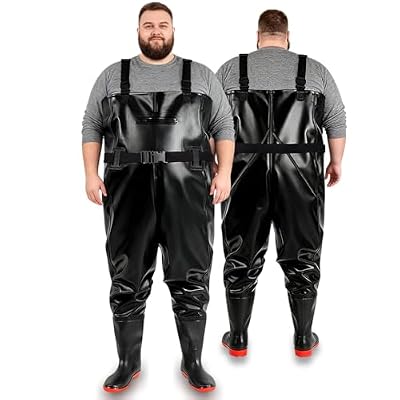
Plus Size Fishing Waders for Men Waterproof, Or Chest Waders for Women. XL
Selected for "plus size wader sizing guide": this listing is a outdoor gear product (Plus Size Fishing Waders for Men Waterproof, Or Chest Waders for Women. XL), matching the product category this article compares.
View on AmazonPlus Size Fishing Waders for Men Waterproof, Or Chest Waders for Women. XXL
Selected for "plus size wader sizing guide": this listing is a outdoor gear product (Plus Size Fishing Waders for Men Waterproof, Or Chest Waders for Women. XXL), matching the product category this article compares.
View on Amazon
FROGG TOGGS Anura II Breathable Stockingfoot Chest Wader Stout Sizes
Selected for "plus size wader sizing guide": this listing is a outdoor gear product (FROGG TOGGS Anura II Breathable Stockingfoot Chest Wader Stout Sizes), matching the product category this article compares.
View on AmazonQuick answer: Our top pick in 2026 is the Chest — our #1 rated choice. See the full ranked comparison, alternatives and buying advice below.
Quick Verdict
| Measurement | How to take it | What it controls | What goes wrong in plus sizes |
|---|---|---|---|
| Chest | Around the fullest point, tape level, not pulled tight, over a base layer | Upper body room and where the top of the wader sits | Sizing up for chest drags the inseam longer than you need |
| Waist | At your natural waistline, standing relaxed, not sucked in | Where the wading belt cinches and how the rise sits | Most charts assume a waist smaller than the chest; many bodies are the reverse |
| Hips / seat | Around the widest point of the hips and seat | Squatting, kneeling, stepping up a bank | The most commonly under-specified dimension; causes crotch seam blowouts |
| Inseam | Crotch to floor in socks, against a wall | Whether the crotch sits where it should or pulls up | Standard runs add inseam as they add girth, leaving fabric pooling at the ankle |
| Rise (crotch to shoulder) | From crotch up the front to the top of the shoulder | High-stepping without the crotch pulling up | Rarely published; test it by high-stepping before removing tags |
| Foot / boot size | Street shoe size, then add for socks and neoprene | Stockingfoot sizing and wading boot fit | Buying boots in street size, leaving no room for the neoprene bootie |
| Layering allowance | Re-measure chest and waist over winter layers | Cold-weather fit | Waders that fit in July are tight over fleece in November |
How to Choose
Take the measurements properly, once
Use a soft tape, stand normally, and have someone else take the readings if you can, because self-measuring the seat and inseam is unreliable. Wear the base layer you would actually fish in, not nothing, since a fleece base layer alone can add an inch or more to the chest. Write the numbers down and keep them on your phone. Every wader brand has a different chart, and having your four numbers to hand turns each purchase into a lookup rather than a guess.
Read the chart on the widest dimension, then fix the length separately
Wader charts are additive: as the nominal size goes up, girth and inseam both increase. That is the core problem for plus size buyers, because the dimension forcing you up the chart is usually chest, waist or seat, while your inseam has not changed at all. The result is a wader that fits around the body with six inches of surplus leg. The correct answer is not to compromise on girth. Size to the widest measurement, then look for a short or short-stout variant of that size to bring the length back. Caddis publishes short stout sizes; Paramount Outdoors splits its run into regular and stout; BRIVER lists explicit stout sizes. Those are the lines where this actually works.
Know what stout means and what it does not
Stout adds girth through the chest, waist and seat without adding proportional height. Short stout adds girth and subtracts length. Neither is a euphemism for “bigger”; they are different pattern shapes. A standard XXL and a stout XXL from the same brand can have the same chest measurement and very different waist and seat measurements. If a brand offers both and you carry weight through the middle, the stout version is almost always the right one even if the plain size technically fits your chest.
Size for movement, not for a neat silhouette
Waders are supposed to have slack. The functional test is not whether they look tidy; it is whether you can perform the four wading movements. Put the waders on over real layers, fasten the straps, and then: lift one knee as high as it will go, squat all the way down, kneel on one knee, and reach both arms overhead. If the crotch yanks upward on the high step, the rise is too short. If the shoulder straps cut in when you reach, either the rise is short or the straps need lengthening. If you cannot squat fully, the seat is too tight. Any of those means the pair goes back.
Between two sizes, size up
Excess fabric is a minor nuisance; a tight wader is a mobility problem and a durability problem at the same time. Waders that are tight through the seat and thighs put every seam under load on every step, and that repeated stress is what produces pinhole leaks at the crotch and inner thigh within a season. If you are between sizes and there is no stout option, take the larger one and cinch the wading belt tighter.
Size wading boots over the stockingfoot, not over your foot
Stockingfoot waders end in a neoprene bootie, and that bootie plus a wading sock takes up real volume. The standard approach is to order wading boots at least one full size above your street shoe size, sometimes two if you wear thick socks. Boots that are too small cut circulation and get cold fast; boots that are slightly large can be laced down. Bootfoot waders sidestep this by building the boot in, but then the boot size is tied to the wader size, which is a constraint if your foot and body sizes do not track together.
Re-measure for winter
If you fish into cold weather in breathable waders, you are wearing fleece or insulated layers underneath, and that can add two to four inches to the chest and waist. Measure over those layers and check the result against the chart. A lot of people buy waders in spring that fit perfectly and find them restrictive in November, then blame the waders. Neoprene waders are a different calculation because the insulation is the garment; they are sized to fit closer.
The Picks in Detail
Diagnosing fit from the symptom
Most wader complaints map onto a specific measurement. Crotch pulls up when you high-step means the rise is too short — you need a longer body, not a wider one, and on many brands that means going up a size and accepting the extra girth. Shoulder straps dig in is usually the same problem, showing up at the top instead of the bottom; lengthen the straps first, and if that does not fix it the rise is short. Cannot squat fully means the seat and thigh measurement is too tight. Fabric bunches behind the knee means the inseam is too long, which is what a short or short-stout cut is for. Waist gaps while the chest is snug is the classic mismatch on unisex waders and is best solved by a women’s-specific or stout pattern.
Why unisex sizing often fails and sometimes works
Unisex waders are cut on a men’s pattern, which generally means a straighter line from chest to waist and more room through the waist relative to the chest than a women’s pattern gives. If you carry weight through the middle, that can actually work in your favour, and several of the most size-inclusive listings on the market are unisex. What you lose is chest shaping, so expect either compression across the bust or excess fabric above it. It is a genuine trade-off rather than a strictly worse option, and worth trying if women’s-specific charts are not reaching your measurements.
The wading belt is not optional
Whatever size you end up in, a wading belt goes on over the waders at the waist every time you get in the water. It restricts how much water floods into the waders if you go in, which is the difference between a cold, annoying walk back to the truck and a genuine struggle to get out of a current with waterlogged legs. The other benefit is fit: cinching the belt takes up slack at the waist, which is exactly what you have too much of if you sized up for chest or seat. Check the maximum belt length in the listing before ordering, because several popular wading belts top out shorter than a plus size waist. The same rule applies to waist-high wader pants; the water-entry logic does not change.
What to do when nothing on the chart fits
If your measurements sit beyond the published run, three things are worth trying before giving up. First, look at hunting waders rather than fly fishing waders; waterfowl lines are cut fuller because they are designed to be worn over insulation. Second, look at bootfoot neoprene models, which tend to run generously through the body. Third, consider waist-high wader pants with a separate wading jacket: taking the chest out of the equation removes the dimension that most often forces you off the end of the chart, and it is a cooler setup in summer anyway. It is not a workaround so much as a different and often better system for shallow wading.
Storage and care, because fit is cumulative
Hang waders upside down by the feet to dry rather than folding them, and never store them creased in a hot car. Repeated folding at the same line breaks down the laminate and produces leaks exactly where the crease sits, which on a pair that is slightly too small is the already-stressed crotch seam. Rinse saltwater off, dry them fully before storage, and treat the seam-sealed areas gently. A pair that fits properly and is stored properly should last several seasons; a pair that is tight and folded will not.
Related guides: best hammock for plus size campers, best plus size camping chair weight capacity, best plus size fishing waders for women, best plus size hiking pants, best plus size life jacket
FAQ
Should I order waders in my normal clothing size?
No. Wader sizing is built on body measurements and each brand publishes its own chart, so the same nominal size can differ by several inches between manufacturers. Take your chest, waist, hip and inseam measurements and match them to the specific brand’s chart every time. Plus size sizing is inconsistent enough across brands that ordering on habit is close to random.
What is the difference between stout and short stout?
Stout adds girth through the chest, waist and seat without adding proportional height. Short stout adds that girth and also reduces the inseam. Short stout is usually the right answer if standard sizes fit your body but leave excess length in the leg, which is the most common plus size wader complaint.
How much room should waders have?
Enough to lift a knee to your chest, squat fully, kneel and reach overhead, wearing the layers you will actually fish in. If any of those movements pulls the crotch or the shoulder straps, the pair is too small in the rise. Slack around the legs is normal and correct; the wading belt takes up the surplus at the waist.
What size wading boots do I need with stockingfoot waders?
At least one full size above your street shoe size, sometimes two, to leave room for the neoprene bootie plus a wading sock. Too-small boots restrict circulation and make your feet cold quickly, which is the fastest way to end a day early.
Do waist-high waders need a belt as well?
Yes. The same water-entry problem applies: a waist-high pant that fills with water is heavy and restricts your legs exactly when you need them. Most waist-high waders include a belt at the waistband; use it, and make sure it actually cinches rather than just sitting there at full extension.
Ready to decide? Our #1 pick for 2026 is the Chest.
Live price & availability on Amazon.
Related Reviews & Guides

10 Best Plus Size Sunglasses: Wide-Fit Frames for Every Face Shape
6 Best Clubbing Dresses For Plus Size 2026