
Last Updated: November 23, 2026
For a heavier adult, the hard part of knee scooter shopping is not finding a scooter. It is finding one whose published weight capacity genuinely covers your body, whose knee pad is wide enough for a larger shin to rest on for weeks, and whose wheels match the ground you actually cross between the bedroom, the car, and the clinic. A frame rated below your weight flexes, wobbles, and wears out its steering long before your ankle heals.
This guide is for adults who need that published headroom, including taller riders and anyone whose recovery route leaves smooth floors. Every model below was chosen from the names, capacities, and measurements printed on its own Amazon product page, and each one publishes a 350 lb capacity on that page.
Quick Picks
As an Amazon Associate we earn from qualifying purchases.
| Product | Best for | Key spec from title |
|---|---|---|
| Drive Medical 796 Steerable Knee Walker | Daily home and office use on mixed floors | 350 lb capacity with dual braking |
| Vive Mobility All Terrain Knee Scooter | Tall riders crossing rough outdoor ground | Four 12-inch pneumatic wheels, 350 lb capacity |
| Roscoe Medical Knee Scooter (ROS-KSBG) | Long indoor days on smooth hospital-style floors | Dual padded knee platform, 350 lb capacity |
| KneeRover QUAD All Terrain Knee Scooter | Maximum stability on grass, gravel, and dirt | Four 12-inch air-filled tires |
| KneeRover Original Steerable All Terrain | Taller riders who fold the scooter into a car | Three 12-inch pneumatic tires, foldable frame |
How to Choose
Start With the Published Weight Capacity
Capacity is the first filter because everything else on the scooter depends on it. A frame, steering column, and brake set built for a lighter rider will feel vague and unstable under a heavier one, especially during turns and stops. Look for the capacity printed in the product title, the feature bullets, and the specification table on the same listing, and treat the lowest figure you find as the real limit. Leave yourself margin rather than riding exactly at the ceiling, because you will carry a bag, a water bottle, and sometimes a shopping basket along with your body weight.
Measure the Knee Pad, Not Just the Frame
Your shin and knee spend hours a day on this pad, so its dimensions matter as much as the frame rating. Wider pads spread pressure across a larger leg instead of concentrating it on one narrow ridge, and a longer pad supports more of the shin behind the knee. Compare the pad width and length printed on each listing against your own leg before ordering. Where a brand splits the pad into two cushions, check the combined footprint. If a listing does not publish pad dimensions at all, treat that silence as a real gap and weigh the model accordingly.
Match Wheel Size and Type to Your Routes
Small solid casters are fine on tile, laminate, and clinic corridors, but they chatter and catch on driveway seams, grass, and broken sidewalk slabs. Large pneumatic tires roll over those obstacles and cushion the ride, at the cost of a bigger, heavier scooter. Count your outdoor trips honestly: a rider who crosses a gravel parking lot twice a day needs air-filled tires, while someone recovering in a single-story home may never leave smooth flooring. Four wheels add straight-line stability, while three-wheel layouts turn tighter in kitchens and bathrooms.
Check the Height Ranges Against Your Body
A knee scooter only works when the pad sits level with your standing knee and the handlebars meet your hands without hunching. Compare the published pad height range and handlebar height range with your measurements before you buy, not after assembly. Taller riders should pay special attention, because several heavy-duty models still top out early on handlebar height. Riders near the bottom of a range face the opposite problem: a pad that cannot drop low enough forces the injured leg upward and strains the hip on the standing side.
The 5 Best Options
Drive Medical 796 Steerable Knee Walker

The Drive Medical 796 is the straightforward heavy-duty pick for everyday recovery at home or at work. Its alloy steel frame publishes a 350 lb capacity, the dual padded knee cushions give a larger shin a broader landing spot than a single narrow pad, and the 8-inch casters suit tile, wood, and low-pile carpet better than rough yards. A removable basket handles the small cargo problem that crutches make impossible, and the dual braking system gives a heavier rider two-handed stopping control on ramps and slopes.
Specs
- Weight capacity: 350 lb
- Knee pad: dual padded cushions, 15 x 7 in
- Knee pad height: 16.5 to 20.5 in
- Handlebar height: 31 to 40 in
- Wheels: 8-inch casters
- Overall dimensions: 30 x 16 x 31 in
- Item weight: 21 lb
- Frame material: alloy steel
- Color: Pewter
- Basket: removable, included
Best for: Riders who mostly move between rooms, offices, and clinics on finished floors.
Watch out for: One description line on this same Amazon page states a 300 lb figure alongside the 350 lb rating in the title and bullets, so plan against the lower number if you are anywhere near it.
ASIN: B00I471EI8
Vive Mobility All Terrain Knee Scooter
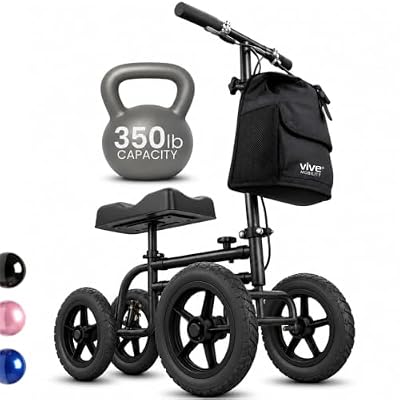
Vive built this scooter for riders whose recovery does not stay indoors. Four 12-inch pneumatic wheels carry the 350 lb rated steel frame over grass, gravel, and cracked pavement that would stop small casters, and the adjustment ranges run tall: the knee platform rises to 26 inches and the handlebars to 46 inches, with the listing aiming at users from 5 ft 3 in to 6 ft 6 in. Dual rear friction brakes manage descents. Note that Vive Health has a current recall on certain adult bed rails; that recall covers bed rails only and does not include this knee scooter.
Specs
- Weight capacity: 350 lb
- Wheels: four 12-inch pneumatic tires
- Knee platform height: 20 to 26 in
- Handlebar height: 38 to 46 in
- Recommended user height: 5 ft 3 in to 6 ft 6 in
- Overall dimensions: 36 x 18 x 45.5 in
- Item weight: 30.5 lb
- Frame material: steel
- Brakes: dual rear friction brakes
- Knee pad dimensions: not stated
- Storage bag: included
Best for: Tall riders whose route to the car or mailbox crosses uneven outdoor ground.
Watch out for: The listing never publishes the knee pad dimensions, and the platform starts at 20 inches high, which can sit tall for shorter legs.
ASIN: B07D9SZS2S
Roscoe Medical Knee Scooter (ROS-KSBG)

Roscoe Medical comes out of the clinical supply world, and this burgundy scooter reads like it: a dual padded platform sized at 7 by 14 inches, a 350 lb capacity, and height ranges that start low enough for shorter riders. At 22.8 lb it is the lightest model in this guide, and it folds for transport or storage between uses. The 8-inch polyurethane wheels are a smooth-floor choice, rolling quietly on tile and sealed concrete while shrugging off the punctures that air-filled tires can pick up.
Specs
- Model: ROS-KSBG
- Weight capacity: 350 lb
- Knee platform: dual pad, 7 in wide x 14 in long
- Platform height: 17.5 to 22 in
- Handle height: 31 to 41 in
- Wheels: 8-inch polyurethane
- Item weight: 22.8 lb
- Color: Burgundy
- Basket: detachable, included
- Folding: yes
Best for: Shorter or lighter-framed heavy riders spending long days on smooth indoor floors.
Watch out for: Solid 8-inch wheels transmit bumps instead of absorbing them, so broken pavement and gravel will feel harsh on the injured leg.
ASIN: B00MECBY20
KneeRover QUAD All Terrain Knee Scooter

The QUAD is the stability-first answer in the KneeRover line. Four 12-inch pneumatic tires plant a wide footprint under the 350 lb rated frame, which calms the side-to-side tipping that makes heavier riders nervous on a three-wheel layout. Tie-rod steering keeps the front end tracking straight, a rear drum brake handles slowing, and the recommended height range runs from 5 ft to 6 ft 4 in. At 34 inches long it needs more room to turn than the compact indoor models, which is the honest trade for its outdoor composure.
Specs
- Weight capacity: 350 lb
- Wheels: four 12-inch pneumatic tires
- Recommended user height: 5 ft to 6 ft 4 in
- Overall length: 34 in
- Item weight: 26 lb
- Steering: tie-rod
- Brake: rear drum brake
- Knee platform dimensions: not stated
- Color: Metallic Blue
Best for: Riders who want the steadiest platform for yards, gravel drives, and uneven sidewalks.
Watch out for: The listing does not publish knee platform dimensions, and the long frame needs wider turning space in small bathrooms and kitchens.
ASIN: B07BC27KXB
KneeRover Original Steerable All Terrain Knee Scooter

The Original All Terrain is the three-wheel KneeRover, built around three 12-inch pneumatic tires and a recommended height range that starts at 5 ft 6 in, so it suits taller riders better than most. It publishes the same 350 lb capacity as the QUAD, adds a stabilizer training wheel for the first unsteady days, and folds down for car transport. The three-wheel layout turns in a tighter circle than the QUAD, which helps in hallways and elevators, though it asks for a little more balance from the rider outdoors.
Specs
- Weight capacity: 350 lb
- Wheels: three 12-inch pneumatic tires
- Recommended user height: 5 ft 6 in to 6 ft 5 in
- Item weight: 28.2 lb
- Steering: tie-rod
- Stabilizer training wheel: included
- Folding: yes
- Color: Blue
Best for: Taller riders who need outdoor tires plus a frame that folds into a trunk.
Watch out for: The height range starts at 5 ft 6 in, so shorter riders should confirm the pad drops low enough for a level knee before ordering.
ASIN: B0FQFJQTM7
Which One Fits Your Situation
You Are Healing at Home on Hard Floors
Stay with the small-wheel models. The Drive Medical 796 and the Roscoe ROS-KSBG roll quietly on tile and wood, turn in less space, and weigh less when you need to shift them around furniture. Their 8-inch wheels are the right tool indoors, and both publish pad dimensions, which helps a larger leg settle in comfortably.
Your Recovery Includes Yards, Gravel, or Broken Sidewalks
Choose pneumatic tires and, if balance worries you, four of them. The KneeRover QUAD is the steadiest option here, while the Vive All Terrain matches it on wheel size and adds taller adjustment ranges. The three-wheel KneeRover Original also handles rough ground, but it rewards a rider with decent balance.
You Are Tall and Need the Pad and Bars to Reach
The Vive All Terrain publishes the tallest ranges in this guide, with handlebars up to 46 inches and a platform up to 26 inches. The KneeRover Original is the other tall-rider pick, with a recommended range starting at 5 ft 6 in. Shorter riders should look at the Roscoe instead, whose platform starts at 17.5 inches.
The Scooter Has to Ride in a Car Between Appointments
Folding frames earn their keep here. The Roscoe folds at 22.8 lb, the lightest lift in the guide, and the KneeRover Original folds as well despite its big tires. The Drive 796 is not a folder, so measure your trunk before choosing it for a commute-heavy recovery. Ask whoever drives you to practice the lift once before the first appointment morning arrives.
Common Mistakes
- Trusting the headline capacity without scanning the whole listing, where a second, lower figure sometimes appears in the description text.
- Ordering small solid wheels for a recovery route that crosses gravel, grass, or cracked pavement every day.
- Setting the knee pad by feel on the first day instead of leveling it with the knee of your standing leg.
- Forgetting to measure doorways, bathroom turns, and trunk space against the scooter’s full length and width.
- Sitting on the knee pad like a stool or putting weight through the injured foot, against the non-weight-bearing orders the scooter exists to follow.
Frequently Asked Questions
How much weight can these knee scooters actually hold?
Every model in this guide publishes a 350 lb capacity on its Amazon page. One listing, the Drive Medical 796, also carries a lower 300 lb figure in a single description line, so the safe habit is to plan against the lowest number printed anywhere on the page you buy from.
Are knee scooters steady enough for heavier riders outdoors?
They can be, with the right wheels. Large pneumatic tires roll over grass, gravel, and sidewalk cracks that stop small casters, and a four-wheel layout like the QUAD resists side tipping. Ride slowly, brake before descents, and avoid wet grass and loose sand, where any knee scooter can slide or dig in.
What knee pad size should a larger leg look for?
Start with the published pad footprint. The pads detailed in this guide run 7 inches wide and 14 to 15 inches long, which gives a broad shin room to spread its weight. Measure your own shin, favor dual-cushion designs, and be cautious with any listing that refuses to publish pad dimensions at all.
Which leg can I use a knee scooter with?
These models work for an injury on either side, because the knee pad and steering do not lock you into one leg. Set the pad height so your hips stay level, keep the injured foot fully off the ground, and follow your surgeon’s non-weight-bearing instructions for the whole recovery period.
Related Reviews & Guides




5 Best Plus Size Bike Helmets for Big Heads (November 2026)

6 Best Plus Size Tunic Shirts For Women 2026