
Last Updated: November 23, 2026
Once a pivot transfer stops being safe, the real decision is not which brand looks familiar. It is whether a hand-pumped hydraulic lift gives you enough control, or whether a powered lift is worth managing a battery for, and that choice sits underneath a harder limit: the capacity printed on the listing itself. For a larger body, that figure, the sling rating and the base width decide whether a lift belongs in the house at all.
This guide is for households caring for a larger adult at home, caregivers handling daily bed-to-chair transfers, and families setting up after a hospital discharge. Every product below was chosen from the names and specifications on its Amazon page, and each one publishes a weight capacity of at least 400 lb on that page.
Quick Picks
As an Amazon Associate we earn from qualifying purchases.
| Product | Best for | Key spec from title |
|---|---|---|
| Invacare 9805P Hydraulic Patient Lift | Caregivers who want a manual lift with no battery to manage | 450 lb weight capacity |
| ProHeal Electric Lift | Households needing the highest capacity in this group | 500 pound weight capacity, 6 point spreader bar |
| Vive Electric Patient Lift | Daily transfers with an included washable sling | Electric lift with sling included |
| Hi-Fortune HY101-01A Electric Patient Lift | One-handed push-button lifting, including from the floor | 400 lb weight capacity with medium U-sling |
| Hi-Fortune HY201A Electric Patient Lift | Homes where the lift must fold away after use | Foldable frame, 400 lb weight capacity |
How to Choose
Start with the capacity printed on the listing
Capacity is the gate everything else walks through. Use the figure on the Amazon listing itself, not the number in a roundup headline, because the two do not always agree, and the listing is the document that describes the exact unit being shipped. Leave headroom rather than buying at the limit: clothing, the sling itself and day-to-day weight changes all eat into the margin. Remember that the sling carries its own separate rating, and both numbers must cover the person being lifted. Every lift in this guide publishes at least 400 lb on its own page, which is where the shortlist started.
Hydraulic pumping or powered lifting
A hydraulic lift asks the caregiver to pump a handle for every raise, and in exchange it never needs charging and still works during a power cut. An electric lift replaces that effort with a push-button actuator, soft starts and stops, and an emergency stop button, but it adds a battery that must stay charged and usually a heavier frame. Frequency settles the question for most homes. One transfer a day is manageable by hand. Four or five transfers a day, every day, will wear a caregiver down, and powered lifting stops being a luxury and becomes the safer plan.
Base width, lift range and your floor plan
Measure before anything arrives. The base legs have to slide under the bed, open around the wheelchair or commode, and still fit through the doorways on the route between them, so compare the published base width range against your narrowest door and your under-bed clearance. The lift range matters at both ends: the low end decides whether the lift can pick someone up from the floor after a fall, and the high end decides whether it clears a tall mattress. Small casters also struggle on deep carpet, so plan transfer routes across hard floors where you can.
The sling decides whether the lift works
The lift only raises what the sling holds, so treat the sling as half the purchase. Full-body slings support the head and suit someone with little trunk control, U-slings leave the bottom open for toileting, and mesh versions drain water for bath transfers. Size the sling from the maker’s own chart rather than clothing size, and match the sling’s anchor points to the cradle: a six-point bar and a four-point cradle do not take every sling the same way. If a listing does not state that a sling is included, assume it is a separate purchase and budget for one rated at or above the lift’s capacity.
The 5 Best Options
Invacare 9805P Hydraulic Patient Lift

The 9805P is the traditional choice in this group: a manual hydraulic floor lift from a long-running mobility brand, rated at 450 lb on its listing. Its bent mast moves the boom out over the base, which helps when a chair or commode sits close to a wall, and the padded six-point swivel bar spreads sling straps wider than a four-point cradle. At 68 lb it is also the lightest lift here, so one caregiver can reposition it between rooms without a second pair of hands. There is no battery to charge, which suits homes where transfers happen on an unpredictable schedule.
Specs
- Capacity: 450 lb
- Lift type: manual hydraulic
- Lift range: 20 to 64 in
- Spreader bar: 6-point padded swivel bar
- Mast: bent mast design
- Item weight: 68 lb
- Base length: 46.75 in
- Color: beige
- Sling included: not stated
Best for: Caregivers who want a proven manual lift and no battery routine.
Watch out for: The listing does not state that a sling is included, so confirm the sling situation and its rating before ordering.
ASIN: B075JZDSWZ
ProHeal Electric Lift
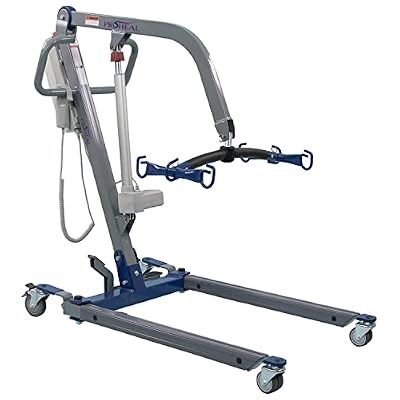
ProHeal’s electric lift carries the highest rating in this roundup at 500 lb, and it is the only pick here built around a six-point spreader bar on a powered frame. The base opens by foot pedal, so the caregiver keeps both hands free for the sling, and manual emergency lowering is built in for a power cut mid-transfer. It is aimed at households doing full-body transfers from low beds and from the floor. The trade-off is paperwork: the listing leaves several figures unstated, and whether a sling is in the box is not specified, so confirm both before ordering.
Specs
- Capacity: 500 lb
- Lift type: electric, full body
- Spreader bar: 6-point
- Emergency lowering: manual
- Base opening: foot pedal
- Casters: locking
- Warranty: 3 years
- Lift range: not stated
- Item weight: not stated
- Sling included: not stated
Best for: Larger users who need capacity above the 400 lb class and powered lifting.
Watch out for: The sling is not specified as included, and key figures such as lift range are not stated on the listing, so verify both with the seller first.
ASIN: B083V7WDRD
Vive Electric Patient Lift

Vive’s electric lift is the most completely documented option here. The listing spells out a 400 lb frame rating, a lift range of 31 to 68 inches, a base that adjusts from 24.5 to 31.4 inches, and a machine-washable mesh sling in the box with four anchor points. The cradle bar rotates a full circle, which makes small positioning corrections easier once the person is airborne, and the battery removes from the frame for charging. The soft start and stop on the actuator also matter for an anxious passenger. Assembly is required before the first transfer.
Specs
- Model: MOB1076
- Capacity: 400 lb
- Lift type: electric actuator
- Lift range: 31 to 68 in
- Base width: 24.5 to 31.4 in
- Item weight: 100 lb
- Frame: steel
- Cradle bar: rotates 360 degrees
- Battery: removable
- Sling: included, machine-washable mesh, 4 anchor points
- Frame guarantee: 2 years
Best for: Caregivers who want a complete, well-documented package with the sling included.
Watch out for: The 400 lb rating leaves no headroom for anyone close to that weight, and at 100 lb the lift itself is heavy to carry between floors.
ASIN: B0C6JHLSZX
Hi-Fortune HY101-01A Electric Patient Lift
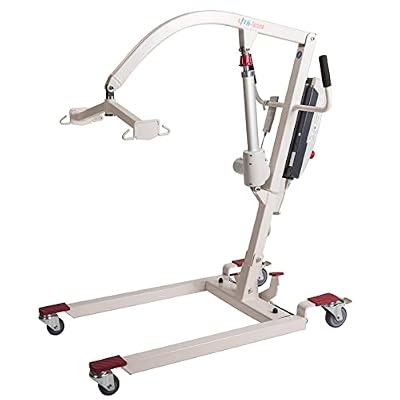
The HY101-01A is a battery-powered lift with a four-point cradle and a push-button hand control, so the caregiver can steady the person with one hand while running the lift with the other. Its listing states a 400 lb maximum, a lifting range of 34 to 68 inches, and a medium U-sling in the box, and the description says it can raise someone from the floor as well as from a bed or commode. At 99 lb it is a heavy unit to drag across carpet, so it suits a home where transfers happen in one main spot.
Specs
- Model: HY101-01A
- Capacity: 400 lb maximum weight recommendation
- Lift type: electric, 8000N motor, DC 24V
- Lift range: 34 to 68 in
- Base width range: 24.5 to 31.5 in
- Cradle: 4-point
- Item weight: 99 lb
- Casters: 3 in front, 4 in rear
- Dimensions: 47 x 24 x 48 in
- Sling: medium U-sling included
Best for: One caregiver who wants push-button control and a sling in the box.
Watch out for: Some retailer copy claims a higher rating for this model; plan against the 400 lb figure printed on the Amazon listing itself.
ASIN: B077YHZGQ2
Hi-Fortune HY201A Electric Patient Lift

The HY201A is the folding sibling of the HY101 above, built on the same 400 lb rating, the same motor class and a similar U-sling package, but on a frame that folds for storage and uses a low base to slide under furniture. That makes it the natural pick when the lift has to live in a closet or a car between uses rather than parked beside the bed. The shared platform means the same cautions apply: plan against the 400 lb figure on the listing, and expect a 99 lb unit that still takes real effort to move.
Specs
- Model: HY201A
- Capacity: 400 lb
- Lift type: electric, foldable frame
- Base: low base design
- Lift range: 34 to 68 in
- Base width range: 24.5 to 31.5 in
- Item weight: 99 lb
- Cradle: 4-point
- Sling: U-sling included
- Motor: 24V, 8000N
Best for: Homes where storage space decides, and the lift cannot stay assembled.
Watch out for: Folding helps storage, not weight; check the folded footprint against your closet or car space before ordering.
ASIN: B07ZF6Q3SK
Which One Fits Your Situation
One caregiver doing several transfers a day
Choose a powered model and save your back for the steering. The Vive pairs push-button lifting with soft starts and stops and includes its sling, so the daily routine stays short. The ProHeal adds a higher 500 lb rating and a foot-pedal base for households where the person being lifted is heavier. Either way, a hydraulic pump handle becomes a burden when transfers repeat all day.
Transfers inside a small bedroom
Start with the tape measure, then pick. The Vive’s base narrows to 24.5 inches for tight doorways, and the Hi-Fortune HY201A uses a low base that slides under furniture that would block a taller frame. The Invacare is the lightest lift here at 68 lb, which matters when it has to be swung around a bed in a room with little spare floor space.
Floor recovery after a fall matters
Look at the bottom of the lift range, not the top. The Hi-Fortune HY101-01A description covers raising someone from the floor, and the ProHeal is built for floor and low-bed transfers with manual emergency lowering. The Invacare’s range starts at 20 inches, the lowest stated here. A lift that cannot get down to the floor turns every fall back into a call for outside help.
The lift has to be stored away between uses
The HY201A folds, which makes it the only realistic choice when the lift shares a room with daily life and has to disappear into a closet. Everything else in this guide is designed to stay assembled and parked beside the bed. If storage is tight but folding is not essential, the Invacare’s lighter frame is the easiest of the fixed lifts to wheel out of the way.
Common Mistakes
- Buying on the capacity in a roundup headline instead of the figure printed on the Amazon listing for the exact model.
- Forgetting that the sling has its own weight rating, separate from the lift frame, and that both must cover the user.
- Skipping doorway, under-bed clearance and turning-space measurements until the lift is already inside the house.
- Ordering a stand assist lift for someone who cannot bear weight; that is a different device class and it will not do this job.
- Letting an electric lift sit uncharged until the morning it is needed for a discharge or an appointment.
Frequently Asked Questions
Can one caregiver operate a patient lift alone at home?
Many home lifts are designed for a single caregiver, and the electric models here add push-button controls that leave one hand free to steady the person. Practice the first transfers with a second adult present anyway, follow the maker’s setup sequence exactly, and keep the route between surfaces clear before anyone leaves the bed.
Does the sling need its own weight rating?
Yes. The sling is a separately rated component, and its limit has to cover the person’s weight just as the lift frame’s limit does. Check the rating on the sling’s label or listing before pairing it with any lift, size it from the maker’s chart, and retire a sling with frayed stitching or worn loops rather than working around the damage.
Will a patient lift roll under a standard bed?
Only if the base height clears the gap under the frame, which varies from bed to bed. Measure the clearance first, then compare it with the base design: low-base models such as the HY201A are built for tight gaps, while taller bases need more room. The legs also need space to open once they are underneath, not just to slide in.
How is a patient lift different from a stand assist lift?
A full-body patient lift raises the person in a sling and asks nothing of their legs, which is the right tool when someone cannot bear weight. A stand assist lift only helps a person who can already support most of their own weight and hold on during the move. Choosing the stand assist for a non-weight-bearing user is the most common and most serious buying error in this category.
Related Reviews & Guides





6 Best Plaid Skirt Plus Sizes 2026

How to Choose a Plus Size Swimsuit: Complete Buying Guide (2026)