
Last Updated: November 23, 2026
Buying a bedside commode as a larger person is really a measurement exercise disguised as a shopping trip. The honest questions are whether the frame is rated well above your weight, whether your hips fit between the arms without squeezing, and whether the seat height lets your feet rest flat so standing up stays safe at 3 a.m. A standard commode rated for a much smaller body fails on all three counts, which is why the bariatric models below exist.
This guide is for plus size adults recovering from surgery, living with limited mobility, or caring for a larger family member at home. Every model here was chosen because its Amazon page publishes both a bariatric weight capacity and a real width figure, and the specs quoted come from those product names and listing details rather than from marketing roundups.
Quick Picks
As an Amazon Associate we earn from qualifying purchases.
| Product | Best for | Key spec from title |
|---|---|---|
| Medline Bariatric Drop-Arm Commode | The highest capacity rating | 1,000 lb weight capacity |
| DMI Drop Arm Portable Toilet Commode | A genuinely wide seat plate | Extra-wide 23.25 in seat |
| Vive Bariatric Bedside 3-in-1 Commode | Folding away between uses | 500 lb capacity, extra wide seat |
How to Choose
Start with the published weight capacity
Capacity is the one number that decides whether a commode belongs on your shortlist at all. Standard bedside commodes are commonly rated near 300 to 350 lb, which leaves almost no safety margin for a larger user who lowers onto the seat with force rather than sitting down gently. The three models in this guide publish ratings of 500 lb or 1,000 lb on their Amazon pages. Pick a rating comfortably above the user’s actual weight, and treat any listing that hides its capacity or buries it in vague heavy-duty language as a listing to skip.
Measure width where the body actually sits
Two different width figures matter, and listings do not always give both. Seat width tells you how much room your hips get on the plate itself, while the width between the armrests tells you whether you can sit down without turning sideways or catching on the arms. A wide arm opening paired with a narrow seat plate is a common compromise on folding models, so read both numbers before ordering. Measure the user’s seated hip width over clothing, add a little clearance on each side, and compare that total against the smaller of the two published figures.
Match the seat height to the bed and the knees
A commode that sits too low forces a deep squat at the exact moment balance is worst, and one that sits too high leaves feet dangling and sliding. Look for push-button adjustable legs, then set the seat so the user’s feet rest flat with knees bent at roughly a right angle. The models below adjust across ranges from about 16.5 in up to 24 in, which covers most bed heights and most leg lengths. If the commode will also stand over an existing toilet, confirm the adjusted height clears the bowl before relying on that setup.
Decide how transfers and emptying will work
Think through the daily routine before choosing a frame style. Drop arms lower out of the way so a user can slide across from a bed or wheelchair instead of lifting over a fixed armrest, which matters enormously for side transfers. A fixed-arm folding frame stores flatter and moves between rooms more easily. Pail size shapes the less glamorous half of ownership: larger pails need emptying less often but weigh more when full, and every model here includes a lid and splash guard to make that trip safer and cleaner.
The 3 Best Options
Medline Bariatric Drop-Arm Commode
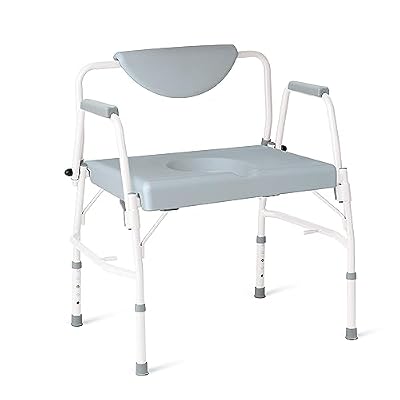
Medline’s bariatric commode is the capacity anchor of this guide, with a published 1,000 lb rating in its Amazon title and a 25 in opening between the arms. That combination suits the largest users and anyone whose caregiver has stopped trusting lighter frames. The arms drop for lateral transfers, the backrest is padded, and the seat height adjusts across a wide range, so it can serve at the bedside first and over a toilet later. It is the heaviest unit here, which is the honest trade for the rating.
Specs
- Weight capacity: 1,000 lb
- Width between arms: 25 in
- Seat depth: 18.5 in
- Seat height: adjustable, 17.5 to 21.5 in
- Seat width: not stated
- Overall width: 31 in
- Item weight: 28.1 lb
- Model number: G1-400BDX1
- Includes: pail, lid and splash guard; padded backrest
Best for: the largest users, and households that want the highest published capacity in a drop-arm frame.
Watch out for: the 31 in overall width needs a genuinely wide spot beside the bed, so measure the floor space and doorway path before ordering.
ASIN: B09YMXLVBT
DMI Drop Arm Portable Toilet Commode

The DMI commode earns its place with the widest actual seat plate in this guide, a published 23.25 in by 18.5 in, under a 500 lb capacity rating. For users whose frustration with standard commodes is the seat itself rather than the frame, that extra plate width changes the experience more than any other single figure. Both arms drop with a release button for side transfers, the legs adjust for height, and the included bucket carries a lid. It reads as a clinical product because it is one, sold under the DMI brand by Mabis Healthcare.
Specs
- Weight capacity: 500 lb
- Seat size: 23.25 in wide by 18.5 in deep
- Seat height: adjustable, 20 to 24 in
- Overall dimensions: 29.5 by 20.5 by 29.25 in
- Bucket: 5 L, with lid
- Arms: drop arms with release button, both sides
- Frame material: not stated
Best for: users who need real seat width for their hips, plus side transfers from a bed or wheelchair.
Watch out for: its lowest seat setting starts higher than the other two models, so shorter users should check that 20 in floor against their lower-leg length.
ASIN: B0CQDGM46B
Vive Bariatric Bedside 3-in-1 Commode

Vive’s bariatric commode is the flexible option: a stainless steel frame rated to 500 lb that works as a standalone bedside commode, a raised seat over a toilet, or a safety frame around one. It folds flat for storage, arrives assembled, and its 27 in between the armrests is the widest arm opening in this guide. Read the seat figure honestly, though: the seat plate itself is 13.75 in wide, so the roominess lives in the arm opening rather than under the hips, and buyers who need a wide plate should look at the DMI above instead.
Specs
- Weight capacity: 500 lb
- Width between armrests: 27 in
- Seat width: 13.75 in
- Seat height: adjustable, 16.5 to 22.5 in
- Frame: stainless steel, folds flat
- Pail: 6 qt, with lid and splash guard
- Assembly: arrives assembled
- Model number: LVA1059
Best for: users who need a wide arm opening and a commode that folds away or moves between bedside and bathroom.
Watch out for: confirm a current seller on the listing before ordering, and note the 6 qt pail is the smallest here, so it needs emptying more often.
ASIN: B06VXCLLQW
Which One Fits Your Situation
You transfer sideways from a bed or wheelchair
Choose between the Medline and the DMI, because both drop their arms out of the transfer path. The Medline suits the heaviest users and adds a padded backrest for longer sits, while the DMI gives the wider seat plate once the transfer is done. Fixed-arm frames, including the Vive, force a lift-over entry that many recovering users cannot manage safely.
Your bedroom has very little spare floor space
The Vive is the realistic pick here. It folds flat when the room needs to function as a bedroom again, moves easily between rooms, and still carries a 500 lb rating with the widest arm opening of the three. The Medline’s 31 in overall width and the DMI’s fixed footprint both assume a permanent spot beside the bed that smaller rooms cannot spare.
You are buying for a parent whose weight is still changing
Buy capacity headroom now rather than replacing the commode later. The Medline’s 1,000 lb rating covers the widest range of futures and doubles as a long-term household fixture, while either 500 lb model works when the user’s weight is stable and known. What you should not do is place anyone on a standard 300 lb commode and hope the frame tolerates the difference.
The commode will also stand over the bathroom toilet
All three models are built for that second job, but the fit depends on bowl height and leg adjustment. The Vive’s range starts lowest and its frame is designed to straddle a toilet as a safety rail, while the Medline and DMI adjust higher for taller bowls. Measure the toilet’s height and the clearance on both sides before assuming any frame will slide into place.
Common Mistakes
- Ordering by capacity alone and ignoring the width between the armrests, which is where larger users actually get stuck.
- Assuming a wide arm opening means a wide seat plate, when some folding models pair a generous opening with a narrow seat.
- Setting the legs once at a guessed height and never checking that the user’s feet rest flat on the floor.
- Choosing a fixed-arm model for someone who transfers sideways, then discovering the lift-over entry is impossible after surgery.
- Skipping the pail lid and splash guard check, then dealing with spills on the walk to the bathroom sink.
Frequently Asked Questions
How much weight capacity does a plus size user actually need?
Choose a published rating comfortably above the user’s real weight, because sitting down adds force beyond static weight. For most plus size adults that means starting at the 500 lb class covered here rather than a standard commode. Anyone approaching or above that figure should move to the 1,000 lb Medline class instead of stretching a lighter frame.
What is the difference between seat width and width between arms?
Seat width is the size of the plate you sit on, while the arm measurement is the open space your hips pass through and rest inside. Both matter: a narrow plate feels unstable even inside a wide frame, and wide hips cannot use a wide plate if the arms block entry. The listings in this guide publish at least one of the two, and the Vive publishes both.
Can a bariatric commode go over a regular toilet?
Yes, all three models here are designed to work as a raised seat or safety frame over an existing toilet as well as a standalone bedside unit. The legs adjust so the frame clears the bowl. Measure your toilet’s height and side clearance first, because bariatric frames are wider than standard ones and some small bathrooms cannot fit the legs around the bowl.
Why does this guide only include three models?
Because only three bariatric commodes cleared the verification bar used here: an Amazon page that publishes both a bariatric capacity and a width figure, with the product identity confirmed across independent sources. Several clinical models from brands such as Drive Medical, McKesson and Dynarex are sold mainly through medical suppliers, and their Amazon listings could not be verified, so they were left out rather than guessed at.
Related Reviews & Guides





6 Best Plus Size Maternity Sweatshirts 2026

Best Plus Size Bikinis for Women in 2026: Compared and Ranked