
Last Updated: November 23, 2026
For a heavier adult, a pair of push-up bars is only useful if the listing itself says the bars can carry the load. Many compact stands publish no weight rating at all, and a rating buried in marketing copy is not the same as a figure in the product’s own specification table. Every pick in this guide clears one gate: its Amazon listing publishes a maximum weight recommendation of at least 300 lb, so the number you plan around comes from the maker, not from a reseller’s guess.
The five pairs split into three shapes. Two are low push-up stands for deeper, wrist-friendly pressing: the rotating Perfect Pushup Elite and the one-piece Kipika bars. Three are true parallettes with working height for dips, L-sits and tuck holds: the beech-handled PULLUP & DIP pair, the 9.5 in Teclor steel bars and the 14 in TABEKE bars. Full-size dip stations are a different, taller class and are outside this guide; everything here stays compact enough for a living-room corner.
Quick Picks
As an Amazon Associate we earn from qualifying purchases.
| Product | Best for | Key spec from title |
|---|---|---|
| Perfect Pushup Elite | Rotating handles for wrist comfort | Supports up to 400 lb |
| PULLUP & DIP Wooden Push-Up Bars | Fixed wooden grip and handstand practice | Ergonomic wooden handles |
| Teclor Steel Push Up Bars | Mid-height steel parallettes | 9.5 in high, 660 lb capacity |
| TABEKE Push Up Bar 14 in | Maximum working height for dips and L-sits | 14 in high steel frame |
| Kipika Push Up Bars | Simple one-piece stands with a wide pad | Bottom anti-slip pad |
How to Choose
Start With the Published Capacity
Open the specification table on the listing, not the headline copy, and look for the maximum weight recommendation field. That field is the maker’s own published ceiling, and it is the only figure worth planning around. Leave margin under it: pressing is a fairly static load, but dips, L-sit holds and handstand entries shift weight suddenly, so a bar rated well above your body weight behaves better than one rated right at it. If a listing publishes no capacity anywhere, treat the bars as unrated and keep looking, however sturdy the frame appears in photos.
Match the Height to the Moves
Height decides what the bars can do. Low stands around 4 to 5 in exist to deepen a push-up and straighten the wrist; there is no clearance under them for anything else. Parallettes around 9 to 10 in add shallow dips and the first L-sit and tuck progressions, because your hips and heels can pass below hand level. A 14 in pair gives the most room of the compact class, but taller frames also act as longer levers, so base length and foot grip matter more as height rises. Buy for the moves on your program, not the tallest bar available.
Choose the Grip Your Wrists Prefer
Grip style changes how a set feels by the third week. Rotating handles let the wrist turn naturally through a press, which suits people whose wrists complain on flat floors, but the moving handle rules out balance work. Fixed grips split by material: beech wood stays dry, takes chalk and never splits like foam; foam padding feels kind at first and slowly compresses flat; hard plastic is the lowest-maintenance option. Diameter matters for larger hands too. Grips around 1.5 to 1.6 in fill the palm and spread pressure better than thin tubing does.
Check the Base Before the Bar
A strong bar on a skating base is still a bad bar. Look at what touches the floor: full rubber pads grip hardest on smooth floors, adjustable anti-slip feet can be leveled on uneven boards, and flat steel feet belong on a mat. Weight cuts both ways. A heavier pair stays planted when you shift forward, while a light pair is easier to store and carry but needs its feet checked before every session. Whatever you choose, load the bars gradually the first time and watch for creep before trusting them with a full set.
The 5 Best Options
Perfect Pushup Elite

The Perfect Pushup Elite takes a different route from every fixed bar here: each handle rotates on steel ball bearings, so the wrist and shoulder can settle into their own angle through the press instead of locking into one position. The round base is 8 in across with textured non-slip treads, and the listing publishes a 400 lb maximum weight recommendation, which clears the gate with room to spare for most adults. At 1.8 lb the pair is the lightest in this guide and stores in a drawer, which suits small training spaces.
Specs
- Brand: Perfect Fitness
- Maximum weight recommendation: 400 lb
- Handle type: Rotating, on steel ball bearings
- Base: 8 in diameter, textured non-slip bottom treads
- Material: ABS and alloy steel
- Item weight: 1.8 lb
- Model number: 96506310019
Best for: Deeper push-ups with less wrist strain at floor level.
Watch out for: Rotating handles are for pressing only. Never use them for L-sits, dips or handstand work, where a handle that turns under load is a hazard.
PULLUP & DIP Wooden Push-Up Bars
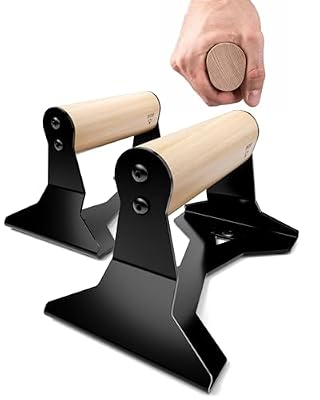
This pair mounts beech wood handles on flat alloy steel feet, a combination aimed at people who dislike foam grips. Wood stays dry under sweaty palms, accepts chalk, and has nothing to peel or compress over time. The listing publishes a maximum weight recommendation of 200 kilograms, roughly 440 lb, and lists a five-year warranty, both unusual at this size. The profile is low, around 5 in, so the job here is push-ups, handstand practice and planche leans rather than clearance work. At 4.2 lb the pair feels planted without being awkward to move between rooms.
Specs
- Brand: PULLUP & DIP
- Maximum weight recommendation: 200 kg (about 440 lb)
- Handle: Beech wood
- Material: Alloy steel
- Item weight: 4.2 lb
- Part number: 01000
- Warranty: 5 years, as listed
Best for: A fixed wooden grip for push-ups and handstand practice.
Watch out for: The low height leaves no room for dips or L-sits, and the flat steel feet belong on a mat or grippy floor rather than polished boards.
Teclor Steel Push Up Bars

The Teclor bars are the mid-height steel option: 9.5 in tall with 17 in rails, built from alloy steel tube 2 mm thick with a 1.5 in grip diameter. That height is the useful middle ground, tall enough for shallow dips, L-sit progressions and tuck holds, short enough to stay steadier than the tallest frames. The listing publishes a maximum weight recommendation of 660 lb, the joint highest figure in this guide. The pair arrives with eight screws and a screwdriver set, so a short assembly step is part of the deal before the first session.
Specs
- Brand: Teclor
- Maximum weight recommendation: 660 lb
- Height: 9.5 in
- Dimensions: 17 x 8.3 x 9.5 in
- Grip diameter: 1.5 in
- Tube thickness: 2 mm
- Material: Alloy steel
- Part number: TC-122
- Included: 2 bars, 8 screws, screwdriver set
Best for: Mid-height steel parallettes for dips and L-sit progressions.
Watch out for: Assembly is required, and a sibling TC-123 listing exists, so confirm the part number on the page matches TC-122 before ordering.
TABEKE Push Up Bar 14 in

At 14 in, the TABEKE bars are the tallest compact parallettes in this guide, and that height is the point: hips and heels clear the floor with room to spare, which opens full dip depth for many adults plus longer L-sit and tuck holds. The frame is steel tube 1.8 mm thick, the listing publishes a maximum weight recommendation of 660 lb, and the handle is wrapped in full-coverage foam at 1.5 in diameter, which softens longer holds. Adjustable anti-slip foot covers let you level the pair on boards that are not perfectly flat.
Specs
- Brand: TABEKE
- Maximum weight recommendation: 660 lb
- Height: 14 in
- Steel thickness: 1.8 mm
- Handle: Full-coverage foam, 1.5 in diameter
- Feet: Adjustable anti-slip covers
- Color: Yellow
Best for: The most working height for dips, L-sits and tuck holds.
Watch out for: A 14 in frame is the longest lever here, so set the feet carefully and re-check them before dynamic work; foam grips also compress with heavy use.
Kipika Push Up Bars

The Kipika stands are the simplest design in the guide: one moulded piece per hand, with a fixed handle set at a slight angle and a wide rubber pad under each base. The pad measures 5.5 by 7.9 in, a lot of floor contact for a stand this small, and the 1.6 in soft plastic grip suits larger hands. The listing prints a maximum weight recommendation of 1,000 lb, the highest figure here, and prints it in the specification table, which is why the pair passes this guide’s gate. There is nothing to assemble and nothing to adjust.
Specs
- Brand: Kipika
- Maximum weight recommendation: 1,000 lb, as printed on the listing
- Handle type: Fixed, angled
- Grip diameter: 1.6 in
- Base pad: 5.5 x 7.9 in rubber
- Dimensions: 7.9 x 5.5 x 4 in
- Material: Plastic
- Part number: GMPUS-01
Best for: A simple, pre-assembled stand with a wide anti-slip pad.
Watch out for: Read the printed 1,000 lb figure as the maker’s ceiling rather than a tested working load, and judge the pair by flex and pad grip in your first sessions.
Which One Fits Your Situation
Your Wrists Ache on Flat Floors
Start with the Perfect Pushup Elite, whose rotating handles let the wrist find its own angle, or the Kipika stands, whose fixed handle sits at a slight backward tilt. Both keep the wrist closer to neutral than a flat palm on the floor, and both keep you at push-up height while you build pressing volume.
You Want Dips and L-Sits, Not Just Push-Ups
Choose by clearance. The 9.5 in Teclor bars cover shallow dips and L-sit progressions in a steadier frame, while the 14 in TABEKE bars give the deepest dip range and the most room under your hands. Low stands, however strong, cannot do this job, so skip them if holds are the goal.
You Train in a Small Room
The low pairs disappear when the session ends: the Perfect Pushup Elite and the Kipika stands fit in a drawer, and the PULLUP & DIP pair slides under a sofa. Tall parallettes need a permanent corner, so measure the spot before choosing the Teclor or TABEKE pairs for a tight space.
You Sit Close to a Bar’s Published Limit
Take the steel pairs rated at 660 lb and keep a wide margin between your working weight and the printed figure, especially for dips and holds that shift load suddenly. Recheck bolts and feet weekly, and retire any bar that develops flex, wobble or a cracked weld, whatever its rating says.
Common Mistakes
- Buying a stand whose listing publishes no weight rating and assuming the frame will hold because it looks sturdy.
- Using rotating push-up handles for L-sits, dips or handstand holds, where a turning handle can dump you sideways.
- Reading a maker’s printed ceiling, including four-figure claims, as a tested working load for daily training.
- Setting tall parallettes on a slick or dusty floor without cleaning the feet and test-loading them first.
- Expecting a low push-up stand to give dip or L-sit clearance it does not have, then forcing the range.
Frequently Asked Questions
How much capacity should a heavier adult look for?
Look for a maximum weight recommendation of at least 300 lb printed in the listing’s own specification table, and prefer more margin if dips or holds are planned, because those moves load the bars less evenly than push-ups. A figure that only appears in marketing text, or nowhere at all, is not a rating worth trusting.
Are parallettes and push-up bars the same thing?
They overlap but are not identical. Push-up bars are low stands built for pressing: more depth, straighter wrists. Parallettes are taller miniature parallel bars that add dips, L-sits and tuck holds. This guide covers compact versions of both and leaves full-size dip stations, a taller and larger class, to a separate comparison.
Can I do dips on push-up bars?
On low stands, no: at 4 to 5 in there is no room for your body to travel below your hands. On parallettes of 9.5 to 14 in, shallow to fairly deep dips are realistic for many adults, depending on arm length and mobility. Full dip stations exist for unrestricted depth, but they are a different, much larger product.
What floor works best under parallettes and push-up bars?
A hard, flat floor or a thin firm mat gives the steadiest base. Thick carpet lets feet and pads sink unevenly, which adds rock at the worst moment. Clean rubber pads and feet before sessions, since dust breaks grip, and load any new pair gradually the first time to confirm nothing creeps.
Related Reviews & Guides


Best Level for Diamonds Bedrock in 2026: Top Picks Compared
6 Best Jumpsuits For Wedding Plus Size 2026