
Last Updated: November 23, 2026
Most medicine balls are built around a nine- or ten-inch shell, which is fine for average hands and frustrating for everyone else: the heavier the ball, the more a larger user must pinch and claw at a surface never sized for them. The real decision is which of the two fixes suits your training — molded dual handles you can actually close your fingers around, or a genuinely large diameter that gives both palms room to spread.
This roundup is for bigger and stronger home users, rotational core trainers, and anyone who has returned a ball that felt like gripping a grapefruit. Every pick was chosen from the names and specifications on its own Amazon page, and each one qualifies in one of two ways: its listing publishes a dual-grip handle design, or its listing publishes a diameter of at least 12 inches. Three picks are handled classic balls; the two 14-inch picks are soft wall-ball builds, labeled as such rather than passed off as traditional rubber balls.
Quick Picks
As an Amazon Associate we earn from qualifying purchases.
| Product | Best for | Key spec from title |
|---|---|---|
| SPRI Dual Grip Xerball, 10 lb | Rotational core work with a secure two-hand grip | Medicine Ball with Handles |
| ZELUS Medicine Ball with Dual Grip, 10 lb | Kettlebell-style swings and carries | Dual Grip, 10/20 lbs |
| JFIT Wall Ball, 8 lb | Wall throws and high-rep conditioning | Wall Ball, 8 LB |
| Champion Sports Rhino Promax RPX18, 18 lb | Heavy two-hand throws for stronger users | 18 lb, Soft Shell with Non-Slip Grip |
| Aeromat Dual Grip Power Medicine Ball, 6 lb | Faster, lighter rotational drills | Dual Grip Power Medicine Ball |
How to Choose
Handles or diameter: pick your route to a real grip
Bigger hands get control in two ways. A dual-grip ball carves handles into the shell, so your fingers close around something fixed instead of palming a curve; that suits swings, halos and Russian twists. A large-diameter ball, 12 inches and up, spreads the load across both palms and is easier to catch cleanly at chest height. Decide which movements dominate your week first, because a handled ball is awkward for partner passes and a big soft ball is the wrong tool for one-hand rotational work.
Weight: heavier is not automatically better
Stronger users often jump straight to the heaviest ball on the page, then lose form by the second set. Rotational and overhead work usually calls for a lighter ball than your ego suggests, because the lever is long and the catch is dynamic. Throws and squats tolerate more load. A sensible pattern for larger adults is one moderate handled ball for core circuits and one heavier large-diameter ball for throws and carries, rather than a single heavy ball asked to do everything badly.
Shell type decides what the ball survives
Firm rubber handled balls bounce, tolerate floor contact and work for throws against sturdy surfaces. Soft wall balls are stitched, padded and built to be caught; their listings say plainly that they are not intended for slamming, and repeated floor slams are exactly what splits their seams. Match the shell to the drill before you order: if your program includes overhead slams, none of the soft picks below belongs in your cart, and you should be shopping the separate slam-ball class instead.
Read the listing’s own numbers before trusting a headline
Diameter claims drift between a product’s title, its structured specification fields and third-party roundups, and the differences matter when hand fit is the whole point of the purchase. Trust the structured fields on the Amazon page itself — item diameter, item dimensions, model and part numbers — over any summary elsewhere. Also confirm which weight variant the page has selected when you order, because several of these listings sell six or more weights under one page and the specifications change with the variant.
The 5 Best Options
SPRI Dual Grip Xerball, 10 lb
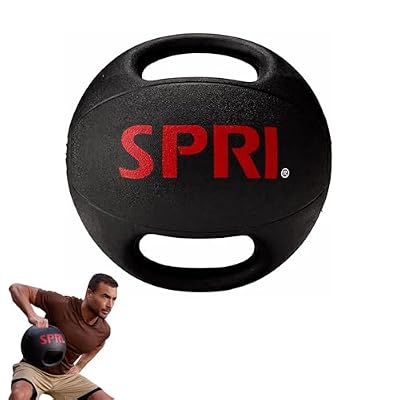
SPRI’s handled ball is the reference design in this category: two thick molded handles cut into a synthetic rubber PVC shell, so larger hands steer the ball by the grips instead of friction alone. The listing aims it at rotational patterns such as golf swings and tennis strokes, plus abdominal, cross-body and lower-body drills, which maps well onto the core circuits most home users actually run. An instruction sheet with an exercise guide is included. For bigger users who want one versatile handled ball for twists, halos and carries, this is the most direct answer here.
Specs
- Brand: SPRI
- Weight: 10 lb (size options run 6 to 20 lb in the listing title)
- Material: Synthetic Rubber PVC
- Handles: Two thick molded handles, per the listing bullets
- Item dimensions: 10.5 x 11.5 x 10 inches
- Ball diameter: not stated
- Model name: Weighted Ball for Exercise
- Part number: 65525
- Manufacturer: Gaiam
- Included components: Medicine ball, instruction sheet
Best for: Rotational core training and swing patterns where a fixed grip matters more than bounce.
Watch out for: The listing page has shown a no-featured-offer summary with other sellers listed, so confirm the seller and that the 10 lb variant is the one selected before ordering.
ASIN: B006SEQQF0
ZELUS Medicine Ball with Dual Grip, 10 lb

ZELUS builds its handled ball from rubber with textured grips, and the listing title itself carries the dual-grip design and the 10 and 20 lb options, so what you are buying is clear before you reach the details. The 10 lb version, model DMB-0010, is the pick here: heavy enough to load swings, squats and rotational work, light enough to keep technique honest across longer sets. Users with big hands who train kettlebell-style patterns — swings, figure-eights, woodchoppers — get the most from this shape, because the two grips let the ball change hands without a fumble at the bottom of the swing.
Specs
- Brand: ZELUS
- Weight: 10 lb (20 lb option in the listing title)
- Model number: ZELUS DMB-0010
- Construction: Rubber construction with textured handles, per the listing
- Handles: Dual grip handles, per the listing title
- Ball diameter: not stated
- Color: not stated
Best for: Kettlebell-style swings, carries and hand-to-hand rotational drills.
Watch out for: Similar ZELUS listings circulate under more than one code, so check that the page you order from names model DMB-0010.
ASIN: B073S6JXPC
JFIT Wall Ball, 8 lb

This is the first of the two soft wall-ball builds, and the listing is upfront about it: a vinyl-coated shell that is laser cut, double stitched and hand stuffed for balance, with a published item diameter of 14 inches. That size is the point for larger users — both palms land flat, catches stay quiet, and the soft shell is forgiving when a rep arrives off-line. At 8 lb it suits high-rep wall throws, thrusters, burpee variations and crunches rather than maximal strength work, and the listing’s recommended uses say the same. Treat it as a conditioning ball, not a slam ball.
Specs
- Brand: JFIT
- Weight: 8 lb
- Item diameter: 14 inches
- Material: Vinyl
- Construction: Laser-cut, double-stitched, hand-stuffed, per the listing bullets
- Part number: J-WB8BL
- Color: Blue/Black
- Included components: Soft wall ball
- Slamming: Not intended for slamming exercises, per the listing
Best for: Wall throws and high-rep conditioning where a big, soft, easy-catching ball helps.
Watch out for: The 4 lb version of this ball is only 9 inches across, so verify the variant on the page is the 8 lb if the 14-inch size is why you are buying it.
ASIN: B08XRZJS2N
Champion Sports Rhino Promax RPX18, 18 lb

The heavy option. Champion’s listing publishes an 18 lb ball with a 14-inch item diameter, a faux leather soft shell and a non-slip grip, under the Rhino ProMax Elite model name — the largest hands-and-load combination in this roundup. It is a wall ball by the listing’s own ball-type field, built for throws, catches and two-handed strength work such as squats, presses and partner drills, where the wide shell gives bigger users a target they can control at arm’s length. Stronger users who found 10 lb handled balls too light for two-handed work are the audience; beginners should start with the JFIT or a handled pick instead.
Specs
- Brand: Champion Sports
- Weight: 18 lb
- Item diameter: 14 inches
- Item dimensions: 14.2 x 14.2 x 14.2 inches
- Material: Faux leather
- Ball type: Wall Ball, per the listing field
- Model name: Rhino ProMax Elite
- Part number: RPX18
- Color: Black
Best for: Stronger users doing heavy two-hand throws, squats and partner drills.
Watch out for: It is a soft-shell wall ball, so keep it off rough ground and out of slam drills, and confirm the 18 lb black variant is selected and in stock at checkout.
ASIN: B005I6731A
Aeromat Dual Grip Power Medicine Ball, 6 lb

Aeromat’s entry is the light, quick option: a rubber ball with a dual soft grip handle that the listing says can be held with one or two hands, aimed at sculpting, toning and rotational training. At 6 lb in the Black/Red color code it will not challenge a strong user’s strength, and it is not meant to — it is the ball for speed work, warm-up rotations, longer endurance circuits and users returning to training who need control before load. The wider Aeromat range runs in color-coded steps up to much heavier weights, but the verified listing here is the 6 lb, so that is the pick.
Specs
- Brand: Aeromat
- Weight: 6 lb (color-coded range described in the listing runs to heavier weights)
- Item diameter: 9 inches
- Material: Rubber
- Handles: Dual soft grip handle, per the listing bullets
- Model number: 35131
- Color: Black/Red
Best for: Fast rotational drills, warm-ups and longer endurance circuits.
Watch out for: Evidence for this code rests on Amazon’s Canadian storefront, so allow for slower delivery, and note the 9-inch body means the handles, not the size, provide the big-hand fit.
ASIN: B000TCNWLI
Which One Fits Your Situation
Your core workouts are mostly twists, halos and swings
Choose between the two handled 10 lb balls. The SPRI Dual Grip Xerball is the established design, with thick molded handles and an instruction sheet to build sessions around. The ZELUS dual grip ball covers the same ground with textured rubber grips and a 20 lb sibling in the same listing if you later want a heavier twin. Either way, your fingers get a fixed hold, which is what rotational work at speed actually needs.
You train against a garage or gym wall
The JFIT Wall Ball is the natural pick: 14 inches across, soft enough to catch quietly, and light enough at 8 lb for the high-rep sets wall work usually means. Set it up for throws, thrusters and wall squats, and respect the listing’s limit — it is not built for floor slams. If your wall sessions are heavier and slower, step up to the Champion below instead of overloading this one.
You are strong, and lighter balls feel like toys
The Champion Sports Rhino Promax RPX18 gives you 18 lb in a 14-inch shell, the only pick here that pairs real load with a two-palm landing area. Use it for squats, presses, carries and controlled throws. Keep the handled 10 lb balls in your rotation as well, because rotational speed work still belongs at the lighter weight even for strong users.
You are restarting training and control comes first
Start with the Aeromat Dual Grip at 6 lb. The soft handles are easy to hold with one or two hands, the weight is forgiving while you rebuild positions, and the rotational drills it is sold for scale from warm-up to full sessions. When the 6 lb feels easy across long circuits, the handled 10 lb picks are the step up, not a heavier version bought on guesswork.
Common Mistakes
- Buying a standard nine-inch ball in a heavy weight, then blaming your grip when the real problem is that the shell was never sized for your hands.
- Slamming a soft wall ball into the floor; stitched wall balls are built for catches, and the listings for both soft picks here say they are not intended for slamming.
- Ordering from a multi-weight listing without checking which variant is selected, since diameter and construction can change between weights on the same page.
- Choosing weight by pride instead of by drill, then losing form on rotational work that should have been done several pounds lighter.
- Trusting a roundup’s diameter figure over the structured fields on the product page itself, where the item diameter is actually published.
Frequently Asked Questions
Why do most medicine balls feel too small for larger hands?
Most classic medicine balls cluster around nine to ten inches in diameter regardless of the user’s size, because the design assumes an average hand span. Larger users end up pinching a heavy, curved surface. The two fixes are a ball with molded handles, which gives your fingers a fixed hold, or a diameter of 12 inches or more, which lets both palms spread across the shell.
Are the 14-inch wall balls in this list the same as medicine balls?
They are a close sub-class rather than the classic rubber design. Wall balls are soft, stitched and padded so they can be caught repeatedly at arm’s length, and both 14-inch picks here are labeled as wall balls on their own listings. They train the same throws, squats and core drills, but they must not be slammed, which is the main handling difference to respect.
What weight should a bigger beginner start with?
For rotational and overhead patterns, a handled ball around 6 to 10 lb is the sensible start even for large users, because the moving lever is long and control matters more than load. Heavier balls in the 14- to 18-pound range suit two-handed squats, carries and controlled throws once your positions are solid. Progress the weight of one drill at a time rather than replacing your whole set at once.
How do I check the diameter before ordering?
Open the specification table on the product’s Amazon page and find the item diameter or item dimensions fields, which the seller publishes in structured form. Confirm the figure against the exact weight variant you are selecting, because some ranges shrink the smallest size — one pick here drops to 9 inches at its lightest weight. If a listing publishes no diameter and no handles, leave it off a big-hands shortlist.
Related Reviews & Guides


6 Best Wrangler Jeans For Plus Size 2026
Best Plus Size Hiking Pants with Stretch in 2026: Compared and Ranked