
Last Updated: November 23, 2026
The real decision with a weight bench is not which exercises it allows, because almost every adjustable bench lists the same presses, rows and step-ups. It is whether the frame, pad and adjustment hardware stay rigid once a larger body and a loaded bar are on it together. Published capacity figures describe that combined load, and budget benches cut corners exactly where heavier lifters notice first: narrow pads, thin steel and ladder racks that flex.
This guide is for heavier beginners starting barbell work, experienced lifters who need a rating with real headroom, and anyone training in a small room where the bench has to fold away. Every bench below was chosen from the names, capacities and dimensions printed on its Amazon page, and each one publishes a weight limit of at least 800 pounds.
Quick Picks
As an Amazon Associate we earn from qualifying purchases.
| Product | Best for | Key spec from title |
|---|---|---|
| Fitness Reality 2000 Super Max XL | Lifters who hate the gap between seat and backrest | No Gap design with detachable leg lock-down |
| RitFit Adjustable Weight Bench BWB01 | The heaviest combined body and barbell loads | 1300LB capacity |
| Keppi Bench1000 PRO | Lifters who want the widest choice of angles | 1200LB weight bench |
| FLYBIRD Adjustable Weight Bench | Small rooms where the bench must fold away | ASTM-Certified 800LBS |
| Fitness Reality 1000 Super Max | Beginners who want a proven, lighter frame | 800 Pound Capacity |
How to Choose
Read the capacity as a combined load
A bench’s weight limit covers your body weight plus everything in your hands or on the bar, not your body weight alone. A 300-pound lifter pressing 200 pounds is already asking a bench for 500 pounds of support before counting the force of the press itself. That is why this guide sets its floor at an 800-pound published rating: it leaves working headroom instead of putting a heavier lifter near the limit on ordinary sets. Add your current body weight to your realistic one-year lifting goal, then buy the rating that clears that sum comfortably.
Check pad width and bench height against your build
Broader shoulders and hips need a pad that supports the shoulder blades without letting them hang off the edges, and listings print pad and seat dimensions in their specification tables. Bench height matters just as much: a taller flat position changes how firmly your feet plant for leg drive, and longer legs on a low bench can leave knees uncomfortably high. Compare the printed flat height and overall length with your inseam and height. Two benches in this guide publish a user height guide of up to 6 feet 4 inches, which is a useful ceiling to check.
Match the adjustment system to how you train
Backrests adjust through ladder racks, pop pins or locking teeth, and each feels different when you are changing angles between sets with weight waiting. Ladder systems are fast and have few parts to wear, while pin systems lock more positively but take a moment longer. Count the positions you will genuinely use: flat, one or two inclines and an upright seat cover most pressing and dumbbell work, and a decline setting only matters if you plan decline presses or anchored core work. More positions are not automatically better if the mechanism feels loose.
Weigh the bench itself and the storage question
Bench weight is a fair proxy for how planted a frame feels, and the spread in this guide runs from under 30 pounds to 65 pounds. Heavy benches resist sliding and tipping during rack work, but they are awkward to drag across a room, so transport wheels and handles matter if the bench moves daily. Folding designs solve the storage problem in spare rooms and apartments, yet every hinge is a place a frame can develop play. Decide honestly whether the bench will live in position or be packed away after every session.
The 5 Best Options
Fitness Reality 2000 Super Max XL

This is the bench for a larger lifter who plans to park it in front of a rack and leave it there. Its backrest and seat meet with no gap at any angle, which removes the dead spot that catches your lower back when you slide into position for a press. The 850-pound rating sits on a 2 by 3 inch steel frame, and at 65 pounds it is the heaviest bench here, so it stays planted during heavy work. A detachable leg lock-down with foam rollers anchors decline sets and sit-ups.
Specs
- Weight limit: 850 lb
- Frame: 2 x 3 inch steel, triangular support structure
- Assembled dimensions: 69.5 x 24 x 52 inches
- Bench weight: 65 lb
- Flat bench height: 18.3 inches
- User height: up to 6 ft 4 in
- Model number: 2806
Best for: lifters who want a fixed, gap-free pressing surface in a dedicated training space.
Watch out for: at 69.5 inches long and 65 pounds, measure your rack spacing and doorway path before ordering.
ASIN: B07B3Q9F22
RitFit Adjustable Weight Bench BWB01

The RitFit carries the highest published rating in this guide, 1,300 pounds, which makes it the natural pick for a heavier lifter whose barbell numbers are still climbing and who does not want the bench to become the weak link. At 60.5 pounds it is a substantial frame rather than a stow-away model, and the listing builds it from carbon steel with iron and aluminum components. Choose this one when total load headroom matters more to you than folding storage or a low bench weight.
Specs
- Weight limit: 1,300 lb
- Bench weight: 60.5 lb
- Part number: BWB01
- Materials listed: aluminum, carbon steel, iron, leather
- Cited variant color: Black
- Back and seat positions: not stated
Best for: heavier lifters who expect their combined body and barbell load to keep growing.
Watch out for: the listing does not state its backrest position count in the specification fields, so confirm the angle range on the page before ordering.
ASIN: B0D2DDT93T
Keppi Bench1000 PRO

Keppi’s bench pairs a 1,200-pound rating with the widest adjustment menu in this group: 12 back positions and 3 seat positions, which the maker counts as more than 36 setting combinations across flat, incline and decline work. The frame uses 70 by 50 millimeter commercial-thickness steel, and the listing states certification to ASTM and EN20957 fitness standards. A removable foot catch supports decline pressing and anchored core exercises. At 55 pounds it sits between the folding benches and the heaviest fixed frames for day-to-day moving.
Specs
- Weight limit: 1,200 lb
- Bench weight: 55 lb
- Dimensions: 58.5 x 24 x 49.6 inches
- Back positions: 12
- Seat positions: 3
- Part number: Bench1000Pro
- Certification stated on listing: ASTM and EN20957
Best for: lifters who rotate through many angles and want decline work with a foot catch.
Watch out for: confirm the removable foot catch is included in the box contents shown on the listing, since it is a separate piece.
ASIN: B09ZNZ7X41
FLYBIRD Adjustable Weight Bench
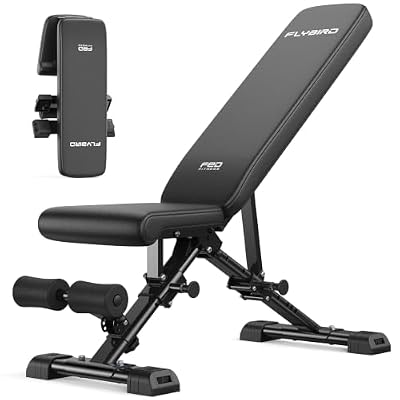
FLYBIRD built this bench for rooms that cannot spare a permanent footprint: it folds for storage and weighs only 28.5 pounds, yet the title still carries an ASTM-certified 800-pound rating. The backrest runs from 90 degrees upright down to a 30-degree decline, and the extended backrest is 30 inches long, which suits dumbbell work, seated presses and step-ups in a spare room or apartment corner. Pick it when the bench has to disappear between sessions but a toy rating is not acceptable.
Specs
- Weight limit: 800 lb
- Model name: A-002
- Bench weight: 28.5 lb
- Backrest range: 90 to -30 degrees
- Extended backrest length: 30 inches
- Design: foldable
Best for: apartment and spare-room lifters who fold the bench away after every workout.
Watch out for: a folding frame this light can shift on smooth floors during heavy sets, so plan a rubber mat underneath it.
ASIN: B07DNYSJ8W
Fitness Reality 1000 Super Max

The 1000 Super Max is the lighter, simpler sibling of the 2000 model above, and it has been a default first bench for heavier beginners for years. Its 800-pound rating comes from the same triangular support idea in a 35-pound frame that folds flat, with a 12-position backrest covering decline through steep incline. It suits a lifter who is starting barbell work, expects moderate loads for a while, and would rather move a manageable bench than wrestle the heaviest frame in the guide.
Specs
- Weight limit: 800 lb
- Model number: 2804
- Dimensions: 59 x 23.5 x 48.5 inches
- Bench weight: 35 lb
- Back positions: 12
- User height: up to 6 ft 4 in
- Design: foldable
Best for: heavier beginners starting barbell and dumbbell training on a lighter, folding frame.
Watch out for: this is the older of the two Fitness Reality benches here, so check the listing’s backrest width against your shoulders before choosing it over the XL model.
ASIN: B01CR4XFIK
Which One Fits Your Situation
You press inside a rack and the bench never moves
Choose between the Fitness Reality 2000 Super Max XL and the RitFit BWB01. The Fitness Reality adds the no-gap pad and leg lock-down for decline work, while the RitFit answers with the highest published rating in the guide. Both are heavy frames that reward a permanent spot in front of the uprights.
Your gym is a corner of a bedroom or living room
The FLYBIRD is the honest fit here. It folds, it weighs under 30 pounds, and it still publishes an 800-pound rating, so a larger lifter is not trading safety for storage. The Fitness Reality 1000 Super Max also folds and adds a 12-position backrest if you want more angles and can manage ten extra pounds of bench.
You are returning to training after a long break
Start with the Fitness Reality 1000 Super Max or the FLYBIRD. Both publish 800-pound ratings that cover a heavier body plus beginner loads with room to spare, and both fold away while training is still becoming a habit. Move to a heavier fixed frame later only if your loads or your routine outgrow them.
You train lots of angles, including decline work
The Keppi Bench1000 PRO offers the most positions in this guide and a removable foot catch for anchored decline sets, backed by a 1,200-pound rating. The Fitness Reality 2000 Super Max XL is the alternative if you prefer a leg lock-down bar with foam rollers over a foot catch for your decline and core work.
Common Mistakes
- Reading the weight limit as body weight alone, when it covers your body plus the bar and plates together.
- Buying the highest capacity and ignoring pad dimensions, so your shoulders or hips hang off a pad that was never sized for you.
- Choosing a folding bench for a permanent rack setup, then fighting hinge play and a light frame on heavy sets.
- Forgetting to measure the room: long benches like the 69.5-inch Fitness Reality 2000 need rack spacing and a clear path through the door.
- Skipping the flat-height check, then finding your feet cannot plant firmly enough for leg drive at your leg length.
Frequently Asked Questions
How much capacity does a heavier lifter actually need?
Add your body weight to the most you realistically expect to press or hold within the next year, then keep a clear margin above that total. For many larger lifters that arithmetic lands between 500 and 700 pounds, which is why every bench in this guide publishes a rating of 800 pounds or more.
Does an 800-pound rating mean the bench suits any lifter under 800 pounds?
No. The rating is a combined load, so an 800-pound bench is not built for an 800-pound person. It means body weight plus weights should stay under that figure. A 350-pound lifter pressing 250 pounds is using 600 of the 800 pounds, which is a sensible working margin.
Are two benches from the same brand in this guide a problem?
No. The two Fitness Reality models are genuinely different benches: the 1000 Super Max is a 35-pound folding frame, while the 2000 Super Max XL is a 65-pound no-gap design with a higher rating. They serve different rooms and budgets, so both earned a place on their own merits.
What should I check when the bench arrives?
Confirm every adjustment position locks without slipping, rock the frame from each corner to feel for flex, and check that pads are firmly attached with no torn stitching. Test the full range with body weight only before adding a bar, and keep the packaging until you have trained on it once.
Related Reviews & Guides




Best Plus Size Petite Jeans for Apple Shape in 2026: Compared and Ranked
6 Best Wrap Dresses For Plus Size 2026