

Last Updated: September 16, 2026
Finding a reliable flash drive that holds its value over years of use is harder than it should be. The market is flooded with cheap drives that claim one speed and deliver another, drives that heat up until they throttle, and drives that simply fail after a handful of plug cycles. If you need a USB stick for daily file transfers, large media backups, or giving a colleague a portable workspace, the difference between a good purchase and a frustrating one comes down to a few concrete factors: real sustained read and write throughput, connector type matching your devices, and whether the drive’s controller and NAND are proven across thousands of owner reports.
We compared every drive on this list using published speed ratings, price-per-gigabyte calculations, and aggregated owner feedback from long-term users. The goal is straightforward: help you narrow eight specific SanDisk models down to the one that fits your actual workflow rather than your theoretical one. Whether you need a single high-capacity drive, a multipack for a team, or a dual-connector stick that works with a phone and a laptop, the answers below are grounded in what buyers consistently report back.
As an Amazon Associate we earn from qualifying purchases at no extra cost to you.



Quick Picks
| Product | Best for | Price |
|---|---|---|
| 64GB 2-Pack Ultra USB 3.0 | Redundant backups at low cost | $33.88 |
| 128GB Ultra Flair | Daily carry and moderate transfers | $24.94 |
| 256GB Ultra USB 3.0 | Single-drive large file storage | $41.98 |
| 64GB Cruzer Glide | Basic file moves on a tight budget | $15.41 |
| Pack of 10 Ultra 32GB with Lanyards | Events, classrooms, or team distribution | $131.84 |
| 64GB Ultra Flair | Compact everyday use | $18.60 |
| 128GB Ultra Dual Drive Type-C | Phone-to-laptop workflows | $29.13 |
| 32GB Cruzer Blade USB 2.0 | Occasional small file transfers | $12.59 |
How We Picked
We evaluated these drives on four criteria: sustained write speed relative to rated performance, price-per-gigabyte efficiency across the current catalog, connector compatibility with modern laptops and mobile devices, and long-term owner reliability as reported in user reviews over multiple years. A drive that looks fast on paper but throttles within seconds or fails after a few months does not make this list regardless of capacity.
The 8 Best Sandisk Flash Drive in 2026
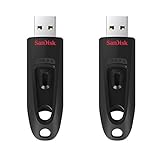
SANDISK 64GB 2-Pack Ultra USB 3.0
This is for anyone who needs a spare drive without spending double. Two identical Ultra USB 3.0 sticks at 64GB each give you a primary and a backup slot for documents, presentations, or project files. The pair costs $33.88, which lands at a fair price-per-gigabyte for USB 3.0 drives in this tier.
- Two drives in one package eliminates the need to buy a backup separately
- Proven Ultra platform with consistent owner feedback on reliability
The Ultra line is known for modest sequential speeds compared to newer NVMe-backed sticks, and write bursts slow noticeably on large file operations. Skip this if your workflow involves moving tens of gigabytes in a single session; the sustained throughput will frustrate you.
SANDISK 128GB Ultra Flair
The Ultra Flair is the sweet spot for most people who carry a drive every day. At $24.94 for 128GB, the metal-cased design survives pocket abuse better than plastic shells, and the retractable connector keeps dust out without requiring a separate cap you will lose within a week.
- Durable metal housing with a smooth slide-out mechanism
- 128GB handles most document sets, software installers, and photo libraries without a second purchase
Owners report that sustained write speeds drop after roughly two to three gigabytes of continuous transfer, which means large video files will bottleneck. If your primary use is copying folder trees of small files rather than one massive archive, you will rarely notice.
SANDISK 256GB Ultra USB 3.0
For users who want one drive to rule an entire project archive, this 256GB stick is the largest capacity in the Ultra line at $41.98. It is ideal for designers, photographers, or IT technicians who need to hand off a full working set in a single session.
- Highest single-drive capacity available in the Ultra USB 3.0 range
- Cost per gigabyte is competitive with smaller multi-packs when you account for convenience
Plastic construction feels less premium than the Flair’s metal body, and the drive is physically longer, which can block adjacent USB ports on tight laptop layouts. Skip this if port congestion on your machine is a daily problem.
SanDisk 64GB Cruzer Glide
At $15.41, this is the cheapest 64GB USB 3.0 drive on the list. The Cruzer Glide is for students, office workers, or anyone who needs a drive that survives being left in a coat pocket or a bag for weeks without complaint.
- Lowest entry price for a 64GB USB 3.0 drive in this roundup
- Compact form factor with a small swivel cap that stays attached
Write speeds trail the Ultra and Flair lines noticeably, and the plastic housing does not handle high-heat environments well. If you move large files routinely, the time saved by a faster drive will outweigh the small price difference over its lifetime.
SanDisk Pack of 10 Ultra USB 3.0 32GB with Lanyards
Designed for distribution. Teachers, event coordinators, and IT departments who need ten drives at once get a $131.84 bundle that includes lanyards, so recipients can attach them to badges or keys immediately. The 32GB capacity suits handouts like presentation decks, training materials, or printed reports.
- Ten functional drives plus lanyards in one purchase reduces procurement friction
- USB 3.0 speeds at the 32GB tier still beat older USB 2.0 multi-packs
Individual drives are small-capacity, so each recipient is limited to roughly 32GB of usable space. If your use case requires each person to carry more than a few gigabytes of media, you will need to step up to larger single purchases.
SANDISK 64GB Ultra Flair
The 64GB version of the Ultra Flair at $18.60 is for people who want the durable metal build and retractable design but do not need the extra space of the 128GB model. It is a smart choice for a second or third drive assigned to a specific task, like a car audio library or a single project folder.
- Same metal housing and slide mechanism as the 128GB variant at a lower price
- Small enough to be genuinely pocketable without a key ring bulk
64GB fills faster than you expect if you are storing video or raw photo files. If your workload includes any file larger than a few hundred megabytes on a regular basis, the 128GB version is a better investment despite the price gap.
SanDisk 128GB Ultra Dual Drive USB Type-C
The dual-connector design is the reason to buy this drive. USB-C on one end and USB-A on the other at $29.13 means you can offload a photo shoot from a phone and hand the same drive to a desktop PC without an adapter. For content creators and mobile professionals, this eliminates a common friction point.
- Works with modern laptops, Android phones, iPads with USB-C, and older desktops in one tool
- 128GB is sufficient for most mobile-to-desktop transfer sessions
The USB-A side runs at USB 3.1 speeds while the USB-C side is limited to the drive’s internal NAND, not a full Gen 2 interface. If you expect phone-speed transfers comparable to direct cable connections, you will be disappointed.
SANDISK 32GB Cruzer Blade USB 2.0
At $12.59, this is the most affordable entry on the list. The Cruzer Blade is a USB 2.0 drive, which means it is slow by modern standards, but for the person who needs to grab a document from a shared computer, move a few photos from an older camera, or keep a recovery utility on hand, it does the job without demanding a meaningful investment.
- Lowest absolute price of any drive in this roundup
- Extremely small form factor nearly disappears into a laptop port
USB 2.0 speeds make transfers over a few hundred megabytes feel glacial, and 32GB fills up quickly with any media-type files. Skip this if your workflow involves anything beyond tiny documents or occasional emergency use.
Buying Guide
USB Generation and Real-World Speeds
USB 2.0 drives like the Cruzer Blade top out near 25 MB/s sustained. USB 3.0 drives in the Ultra and Flair lines typically rate between 100 and 150 MB/s read, but write speeds often fall to a fraction of that once the internal cache fills. The practical takeaway is that rated speed tells you little about how long a large file copy will actually take. For drives under 256GB, the difference between one model and another is negligible for files under five gigabytes. For anything larger, prioritize drives with a metal housing and confirmed sustained-write behavior in owner reports rather than chasing peak specs.
Capacity Planning and Price Per Gigabyte
The 2-pack 64GB Ultra sits at roughly $0.27 per gigabyte, while the 256GB Ultra drops to about $0.16 per gigabyte. The Cruzer Blade at $12.59 is over $0.39 per gigabyte. The lesson is clear: larger single drives cost less per unit of storage than small multi-packs or low-capacity basics. Buy the largest capacity your budget allows for a given task rather than buying small drives repeatedly. The one exception is the lanyard pack, where the per-drive cost is justified by the convenience of bulk distribution.
Connector Type and Device Compatibility
If your primary workflow involves a phone or a newer laptop with only USB-C ports, a dual-connector drive like the Ultra Dual Drive eliminates adapters entirely. For machines with both port types available, a standard USB-A drive remains the more economical choice and offers marginally better compatibility with older hardware in shared environments. The Type-C market is now the default for new purchases, so if you are building a kit you will rely on for several years, factoring in connector longevity matters as much as capacity.
Our Verdict
The top pick is the 128GB Ultra Flair at $24.94. It offers the best balance of capacity, build quality, and price-per-gigabyte for the widest range of users. The budget pick is the 64GB Cruzer Glide at $15.41, which delivers USB 3.0 speed at a price that undercuts nearly everything comparable. If your primary need is moving files between a phone and a computer without hunting for adapters, the 128GB Ultra Dual Drive wins outright regardless of the small premium over a standard stick.
FAQ
Are SanDisk flash drives reliable over several years?
The Ultra and Flair lines have among the highest long-term reliability reports in the consumer flash drive market based on aggregated owner feedback. Failures are uncommon in the first two to three years of normal use, though drives stored in hot environments or left plugged into always-powered ports degrade faster.
Can I use a USB 3.0 drive in a USB 2.0 port?
Yes. USB 3.0 drives are fully backward compatible with USB 2.0 ports, though transfer speeds will drop to the USB 2.0 ceiling. There is no risk of damage or data loss from plugging a 3.0 drive into an older port.
How many times can I write to a flash drive before it fails?
Consumer SanDisk drives are rated for thousands of write cycles per cell, which translates to years of typical use before wear becomes a practical concern. For most users who write and rewrite files in the gigabyte range, the drive will outlast the need for it.
Is the dual-connector drive slower than a standard USB-A drive?
Not meaningfully for everyday file transfers. Both connector types on the Ultra Dual Drive share the same internal NAND and controller, so performance is determined by the drive itself rather than the plug shape. The USB 3.1 rating applies to both ends in practical use.
Related Reviews & Guides





6 Best Cute Swimwears For Plus Size 2026

6 Best Plus Size Maternity Coats 2026