
Last Updated: October 7, 2026
- What “28-Inch” Actually Means
- Spec Comparison: Popular 28-Inch Wide Models
- Door Swing and Clearance: The Fit That Listings Hide
- Counter-Depth vs. Standard-Depth in 28 Inches
- Energy Cost Calculation
- Decision Matrix: Which 28-Inch Type Fits Your Situation
- Durability and Ownership Realities
- How to Buy Without Returns
The best 28 inch refrigerator for most space-constrained kitchens is a 28-inch wide top-freezer with 16 to 18 cubic feet of capacity and a counter-depth or shallow standard-depth cabinet, because it delivers the most usable storage per inch of width while keeping door swing under 30 inches and annual energy costs under $55. For tighter galley layouts, a bottom-freezer or narrow French-door model trades a bit of capacity for better fresh-food access, but you will pay more for the same width.
Quick answer: For most people in 2026, the best 28 is the Frigidaire Top-Freezer 15.6 cu. ft. (FFTR1526 series) — our #1 rated choice. See the full ranked comparison, alternatives and buying advice below.
What “28-Inch” Actually Means
Most refrigerators sold as 28-inch models measure 27.75 to 28.75 inches at the widest point of the cabinet, not including handles. Handles can add 1.5 to 2.5 inches of depth, and hinge caps can add 0.25 inch of width. For a precise fit in a 28-inch opening, you need 0.5 inch of air space on each side for ventilation and 1 inch behind the cabinet, so the alcove should be at least 29 inches wide if the spec sheet lists 28 inches flat.

Verona 28 inch Top Freezer Refrigerator with 17.6 cu. ft. Total Capacity, Reversible Doors, Recessed Handle, Energy Star (Black)
Included for 'Best 28-Inch Refrigerators for a Spacious, Precise Fit' because the listing specifies Reversible Doors and Recessed Handle, details this guide uses to compare options.
View on Amazon
Verona 28 inch Top Freezer Refrigerator with 17.6 cu. ft. Total Capacity, Reversible Doors, Recessed Handle, Energy Star (White)
Included for 'Best 28-Inch Refrigerators for a Spacious, Precise Fit' because the listing specifies Reversible Doors and Recessed Handle, details this guide uses to compare options.
View on Amazon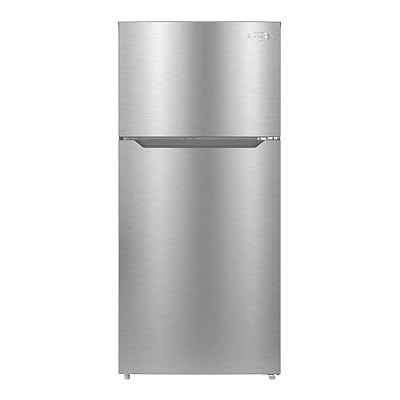
KoolMore 28 Inch 14 Cu Ft Top Freezer Refrigerator, Stainless Steel, Freestanding Full Size Fridge Freezer for Home Kitchen or Garage
Included for 'Best 28-Inch Refrigerators for a Spacious, Precise Fit' because the listing specifies Stainless Steel, details this guide uses to compare options.
View on Amazon
KoolMore 28 Inch 14 Cu Ft Top Freezer Refrigerator, White, Freestanding Full Size Fridge Freezer for Home Kitchen or Garage
Included for 'Best 28-Inch Refrigerators for a Spacious, Precise Fit' because the listing specifies White, details this guide uses to compare options.
View on AmazonAlso check height and depth separately. Many 28-inch wide models are taller than 32-inch wide models to compensate for lost width, often 66 to 70 inches high including hinges. Standard depth is typically 30 to 32 inches including handles, while counter-depth versions for this width are 26 to 28.5 inches deep including doors.
Spec Comparison: Popular 28-Inch Wide Models
These are common platforms you will find in 2026 from major brands in the 28-inch class. Dimensions and energy use are from manufacturer spec sheets; usable capacity is less than advertised total due to ice makers, shelving, and wall thickness.
| Model Type | True Width x Depth (w/ handles) x Height | Advertised / Usable Fresh + Freezer Capacity | Door Swing at 90 Degrees | Energy Use (kWh/year) |
|---|---|---|---|---|
| Frigidaire Top-Freezer 15.6 cu. ft. (FFTR1526 series) | 28″ x 29.6″ x 64.3″ | 15.6 / ~13.8 cu. ft. | 28″ door + 2.5″ handle clearance, needs 30.5″ in front | 338 |
| GE Top-Freezer 17.5 cu. ft. (GTE17/18 series) | 28″ x 32.75″ x 67.4″ | 17.5 / ~15.4 cu. ft. | 28″ door + 2″ handle, needs 31″ in front | 355 |
| Whirlpool Top-Freezer 18 cu. ft. (WRT318 series) | 28″ x 32.4″ x 65.5″ | 18.0 / ~16.0 cu. ft. | 28″ door + 1.75″ handle, needs 30.75″ in front | 365 |
| Samsung Top-Freezer 17.4 cu. ft. (RT18M6215 series) | 28.75″ x 30.75″ x 66.75″ | 17.4 / ~15.6 cu. ft. | 28.75″ door + 2.25″ handle, needs 31.5″ in front | 348 |
| LG Bottom-Freezer 14.7 cu. ft. (LTCS20020/LBNC15232 series style) | 27.75″ x 28.75″ x 68.5″ | 14.7 / ~13.2 cu. ft. | 27.75″ door + 2″ handle, needs 29.5″ in front | 332 |
| Midea / Danby Compact Bottom-Freezer 10.1 cu. ft. | 27.5″ x 26.9″ x 60.2″ | 10.1 / ~9.4 cu. ft. | 27.5″ door + 1.5″ handle, needs 28″ in front | 298 |
Key takeaway: A counter-depth or shallow 28-inch model like the LG-style bottom-freezer saves 3 to 4 inches of floor space in front of counters even though advertised capacity is lower. Usable space converges because taller cabinets add vertical storage that is harder to access but counts toward the total.
Door Swing and Clearance: The Fit That Listings Hide
Width is only half the fit question. For kitchens with an island or wall perpendicular to the fridge, door swing determines if you can open bins and drawers fully.
- Top-freezer: Both doors usually need 90 degrees to slide out crispers. At 90 degrees, the open door extends about equal to the fridge width plus handle depth. Allow 30 to 32 inches of clear floor in front of the fridge face.
- Bottom-freezer single door: Similar swing to top-freezer, but freezer drawer needs 20 to 24 inches of pull-out in front. Do not place directly against a side wall without a 2-inch filler strip, or the door will not open past 90 degrees.
- Narrow French-door (27-28 inch): Each door is ~14 inches, so swing radius is smaller. You can often open one side fully with an island 36 inches away, where a single 28-inch door would hit. The trade-off is a center mullion and slightly narrower shelves.
To calculate your clearance: Measure from the back wall to the front edge of the nearest counter or island. Subtract the fridge depth with handles. The remainder is your passing clearance when doors are closed. Then add door thickness (about 2.5 inches) plus handle to see the sweep arc. If your spec sheet lists “depth without handles” and “depth with handles,” always use the with-handles number for planning.
Worked Fit Example for a 28-Inch Alcove
Alcove is 28.5 inches wide, 32 inches deep to the back wall, opposite a counter 36 inches away.
Option A: Standard-depth 28″ x 32.75″ GE-style top-freezer. Cabinet plus handle is 32.75″ deep, so it will protrude 0.75″ beyond the alcove and leave only 3.25″ of aisle when the door is closed (36 – 32.75 = 3.25). With door open 90 degrees, you need 30+ inches, blocking the aisle completely.
Option B: Counter-depth 27.75″ x 28.75″ LG-style bottom-freezer. It sits flush (28.75″ < 32") and leaves 7.25" of aisle closed, and the single door swing still blocks the aisle when open but protrudes 2.5 inches less into the room. This is why counter-depth is preferred when aisle clearance is under 42 inches.
Counter-Depth vs. Standard-Depth in 28 Inches
There are very few true counter-depth French-door models at exactly 28 inches wide; most counter-depth units start at 30 to 33 inches. In the 28-inch width, counter-depth usually means a shallower top-freezer or bottom-freezer cabinet, not a built-in look.
- Choose standard-depth if: You need maximum cubic feet per dollar and have at least 42 inches from fridge face to island or wall. General market range for 17 to 18 cu. ft. standard-depth is typically lower than counter-depth.
- Choose counter-depth / shallow-depth if: Your kitchen is galley or L-shaped, or the fridge is at the end of a run where 3+ inches of protrusion would block traffic. You lose about 1.5 to 2 cu. ft. of usable space but gain walkway and better sightlines.
Energy Cost Calculation
EnergyGuide kWh/year is the most comparable number. In 2026, most 28-inch top and bottom-freezer models range from 298 to 375 kWh/year.
Annual cost = kWh/year x your electricity rate. At the national average of $0.15/kWh:
- 298 kWh/year x $0.15 = $44.70 per year
- 355 kWh/year x $0.15 = $53.25 per year
- 365 kWh/year x $0.15 = $54.75 per year
Over 12 years, the difference between the lowest and highest in the table is about $120. Models with an automatic ice maker add 10 to 20 kWh/year, and stainless finishes do not change efficiency. What does matter is a manual-defrost freezer versus frost-free; manual uses less energy but requires quarterly defrosting that most buyers do not maintain.
Decision Matrix: Which 28-Inch Type Fits Your Situation
| Your Situation | Best Match in 28-Inch Width | Why |
|---|---|---|
| Rental or tight alcove under 29″ wide, budget-focused, need most storage | 15.6 to 17.5 cu. ft. top-freezer (Frigidaire / GE style) | Lowest price range, efficient vertical capacity, simple mechanics, reversible door |
| Narrow galley with island 36-42″ away | Shallow-depth bottom-freezer (~27.75″ wide, under 29″ deep) | Saves 3-4″ aisle depth, fresh food at eye level, single door swing easier to manage than French-door mullion |
| Want French-door feel but only 28″ width | Narrow French-door or 3-door bottom-freezer (Samsung / LG style) | Small doors reduce swing interference; expect higher price range and ~1 cu. ft. less usable width per shelf |
| Garage, basement, or second fridge under 62″ height limit | Compact 10.1 cu. ft. bottom-freezer | Fits under low soffits, lower energy draw, but small freezer drawer limits bulk storage |
| Need widest shelves for pizza boxes / sheet pans | 18 cu. ft. standard-depth top-freezer | Full-width 28″ shelves vs. split French-door shelves that cap at ~13.5″ each side |
Durability and Ownership Realities
28-inch refrigerators use the same compressors and controls as 30 to 33-inch lines, so reliability is similar. What wears first in this size class:
- Door gaskets and hinges: Narrow doors are opened wider and more often to see everything. Clean gaskets every 3 months with warm soapy water and check for tears at the bottom corners. A weak gasket adds 5 to 8% to energy use.
- Crisper slides and freezer rails: Bottom-freezer drawer slides collect crumbs and ice. Vacuum the tracks and wipe dry twice a year; ice buildup bends the rails.
- Condenser coils: On 28-inch models the coils are often on the back or underneath in a tighter enclosure. Dust buildup is the most common cause of running constantly. Pull the unit out and vacuum coils every 6 to 12 months, more often with pets.
- Leveling: Because the cabinet is narrow and tall, being even 0.5 degree out of level causes doors to drift open. Use a level front-to-back and side-to-side after installation.
Common mistakes: Pushing the fridge flush to the back wall and kinking the water line (if equipped), blocking side ventilation with a tight surround, and using the top of the fridge for heavy storage that warps the cabinet top. Consumables are minimal: water filters every 6 months if you have a dispenser, and LED modules that rarely need replacement. Frost-free models still need the drain hole under the evaporator cleared annually – a clogged drain causes water under crispers.
How to Buy Without Returns
Measure three times: alcove width at counter height and at hinge height, height to soffit or cabinet, and depth including baseboard. Bring the spec sheet’s “depth with handle and door” and “width with door open 90 degrees including handle.” If you have a water line, add 2 inches behind for the connection. For deliveries up stairs or tight turns, check carton dimensions – cartons are 2 to 3 inches wider than the cabinet.
If the listing only says “28-inch refrigerator” without a spec PDF, assume it is a 28.75-inch class and plan for 29.5 inches of width with ventilation. Reversible doors are standard on top-freezer models and solve many left-wall clearance problems without buying a different model.
FAQ
Can I replace a 30-inch fridge with a 28-inch model? Yes. Use filler strips or a 2-inch side trim panel to cover the gap for a built-in look, and verify the water line will still reach. You will lose roughly 2 to 4 cu. ft. of advertised capacity.
Do 28-inch refrigerators have less freezer space? Proportional to total size, yes. Most offer 4.2 to 5.8 cu. ft. freezer capacity. Bottom-freezer drawers feel smaller than a top-freezer shelf of the same volume because of the sliding mechanism.
Is a 28-inch French-door worth it? Only if door swing is your main constraint. For the same width, a single-door bottom-freezer gives you one full-width shelf, while French-door splits it into two narrow shelves that limit large trays.
Ready to decide? Our #1 pick for 2026 is the Frigidaire Top-Freezer 15.6 cu. ft. (FFTR1526 series).
Live price & availability on Amazon.

Best Anker Nebula Projectors for Portable Big-Screen Viewing
Best Laptops for College Students