
Last Updated: October 11, 2026
The best women’s rain jackets for plus-size fit and coverage are 3-layer, hip-length shells rated around 20,000 mm waterproof and 20,000 g/m²/24h breathability, sold in 1X–5X with a published pit-to-pit measurement rather than a letter size alone. That spec gives you roughly 4 inches of wearing ease over a sweater, taped seams that hold up in sustained rain, and a hem that stays below the waist when the wind picks up. Expect to pay $150–$250 for it; a $40–$90 two-layer shell is genuinely adequate for commutes and short showers if you accept a shorter hem and a size range that often stops at 3X.
Quick answer: For most people in 2026, the best women’s rain jackets for fit & coverage is the (3-layer shell) — our #1 rated choice. See the full ranked comparison, alternatives and buying advice below.
Quick comparison: the picks at a glance
| Pick | Best for | Waterproof / breathability | Typical size range | Back length | Price range |
|---|---|---|---|---|---|
| Best overall (3-layer shell) | Year-round daily wear | 20K mm / 20K g | 1X–5X | 28–30 in | $150–$250 |
| Best budget (2-layer packable) | Occasional rain, short commutes | 5K–10K mm / 5K g | 1X–3X | 24–26 in | $40–$90 |
| Best for full coverage (mid-thigh coat) | Walking, transit, dresses and skirts | 10K mm / 10K g | 1X–4X | 34–38 in | $120–$220 |
| Best for travel (2.5-layer) | Packing small, unpredictable weather | 10K mm / 10K g | 1X–3X | 26–28 in, packs to pocket | $100–$180 |
| Best for layering over a puffer | Cold-weather layering | 15K mm / 15K g | 1X–5X | 30–33 in drop-tail | $180–$300 |
Best overall: a 3-layer hip-length shell, 1X–5X
This is the jacket that works in April drizzle and October downpours without you thinking about it. Look for a 3-layer construction, where the waterproof membrane is bonded to both a face fabric and a backer, so there’s no loose mesh liner to snag on sleeves. Per manufacturer spec sheets, 3-layer shells in this class typically weigh 400–500 g, pack to about the size of a large grapefruit, and carry fully taped seams plus water-resistant zippers. Brands such as Columbia, Lands’ End, Eddie Bauer, The North Face and Torrid publish extended sizing on at least some outerwear styles, but the range shifts style by style — check the individual size chart rather than the brand’s reputation.

SaphiRose Women's Long Hooded Rain Jacket Outdoor Raincoat Black M
Included for 'Best Women’s Rain Jackets for Fit & Coverage' as a relevant option in this category; details come from the product listing.
View on Amazon
Columbia Womens Switchback IV Rain Jacket, Black, Medium
Included for 'Best Women’s Rain Jackets for Fit & Coverage' because the listing specifies Black and Medium, details this guide uses to compare options.
View on Amazon
The North Face Women's Antora Jacket, Blk, Medium
Included for 'Best Women’s Rain Jackets for Fit & Coverage' because the listing specifies Blk and Medium, details this guide uses to compare options.
View on Amazon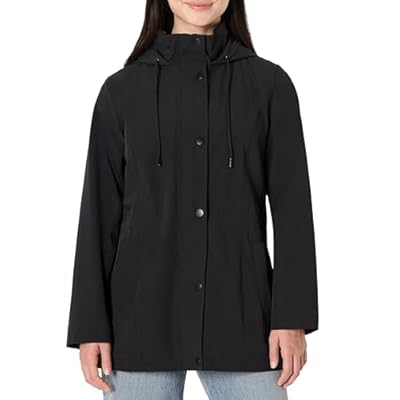
Amazon Essentials Women's Regular-Fit Lightweight Waterproof Long Hooded Rain Jacket, Black, Large
Included for 'Best Women’s Rain Jackets for Fit & Coverage' because the listing specifies Black and Large, details this guide uses to compare options.
View on AmazonWho it suits: anyone who wants one jacket to cover most of the year. Main trade-off: the fabric is stiffer and heavier than a packable shell, and 3-layer jackets cost roughly double the budget tier.
Best budget: a 2-layer packable shell, 1X–3X
Two-layer shells pair a waterproof coating or membrane with a separate mesh or taffeta lining. They keep rain out fine for 30–60 minutes of steady exposure, and they cost $40–$90. The catch for plus bodies is the cut: budget shells are often drafted from a straight-size block and graded up, which means the chest may fit while the hips and upper arms feel tight, and the hem sits at the high hip — around 24–26 inches at the back — so it rides up under a bag or lets rain run onto your seat.
Who it suits: short commutes, dog walks, a jacket that lives in the car. Main trade-off: breathability around 5,000 g and a size ceiling of 3X in most budget lines.
Best for full coverage: a mid-thigh raincoat
If you wear dresses, skirts, or walk to transit, length does more for comfort than any technical spec. A mid-thigh coat measuring 34–38 inches at the back keeps the seat of your clothes dry and blocks wind on the legs. Look for a two-way front zipper (so you can unzip from the bottom when you sit or climb stairs), a storm flap over the zip, and a hem that is either straight or drop-tail. Ten-thousand-millimeter fabric is plenty here — you’re trading a little breathability for length and weight.
Who it suits: city walking, transit commutes, anyone who hates wet thighs. Main trade-off: heavier (700–900 g), warmer, and it restricts stride slightly on stairs.
Best for travel: a 2.5-layer shell that packs into its own pocket
A 2.5-layer jacket uses a printed or sprayed protective layer on the inside face instead of a lining, which drops the weight to roughly 250–350 g and lets the whole jacket stuff into one hand pocket. For travel the practical numbers matter more than the rating: a 10K/10K shell handles most city rain, dries in about two hours on a towel, and takes up less space than a paperback. Sizes usually cap at 3X, and some designs skip hand pockets or pit zips to save weight.
Who it suits: carry-on-only travelers and anyone layering under a pack. Main trade-off: thin face fabric that abrades faster against backpack straps, and a limited size run.
Best for layering over a puffer or fleece
Cold-weather rain shells need to be cut with room, not sized up by guessing. Look for a drop-tail hem (2–3 inches longer at the back), articulated or gusseted sleeves so you can reach forward without pulling the cuffs up your forearm, and a chest measurement published in inches. A 15K/15K shell in a relaxed cut is the sweet spot: waterproof enough for wet snow and sleet, breathable enough that you’re not soaked from the inside after ten minutes of walking.
Who it suits: winter walkers and anyone layering a mid-weight puffer underneath. Main trade-off: it looks bulky worn over a T-shirt in spring, and sleeves often run long.
How to choose: the numbers that decide fit
Letter sizes in plus ranges are not standardized — a 2X in one brand’s rain shell can measure two inches wider at the chest than another’s. Work from circumference instead. Measure your body chest at the fullest point, add the thickness your mid-layer adds, then add wearing ease for a rain shell:
Garment chest (pit-to-pit × 2) ≥ body chest + mid-layer thickness + 4 inches of ease.
Worked example: a 52-inch chest, wearing a fleece that adds about 1.5 inches, needs a garment chest of at least 57.5 inches — so a pit-to-pit measurement of about 29 inches, flat. If the size chart lists 27 inches flat (54 inches around), that jacket will fit over a T-shirt and fight you over a fleece.
| Body chest | Mid-layer | Minimum garment chest | Where to start (varies by brand) |
|---|---|---|---|
| 44 in | T-shirt only | 48 in | 1X |
| 48 in | Fleece (+1.5 in) | 53.5 in | 2X |
| 52 in | Fleece (+1.5 in) | 57.5 in | 3X |
| 56 in | Sweater (+2 in) | 62 in | 4X |
| 60 in | Sweater (+2 in) | 66 in | 5X |
Waterproof ratings are measured as hydrostatic head — how tall a column of water the fabric holds before it leaks. The number on the tag tells you how long you can stay out, not how wet the air is:
| Class | Hydrostatic head | Breathability | Realistic use |
|---|---|---|---|
| Light | 5,000 mm | ~5,000 g/m²/24h | Drizzle, 15–30 minute exposures |
| Everyday | 10,000 mm | ~10,000 g/m²/24h | Steady rain for 1–2 hours |
| All-day | 20,000 mm | ~20,000 g/m²/24h | Wind-driven rain over several hours |
One caveat worth knowing: breathability figures are lab values measured on flat fabric. In humid air, or with a backpack strap pressed across your shoulders, real-world moisture transfer drops noticeably, which is why pit zips — mechanical vents — matter more than the g/m² number for anyone who runs warm.
Coverage: how much length is actually useful
- 24–26 in (high hip): fine for a car-to-door dash, but the hem rides up under a bag.
- 28–30 in (hip): the all-rounder. Covers the waistband and keeps your trousers dry at the top.
- 34–38 in (mid-thigh): the sweet spot for skirts, dresses and transit walking.
- 40–42 in (knee): maximum coverage, but it’s heavy, warm, and awkward on stairs or a bike.
A drop-tail adds 2–3 inches at the back only, which is usually the better buy: you get seat coverage without the front hem catching your knees.
Durability and ownership realities
The waterproof membrane almost never fails first — the durable water repellent (DWR) finish does. It typically stops beading after 15–25 wears or 3–5 washes, and the jacket starts to feel damp even though no water is getting through. That’s fixable:
- Wash with a technical cleaner, never regular detergent, fabric softener, or bleach — detergent residue is what kills beading.
- Tumble dry low for about 20 minutes; heat reactivates the DWR. Skip this and you’ll re-spray unnecessarily.
- Reapply a spray-on DWR when water stops beading after a wash-and-dry cycle. One can lasts several seasons.
- Store hanging, not compressed in a stuff sack, and keep it out of hot cars — heat is what delaminates seam tape, usually after 5–8 years.
- Watch the inner coating on older 2-layer and 2.5-layer jackets; it can flake or turn tacky, which is the point of no return.
The most common mistake plus-size shoppers make is sizing up to solve a hip or arm problem. That buys you a longer sleeve and a boxier shoulder without fixing the actual fit. Check pit-to-pit, hip width, and sleeve length from the armpit separately — those three numbers predict comfort far better than the letter on the tag. The second most common mistake is wearing a cotton hoodie underneath; cotton holds sweat against the membrane and makes any jacket feel clammy within twenty minutes.
Frequently Asked Questions
Should I size up in a plus-size rain jacket?
Only if you plan to layer a fleece or puffer underneath. Measure your body chest, add your mid-layer thickness and 4 inches of ease, then compare that figure to the garment’s pit-to-pit measurement doubled. If the numbers already clear that threshold, sizing up just gives you a longer sleeve and a draftier hem.
Is a 5,000 mm jacket waterproof enough for everyday use?
For short exposures, yes. Five thousand millimeters holds up in drizzle and brief showers, typically 15–30 minutes. For a commute that regularly runs an hour in steady rain, 10,000 mm is the more sensible floor, and 20,000 mm is worth it if you walk or cycle daily in a wet climate.
How long should a rain jacket be for a plus-size figure?
Aim for 28–30 inches at the back for general wear, or 34–38 inches if you wear skirts and dresses or walk to transit. A drop-tail hem, which is 2–3 inches longer at the back only, gives you seat coverage without the front hem restricting your stride.
Do I need pit zips?
If you run warm, yes. Pit zips are mechanical vents that dump heat and moisture far faster than fabric breathability can, and they matter most in humid conditions where membrane performance drops. They add roughly $20–$40 to the price and a small amount of weight.
Can I wash a rain jacket in a normal washing machine?
Usually yes, on a gentle cycle with a technical cleaner instead of detergent. Skip fabric softener and bleach entirely, and tumble dry low for about 20 minutes to reactivate the water-repellent finish. If water still soaks in rather than beading after that, apply a spray-on DWR.
What wears out first on a rain jacket?
The DWR finish, typically after 15–25 wears. It’s a maintenance item, not a defect, and it’s replaceable. Seam tape delamination is the real end-of-life event, and it usually shows up after 5–8 years, sooner if the jacket is stored compressed or left in a hot car.
Ready to decide? Our #1 pick for 2026 is the (3-layer shell).
Live price & availability on Amazon.
Related Reviews & Guides



5 Best White Plus Size Leggings (2026)

5 Best Avidlove Plus Size Lingeries (2026)