
Last Updated: October 11, 2026
The best tripod for most people is the Manfrotto Befree Advanced — roughly 150 cm of maximum height, about 1.5 kg, and an 8 kg payload rating for a $200–250 street price. If you fly with gear, the Peak Design Travel Tripod is the best travel option because it folds to about 39 cm while still carrying a 9 kg payload. For phone-first creators, a Joby GripTight or GorillaPod-class mount at $30–80 covers almost everything a phone tripod needs to do.
Quick answer: For most people in 2026, the best tripods for cameras and phones is the Manfrotto Befree Advanced — our #1 rated choice. See the full ranked comparison, alternatives and buying advice below.
Quick comparison: the best tripods at a glance
Numbers below are typical published specs for each model or spec class. Where a manufacturer lists a range across versions (aluminum vs. carbon, kit vs. legs only), the range is shown.

CAMBOFOTO 74″ Camera Tripod, Phone Tripod for iPhone Lightweight Tripod
Included for 'Best Tripods for Cameras and Phones: Top Picks' because the listing specifies Phone Tripod for iPhone Lightweight Tripod, details this guide uses to compare options.
View on Amazon
Liphisy 64” Tripod for Cell Phone & Camera with Remote and Phone Holder
Included for 'Best Tripods for Cameras and Phones: Top Picks' as a relevant option in this category; details come from the product listing.
View on Amazon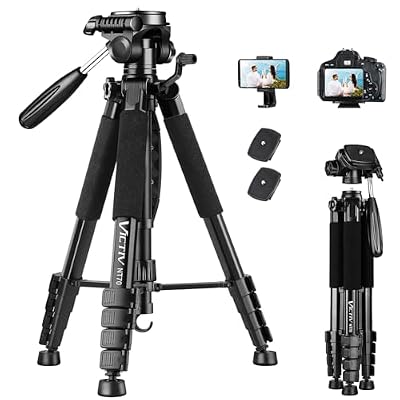
VICTIV 74” Camera Tripod, Tripod for Camera and Phone with Phone Holder
Included for 'Best Tripods for Cameras and Phones: Top Picks' because the listing specifies Tripod for Camera and Phone with Phone Holder, details this guide uses to compare options.
View on Amazon
K&F CONCEPT 75" Aluminum Camera Tripod, Lightweight and Compact for Travel
Included for 'Best Tripods for Cameras and Phones: Top Picks' because the listing specifies Lightweight and Compact for Travel, details this guide uses to compare options.
View on Amazon| Pick | Best for | Max height | Folded length | Weight | Payload rating | Head type | Price range |
|---|---|---|---|---|---|---|---|
| Manfrotto Befree Advanced | Best overall | ~150 cm | ~40 cm | ~1.5 kg | ~8 kg | Ball head | $200–250 |
| Peak Design Travel Tripod | Best for travel | ~152 cm | ~39 cm | 1.3 kg carbon / 1.6 kg aluminum | ~9 kg | Integrated ball head | $350–650 |
| Benro S-series or Manfrotto 502-class fluid kit | Best for video | 160–175 cm | 70–80 cm | 2.5–3.5 kg | 4–8 kg (head-limited) | Fluid head | $250–600 |
| Joby GorillaPod 3K / GripTight Pro 2 class | Best for phones | 0.3–1 m, flexible | Packs flat | 0.2–0.4 kg | ~3 kg | Flexible ball joints | $30–80 |
| K&F Concept / Neewer-class aluminum travel tripod | Best budget full-size | 140–155 cm | 45–50 cm | 1.2–1.6 kg | 4–6 kg | Ball head | $50–90 |
| Manfrotto 190/055-class or Really Right Stuff-class carbon | Best heavy-duty / studio | 170–180 cm | 60–70 cm | 2.5–3.5 kg | 7–10 kg+ | Head sold separately | $350–1,200 |
The picks, and who each one actually suits
Best overall: Manfrotto Befree Advanced
It hits the middle of every important number: tall enough for eye-level shooting for most people under about 1.8 m, short enough to strap to a daypack, and rated to roughly 8 kg — several times the weight of a mirrorless body with a standard zoom. The trade-off is the ball head. It is perfectly good for stills and fine for locked-off video, but it will not give you the smooth, damped pan you get from a fluid head.
Best for travel: Peak Design Travel Tripod
The reason it wins for travel is not weight, it is volume. Per the manufacturer’s spec sheet, it folds to roughly 39 cm with no protruding head or handles, so it slides into a backpack side pocket instead of forcing a separate case. Carbon saves about 0.3 kg over aluminum for a significant price jump, which matters if you are counting grams on long walks and less if you are driving to locations. Trade-off: the center column design is optimized for portability, so it is not the most rigid platform for long telephoto work.
Best for video: a fluid-head kit in the Benro S-series or Manfrotto 502 class
For video, the head matters more than the legs. A fluid head with adjustable pan and tilt drag lets you start and stop a move without a jerk at the beginning or end, which no ball head can do. Payload ratings here are usually limited by the head, not the legs — a 4 kg fluid head is a hard ceiling even if the legs are rated for 10 kg. Trade-off: these kits are heavier (2.5–3.5 kg) and do not fold small, so they are location tripods, not backpacking tripods.
Best for phones: Joby GorillaPod 3K and GripTight Pro 2 class
Phone tripods solve a different problem: wrapping around a railing, standing on a counter, or holding a phone at chest height for a talking-head shot. Flexible-leg models grip uneven surfaces that a rigid tripod cannot, and the whole thing weighs less than a water bottle. Trade-off: flexible joints creep under load over time, and the maximum height is usually below 1 m, so you will not get true eye-level framing.
Best budget full-size: K&F Concept / Neewer-class aluminum travel tripod
At $50–90 you get aluminum legs, four sections, twist locks, and a ball head rated for 4–6 kg. For a phone, an action camera, or a lightweight mirrorless kit shot in calm conditions, that is enough. Trade-off: the ball head is the weak point — expect a smaller ball, less precise friction control, and a clamp that may not hold a heavy lens at an angle without slipping.
Best heavy-duty: Manfrotto 190/055-class or a Really Right Stuff-class carbon tripod
These are for long lenses, studio work, and anyone who shoots in wind. Extra leg diameter and mass are what kill vibration, and a 3 kg tripod is simply more stable than a 1.5 kg one. Buy legs and head separately at this level so you can match a heavy ball head or a geared head to your subject. Trade-off: cost and carrying weight — this is the class you leave set up in a corner rather than carry all day.
How to choose: three numbers that decide almost everything
1. Height, measured from your eye, not the spec sheet
Most tripods advertise maximum height with the center column fully raised — the least stable configuration. A worked example: if you are 1.75 m tall, your eye sits around 1.65 m. The camera’s viewfinder adds roughly 10–15 cm above the head plate, so you need the plate at about 1.50–1.55 m for comfortable eye-level framing. Add a small margin and look for a tripod that reaches 1.55–1.65 m with the column down, which usually means a listed maximum height of 1.65–1.75 m.
2. Payload: use a 2× to 3× rule
Do not buy a tripod rated just above your gear weight. Add up body plus heaviest lens — say a 1.5 kg camera and a 1 kg lens for 2.5 kg total — then look for a payload rating of 5–7.5 kg. Use the 3× end of that range if you shoot long lenses, in wind, or with the center column raised, because all three reduce effective stability. Remember the head is often the real limit: a 3 kg-rated ball head on 8 kg-rated legs still only holds 3 kg.
3. Head type: match it to what you shoot
| Head type | Best for | Typical payload | Typical price | Main trade-off |
|---|---|---|---|---|
| Ball head | Stills, travel, quick setup | 5–20 kg | $40–300 | No smooth panning; fine framing takes practice |
| Fluid head | Video, panning shots | 2.5–8 kg | $100–600 | Heavy, bulky, limited tilt range on cheap models |
| 3-way pan-and-tilt | Architecture, macro, precise framing | 3–8 kg | $50–200 | Slow to set up; handles snag on bags |
| Gimbal | Heavy telephoto | 5–15 kg | $100–400 | Bulky, needs a level base, awkward for anything else |
Two more specs worth checking: leg locks and plate system. Twist locks are more weather-resistant and snag less; flip locks are faster and let you see at a glance whether they are tight. For plates, the Arca-Swiss dovetail is the closest thing to an industry standard, so an Arca-compatible clamp lets you share plates between a tripod, a monopod, and a gimbal. Proprietary systems such as Manfrotto’s RC2 work well but lock you in.
Matching the tripod to your situation
| Your situation | What to prioritize | Sensible choice |
|---|---|---|
| Fly 3+ times a year, mirrorless kit | Folded length under 45 cm, weight under 1.6 kg | Peak Design Travel Tripod or Befree Advanced |
| Phone only, filming try-on or talking-head clips | Flexible legs, phone clamp, under $80 | GorillaPod 3K / GripTight class |
| Shooting video for clients | Fluid head with adjustable drag, 4–8 kg payload | Benro S-series or Manfrotto 502-class kit |
| Total budget under $100 | 4-section aluminum, 4–6 kg payload, accept a basic ball head | K&F Concept / Neewer-class travel tripod |
| Long lenses, wind, or studio | Thicker legs, 7 kg+ payload, head bought separately | Manfrotto 190/055-class or carbon heavy-duty |
| Use it 5 times a year or less | Spend less, prioritize folded size | Budget aluminum class; upgrade later |
Cost per use is a useful tiebreaker. A $400 carbon travel tripod used on 30 shoots a year for eight years works out to about $1.65 per shoot — cheaper than most accessories you will buy and forget. A $70 tripod that annoys you enough that you leave it at home costs more per usable shot, no matter the sticker price.
What wears out first, and how to make a tripod last
Tripods fail in a predictable order. Leg lock bushings and threads go first, usually because grit gets into them; symptoms are a lock that needs extra force or a leg that slowly collapses under load. Rubber feet wear flat or fall off next, especially if you drag the tripod across pavement instead of carrying it. On fluid heads, the drag grease and the pan bearing are the wear items — a head that once moved smoothly will start to feel notchy. Ball head clamps wear at the contact surface and eventually stop holding heavy lenses at steep angles.
Maintenance is mostly about sand and salt. After any beach or coastal shoot, extend every leg section and wipe the tubes and threads with a damp cloth, then dry fully before collapsing — trapped moisture and salt are what corrode aluminum and seize twist locks. Do not lubricate leg threads with oil; it attracts grit. Store the tripod with the head slightly loose, not cranked down, so the clamp and the head’s friction surfaces are not under load for months. Common mistakes: raising the center column as a habit instead of as a last resort, hanging a bag from the center column hook so it can swing in the wind, and over-tightening leg locks to compensate for a worn bushing instead of replacing it.
Frequently Asked Questions
What is the difference between a tripod’s payload rating and my camera’s actual weight?
The payload rating is the maximum weight the manufacturer says the legs and head can support while still working properly — not the weight at which stability is at its best. Stability typically peaks well below the maximum, which is why a 2× to 3× margin between your gear weight and the rating is a practical target. A tripod loaded to its exact limit will still hold the camera, but it will flex, vibrate, and drift more.
Do I need carbon fiber, or is aluminum fine?
Carbon fiber is roughly 25–35% lighter than aluminum for comparable legs and damps vibration slightly better, which is why travel and long-lens shooters pay for it. Aluminum is cheaper, more resistant to impact damage, and perfectly adequate for anyone who is not carrying the tripod long distances. If you are deciding between a cheap carbon tripod and a good aluminum one at the same price, take the aluminum.
Can I use a full-size tripod with a phone?
Yes, and it is often better than a mini tripod if you want eye-level framing. You will need a phone clamp that screws onto a standard 1/4″-20 stud, which almost every tripod head has. The main downside is bulk — a 1.5 kg tripod is overkill for a phone, and a flexible mini tripod will get you into tighter spots.
How tall should a video tripod be?
Aim for a platform height that puts the lens roughly at your subject’s eye level, then add margin. For interviews, that usually means a tripod reaching 1.5–1.7 m with the center column down. Raising the column on a fluid head is worse than on a ball head, because the extra leverage amplifies every wobble in a pan.
Is a fluid head worth it for casual video?
If you shoot mostly locked-off shots, a ball head is fine and much lighter. If you pan or tilt during a shot — following a subject, revealing a product, or filming a walk-through — a fluid head is the single biggest quality upgrade you can make. Even an entry-level fluid head with adjustable drag will produce smoother starts and stops than any ball head.
How do I stop a tripod from vibrating or tipping in wind?
Keep the center column down, splay the legs wider, and hang a weighted bag from the hook under the head so it hangs still rather than swinging. Avoid extending the thinnest bottom leg sections unless you need the height — those sections are the least rigid. On soft ground, press each foot into the surface before you let go of the camera.
Ready to decide? Our #1 pick for 2026 is the Manfrotto Befree Advanced.
Live price & availability on Amazon.
Related Reviews & Guides
Best Pet Cameras for Monitoring Dogs and Cats
Best Professional Automotive Diagnostic Scanners