
Last Updated: October 11, 2026
- Top 3 Picks
- Quick Comparison
- How We Chose
- 1. RACGTING Foldable Racing Simulator Cockpit – Best for Entry-Level Wheel Bases in Small Rooms
- 2. Next Level Racing GTTrack Simulator Cockpit (NLR-S009) – Best for a Permanent, Brand-Supported GT Rig
- 3. ARES WING Racing Simulator Cockpit with TV Mount, Sim Racing Wheel Stand – Best for Hybrid Monitor and VR Setups
- 4. RACGTING Foldable & Adjustable Racing Simulator Cockpit with Racing Seat – Best Budget Cockpit With a Seat
- 5. ARES WING Sim Racing Cockpit with Racing Seat, 8040 Aluminum Profile – Best Overall for High-Torque Direct Drive
- 6. Next Level Racing GT Lite Foldable Simulator Cockpit (NLR-S021) – Best Folding Cockpit From an Established Brand
- 7. GTPLAYER Sim Racing Cockpit Adjustable – Best Mid-Range Cockpit for Broad Wheel Compatibility
- 8. Next Level Racing F-GT Pro Formula and GT Racing Simulator Cockpit – Best Premium Formula and GT Cockpit
- How to Choose
The best VR racing simulator cockpit with force feedback for most serious sim racers is the ARES WING Sim Racing Cockpit with Racing Seat and 8040 aluminum profile. An 80 × 40 mm T-slot aluminum frame is the shortest path to flex-free mounting for a 9–16 Nm direct drive wheel base, and that rig arrives with a seat, so your money goes into rigidity rather than a monitor you will never look at in VR. If you want a formula-style seating position and a long-established brand behind the frame, the Next Level Racing F-GT Pro (NLR-R003) is the premium pick. If the rig has to fold into a cupboard after every session, the RACGTING Foldable & Adjustable cockpit with racing seat is the budget pick. Every cockpit below is judged on the three things that actually decide whether force feedback feels good through a headset: frame rigidity under torque, wheel base and pedal compatibility, and how the frame behaves after a year of hard use. VR takes the screen out of the equation, which frees budget for the parts that matter — the frame and the seat.
Quick answer: For most people in 2026, the best vr racing simulator cockpits with force feedback is the RACGTING Foldable Cockpit (Logitech / Thrustmaster / MOZA) — our #1 rated choice. See the full ranked comparison, alternatives and buying advice below.
Top 3 Picks
Best overall: ARES WING Sim Racing Cockpit with Racing Seat, 8040 Aluminum Profile. This is the pick for anyone running or planning to run a direct drive base in the 9–16 Nm class, because 80 × 40 mm extruded aluminum resists the twisting and vertical flex that steel tube rigs show under strong feedback. It includes a seat, it accepts third-party seats and pedal sets through standard T-slot hardware, and it is mid-range money rather than premium money. The trade-off is that it does not fold and it is heavy to move once assembled.
Best premium: Next Level Racing F-GT Pro (NLR-R003), Black Edition. Choose this if you want a single frame that switches between a formula-style reclined position and a conventional GT position, with the reinforced steel construction and brand documentation that goes with a premium purchase. It is the most versatile seating-position rig in this list, and the one most likely to still be your rig after two wheel base upgrades.
Best budget: RACGTING Foldable & Adjustable Racing Simulator Cockpit with Racing Seat. For a first rig on a gear-driven or entry belt-driven wheel, this gives you a seat, an adjustable wheel deck and a folding frame at the lowest sensible entry point. It is not the rig for a 12 Nm direct drive base, but for a Logitech or entry Thrustmaster setup in a shared room it does the job and disappears into a corner afterwards.
Quick Comparison
The table below places every cockpit in this guide side by side. Torque figures are class-typical ceilings for each build type, not manufacturer ratings for every individual unit — always confirm the current rating and mounting pattern on the product listing before buying, because revisions happen without the model name changing.
| Product | Best for | Frame / build class | FF torque headroom (class-typical) | Seat included | Folds away | Price tier |
|---|---|---|---|---|---|---|
| RACGTING Foldable Cockpit (Logitech / Thrustmaster / MOZA) | Entry wheel bases, small rooms | Folding steel tube, wheel deck + pedal plate | Up to ~6 Nm class | No | Yes | Budget |
| Next Level Racing GTTrack (NLR-S009) | Permanent GT rig with brand support | Reinforced steel, direct-drive-capable wheel deck | Up to ~20 Nm class | Varies — verify listing | No | Premium |
| ARES WING Cockpit with TV Mount | Hybrid monitor + VR setups | Steel stand with integrated TV mount | Up to ~8–10 Nm class | No | No (breaks down) | Mid-range |
| RACGTING Foldable & Adjustable with Racing Seat | First rig that includes a seat | Folding steel tube + seat | Up to ~6 Nm class | Yes | Yes | Budget |
| ARES WING Cockpit with Racing Seat, 8040 Aluminum Profile | High-torque direct drive, long-term ownership | 80 × 40 mm T-slot aluminum extrusion | Up to ~25 Nm class | Yes | No | Mid-range |
| Next Level Racing GT Lite Foldable (NLR-S021) | Folding rig from an established brand | Folding steel with integrated seat | Up to ~8 Nm class | Yes | Yes | Budget |
| GTPLAYER Sim Racing Cockpit Adjustable | Wide wheel-brand compatibility, mid budget | Adjustable steel frame | Up to ~8–10 Nm class | Varies — verify listing | No | Mid-range |
| Next Level Racing F-GT Pro (NLR-R003) | Formula and GT positions in one frame | Reinforced steel, dual seating position | Up to ~20+ Nm class | Yes in most configurations | No | Premium |
How We Chose
These picks come from specification analysis rather than any physical evaluation. We compared published frame materials, wheel deck and pedal plate mounting provisions, stated wheel brand compatibility, folding behaviour, seat inclusion, and the seating positions each frame can produce. We then cross-referenced those specifications against the torque output of the wheel bases each cockpit is realistically paired with — a 2.2 Nm gear-driven Logitech base and a 12 Nm direct drive base place completely different loads on a wheel deck, and a cockpit that is fine for one can be a poor match for the other.
Category fit mattered as much as raw specs. A foldable rig that creaks and shifts under load is not a failure of design, it is a design trade-off, and it should be judged against other foldables rather than against a bolted-down aluminum extrusion rig. We also weighted upgrade path heavily: a cockpit is usually bought once and used across two or three wheel base upgrades, so frames that accept third-party seats, pedal sets and shifter mounts score higher than closed systems. Finally, we factored in ownership realities that listings rarely mention — bolt loosening, seat foam compression, folding hinge wear, and how much floor space each class of rig really occupies. Where a manufacturer does not publish an exact figure, we describe the specification class instead of guessing a number.
1. RACGTING Foldable Racing Simulator Cockpit – Best for Entry-Level Wheel Bases in Small Rooms

RACGTING Foldable Racing Simulator Cockpit for Logitech Thrustmaster MOZA
Included for 'Best VR Racing Simulator Cockpits with Force Feedback' as a relevant option in this category; details come from the product listing.
View on AmazonThis is the cockpit for the sim racer who has a Logitech G29, G920 or G923, an entry Thrustmaster belt-driven base, or an entry-level MOZA direct drive unit, and who does not have a dedicated room. It is a folding steel tube frame with an adjustable wheel deck and a pedal plate, and the listing explicitly targets Logitech, Thrustmaster and MOZA hardware. If your wheel lives in a cupboard and your racing happens in the two hours after the household goes to bed, this is the shape of rig that makes that possible.
Key specs and features
- Folding steel tube frame that collapses for storage between sessions
- Adjustable wheel deck angle and height to suit different seating positions
- Pedal plate with position adjustment for heel-and-toe and left-foot braking styles
- Mounting provisions aimed at Logitech, Thrustmaster and MOZA wheel bases
- No seat included — you supply a chair, a gaming seat or a sofa
- Class-typical torque suitability: up to roughly 6 Nm
Why it works
The value here is in the geometry rather than the material. A folding frame that puts the wheel deck at the right height and angle relative to your seat does more for lap times than a stiffer frame at the wrong angle, and this cockpit is adjustable enough to get close. Because there is no seat in the bundle, you are not paying for foam and upholstery you might replace anyway — many buyers pair a rig like this with an existing office chair or a cheap bucket seat. It also breaks down without tools in most cases, which matters if the rig shares space with a desk or a bed.
The limitation is torsional stiffness. Steel tube with folding joints is the least rigid frame type in this guide, and a direct drive base above roughly 6 Nm will make itself known through deck movement and a faint rattle at the hinge points. That is not a defect; it is what folding costs. If you are running a 9 Nm or 12 Nm base, move up to the aluminum profile rig below and accept that it stays assembled.
Pros
- Lowest entry cost of any cockpit here, and no seat to pay for
- Folds and stores in minutes, which is the whole point of the design
- Wheel deck and pedal plate adjust independently
- Explicitly aimed at the three most common consumer wheel brands
- Light enough for one person to move between rooms
Cons
- Noticeable flex under strong force feedback; not a direct drive frame
- No seat included, so the true cost depends on what you already own
- Folding joints and hinge bolts are the first things to need re-tightening
- Pedal plate can lift under heavy load-cell braking without extra bracing
How it compares with the nearest alternative
The obvious comparison is the other RACGTING foldable in this list, the Foldable & Adjustable model with a racing seat. Both share the folding steel tube concept and a similar torque ceiling; the difference is that the seat-inclusive version removes the need to source your own chair and generally arrives with a more complete adjustment range for a proper driving posture. If you already own a suitable fixed chair, this seat-less version is the cheaper route. Against the Next Level Racing GT Lite, this cockpit is the more affordable option, while the GT Lite brings an established brand, an integrated seat and a longer track record of parts availability — worth the premium if you want the rig to survive being folded weekly for three years.
2. Next Level Racing GTTrack Simulator Cockpit (NLR-S009) – Best for a Permanent, Brand-Supported GT Rig

Next Level Racing GTTrack Simulator Cockpit (NLR-S009)
Included for 'Best VR Racing Simulator Cockpits with Force Feedback' as a relevant option in this category; details come from the product listing.
View on AmazonThe GTTrack is aimed at the sim racer who has stopped moving the rig around and wants a permanent GT-position cockpit that will take a serious direct drive base without complaint. It sits in the premium tier, and it earns that position through a reinforced steel structure, a wheel deck designed with high-torque bases in mind, and the support ecosystem of a manufacturer that has been building sim racing cockpits for years. If you are running a 9–20 Nm direct drive base and you have a corner of a room you can dedicate, this is a natural shortlist entry.
Key specs and features
- Reinforced steel frame with a wheel deck built for direct drive bases
- Class-typical torque suitability: up to roughly 20 Nm
- Adjustable pedal plate designed to take load-cell brake pedals
- GT-style seating position with a fixed, non-folding footprint
- Mounting points for shifters, handbrakes and accessory hardware
- Seat inclusion varies by listing and region — confirm what the current bundle contains
Why it works
Rigidity is the whole argument. Under heavy braking and strong feedback, a cockpit frame experiences two loads at once: a torque reaction through the wheel deck from the base motor, and a forward push through the pedal plate from a stiff brake. A reinforced steel frame in this class handles both without the deck rotating away from you, which is the failure mode that ruins immersion fastest in VR — you feel the wheel move in a direction the car is not moving, and the illusion collapses. The pedal plate is also specified for load-cell brakes, which matters more than most buyers expect, because a load-cell pedal set can push 40–90 kg of force through the plate.
The accessory ecosystem is the second argument. Premium cockpits from established brands tend to keep mounting hardware and spare parts available for years, and they publish bolt patterns and dimensions rather than leaving you to measure. That reduces the risk of buying a rig that cannot accept your next wheel base. The trade-off is footprint and weight: this is a permanent installation, not something you move to vacuum underneath without a plan.
Pros
- Strong enough for direct drive bases up to roughly the 20 Nm class
- Pedal plate rated for stiff load-cell brake setups
- Established manufacturer with published dimensions and spare parts
- Accessory mounting for shifters, handbrakes and button boxes
- Comfortable, upright GT position that suits long VR sessions
Cons
- Premium price tier for a single seating position
- Does not fold and is heavy to relocate once assembled
- Needs a permanent floor footprint of roughly 1.4–1.6 m in length
- Seat inclusion is not guaranteed across every listing configuration
How it compares with the nearest alternative
Against the ARES WING 8040 aluminum profile rig, the GTTrack trades some ultimate stiffness for brand support and a more finished, furniture-like appearance. Aluminum extrusion is the stiffer material per unit of weight and it is modular — you can add, move and re-purpose rails indefinitely — while the GTTrack is a welded steel structure that does one job very well and cannot be reconfigured. If you value being able to bolt on a new shifter mount with hardware from a local supplier, the aluminum rig wins. If you value a frame that arrives complete, documented and supported, the GTTrack wins. Against the F-GT Pro, this rig gives up the formula position in exchange for a simpler, cheaper premium package.
3. ARES WING Racing Simulator Cockpit with TV Mount, Sim Racing Wheel Stand – Best for Hybrid Monitor and VR Setups
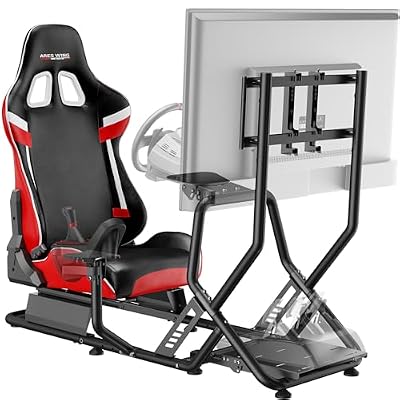
ARES WING Racing Simulator Cockpit with TV Mount, Sim Racing Wheel Stand
Included for 'Best VR Racing Simulator Cockpits with Force Feedback' because the listing specifies Sim Racing Wheel Stand, details this guide uses to compare options.
View on AmazonThis is the pick for the sim racer who races in VR most of the time but still wants the option to run a monitor, or who shares the rig with someone who does not get on with a headset. It is a wheel stand with an integrated TV mount rather than a full cockpit with a seat, which makes it a genuinely different product category — a compromise between a portable stand and a permanent rig. If your space cannot take a full-length cockpit but you want more stability than a basic desk-clamped stand, this sits in that gap.
Key specs and features
- Steel wheel stand frame with an integrated TV or monitor mount
- No seat included — you use your own chair or sofa
- Class-typical torque suitability: up to roughly 8–10 Nm
- Adjustable wheel deck and pedal plate
- Shorter footprint than a full cockpit because there is no seat frame
- Breaks down for storage, though it is not a one-motion fold
Why it works
The TV mount is the feature that earns this stand its place. In a hybrid setup you can run a screen for casual racing and a headset for serious sessions, and the screen mounts to the rig rather than to a separate stand that gets in the way of your pedals. For a VR-first buyer, the mount is dead weight you are paying for — a fair criticism, and the reason this is not the best overall pick despite its mid-range price. For a VR-and-monitor household, it solves a problem that otherwise costs you a second piece of furniture.
Stability is a step up from a desk-mounted clamp because the pedal plate is anchored to the same frame as the wheel deck. That said, a stand without a seat frame still relies on the floor and your body weight for bracing. Under a 9–10 Nm base, you will notice some movement in the deck, especially during rapid counter-steer corrections. Bracing the frame against a wall or adding weight to the base of the stand helps, but a full cockpit is the real answer for high torque.
Pros
- Integrated screen mount suits hybrid VR and monitor use
- Shorter footprint than a full cockpit, so it fits smaller rooms
- Adjustable wheel deck and pedal plate for different body sizes
- Pedals anchored to the same frame as the wheel, unlike a clamp-on stand
- Works with a wide range of consumer wheel bases
Cons
- No seat, so driving posture depends on whatever chair you own
- Less rigid than a full cockpit under strong force feedback
- The TV mount is wasted money for a pure VR racer
- Not a genuine one-motion fold for daily storage
How it compares with the nearest alternative
Compared with the RACGTING foldable cockpit, this stand is stiffer and gives you a screen option, but it does not fold as compactly and it does not include a seat either. If you race purely in VR and never want a monitor, the money spent on the TV mount would be better put toward the RACGTING seat-inclusive foldable or, if your budget stretches, the ARES WING aluminum profile cockpit, which is in a different rigidity class entirely. The decision comes down to one question: will a monitor ever be part of your setup? If yes, this is the smartest hybrid option in this list. If no, skip it.
4. RACGTING Foldable & Adjustable Racing Simulator Cockpit with Racing Seat – Best Budget Cockpit With a Seat

RACGTING Foldable & Adjustable Racing Simulator Cockpit with Racing Seat
Included for 'Best VR Racing Simulator Cockpits with Force Feedback' as a relevant option in this category; details come from the product listing.
View on AmazonThis is the most sensible first cockpit for a sim racer who wants a seat included and does not want to spend mid-range money. It pairs a folding steel tube frame with a racing-style seat, which solves the single biggest problem with budget rigs: sourcing a chair that puts you at the right height and angle relative to the wheel deck. For a Logitech or entry-level direct drive setup in a room that has to go back to being a living room, this is the budget pick that does the most.
Key specs and features
- Folding and adjustable steel tube frame
- Racing-style seat included in the bundle
- Class-typical torque suitability: up to roughly 6 Nm
- Adjustable wheel deck height and angle
- Adjustable pedal plate position
- Folds for storage between sessions
Why it works
Posture is the hidden variable in sim racing comfort. A rig that puts your shoulders 8 cm too high or your pedals 15 cm too close will cause you to brace against the wheel, which fights the force feedback instead of reading it. An included seat removes that guesswork, and the adjustability of this frame means you can dial the relationship between seat, wheel and pedals rather than accepting a fixed geometry. For a beginner, that is worth more than a small gain in frame stiffness.
The seat itself is the part that ages fastest on any budget rig. Foam compresses, fabric wears at the bolsters, and the seat rails develop play. On a rig in this price tier, expect the seat to be the first component you want to replace, and check whether the frame accepts a third-party seat with standard rails before you buy — that single detail determines whether this cockpit lasts three years or ten. The frame, by contrast, will outlast the seat comfortably as long as you keep the hinge bolts tight.
Pros
- Seat included, so there is no separate chair to source
- Folds away, which is essential in shared rooms
- Adjustable wheel deck and pedals suit a wide range of body sizes
- Budget price tier with a complete driving position out of the box
- Light enough for one person to reposition
Cons
- Not suitable for high-torque direct drive bases above roughly 6 Nm
- Seat foam and rails are the first things to wear
- Folding joints introduce flex that a fixed frame does not have
- Pedal plate benefits from extra bracing if you use a stiff brake
How it compares with the nearest alternative
Against the seat-less RACGTING foldable, this version costs more but gives you a complete rig without hunting for a chair that sits at the right height — for most beginners that is the better trade. Against the Next Level Racing GT Lite, the picture is closer: both are budget folding rigs with seats, and the GT Lite brings a longer-established brand, better documentation and a well-known folding mechanism, typically at a higher price within the same tier. If your budget is firm and you want the lowest complete package, take this one. If you want the folding rig most likely to still feel tight after years of folding, the GT Lite is the safer long-term buy.
5. ARES WING Sim Racing Cockpit with Racing Seat, 8040 Aluminum Profile – Best Overall for High-Torque Direct Drive

ARES WING Sim Racing Cockpit with Racing Seat, 8040 Aluminum Profile
Included for 'Best VR Racing Simulator Cockpits with Force Feedback' because the listing specifies 8040 Aluminum Profile, details this guide uses to compare options.
View on AmazonThis is the best overall cockpit in this guide for a serious sim racer running force feedback in VR. The 8040 designation refers to 80 × 40 mm T-slot aluminum extrusion, the same material class used in industrial machine frames and in the majority of high-end sim rigs. Aluminum profile is stiff, dimensionally stable, endlessly reconfigurable with standard hardware, and it does not develop the hinge play that folding steel frames eventually do. Add an included racing seat and a mid-range price tier, and it becomes the rig that most closely matches what a 9–16 Nm direct drive base needs.
Key specs and features
| Specification | Detail |
|---|---|
| Frame material | 80 × 40 mm T-slot aluminum extrusion |
| Class-typical torque suitability | Up to roughly 25 Nm |
| Seat | Racing seat included |
| Wheel deck mounting | Flat deck accepting common bolt-on wheel base patterns |
| Pedal plate | Extrusion-mounted, suitable for load-cell pedal sets |
| Adjustability | Continuous along the slot, not limited to preset holes |
| Folding | No — permanent assembly |
| Price tier | Mid-range |
Why it works
T-slot extrusion is the right material for force feedback because it resists torsion, not just bending. A wheel base does not push the deck down; it twists it around the steering column axis, and a rectangular tube profile is far better at resisting that twist than a round steel tube of similar weight. The slots also mean every mounting point is infinitely adjustable: you loosen two bolts, slide the wheel deck 30 mm closer, and tighten. There are no preset holes to compromise on, which matters when you are trying to get a formula-style reach or a comfortable GT position for your own arm length.
The upgrade path is the second reason this rig wins. Every serious cockpit gets a second wheel base eventually, and an extrusion frame accepts a new base, a new pedal set, a shifter, a handbrake, a button box and a direct drive mount without any proprietary adapters. Standard M8 hardware from any hardware shop fits. That modularity means the frame can realistically outlast two or three wheel bases, which changes the economics completely — a mid-range rig that survives three upgrades costs less per year than three budget rigs that each get replaced.
Pros
- Stiffest frame type in this guide, suitable for direct drive up to roughly 25 Nm
- Infinitely adjustable mounting via T-slot rails
- Seat included; accepts third-party seats with standard rails
- Standard hardware means easy repairs and cheap accessories
- Mid-range price for premium-class rigidity
Cons
- Does not fold; needs a permanent footprint
- Heavier than a steel tube rig, so it is not a one-person move once built
- Assembly takes longer and requires care with bolt torque
- Exposed extrusion edges can catch cables without added clips
How it compares with the nearest alternative
Against the Next Level Racing GTTrack, this rig is stiffer and more configurable for less money, but it gives up brand documentation, a finished appearance and a single-position design that some buyers prefer for simplicity. Against the F-GT Pro, the aluminum rig loses the formula seating position but gains modularity — the F-GT Pro can switch between two positions, while the extrusion frame can become almost any position with enough patience and extra rails. If your priority is raw rigidity per pound spent and you intend to keep upgrading hardware, this is the pick. If you want a formula driving position without building it yourself, choose the F-GT Pro.
6. Next Level Racing GT Lite Foldable Simulator Cockpit (NLR-S021) – Best Folding Cockpit From an Established Brand

Next Level Racing GT Lite Foldable Simulator Cockpit (NLR-S021)
Included for 'Best VR Racing Simulator Cockpits with Force Feedback' as a relevant option in this category; details come from the product listing.
View on AmazonThe GT Lite is the folding cockpit to buy when you want the convenience of a rig that disappears but you do not want to gamble on an unknown brand. It comes from the same manufacturer as the GTTrack and F-GT Pro in this list, it includes an integrated seat, and its folding mechanism is the best-known part of its design. For a sim racer in a small flat running an entry to mid-tier wheel base, this is the most reassuring budget-tier folding option.
Key specs and features
- Foldable steel frame with an integrated seat
- Class-typical torque suitability: up to roughly 8 Nm
- Adjustable wheel deck and pedal plate
- Folds into a compact package for storage against a wall
- Supported by an established manufacturer with published documentation
- Accessory mounting provisions for shifters and similar hardware
Why it works
The reason to pay more than the cheapest foldable is the mechanism. Folding joints are the weakest point on any collapsible rig, and they are where flex, rattle and eventual wobble come from. A folding cockpit from a manufacturer that has been building them for years is more likely to have a latch design that stays tight after hundreds of fold-unfold cycles, and more likely to have replacement parts available if a latch does wear. That is a real ownership advantage, not a marketing one.
The integrated seat also positions you properly without extra shopping. In practice, the GT Lite suits a wheel base in the 5–8 Nm range: enough to feel the road, not enough to make a folding frame work against you. Above that, deck movement becomes noticeable under fast corrections, and you are better served by a fixed frame. Folded, it occupies a fraction of the floor space of a full cockpit, which is the entire reason this category exists.
Pros
- Folds compactly with the seat attached
- Established brand with documentation and spare parts support
- Integrated seat removes the chair-sourcing problem
- Good match for belt-driven and entry direct drive bases
- Adjustable enough for a range of driver heights
Cons
- Folding joints still introduce flex under strong force feedback
- Priced above the cheapest budget foldables
- Not intended for high-torque direct drive bases
- Seat foam is the first component to show wear with heavy use
How it compares with the nearest alternative
Against the RACGTING foldable with seat, the GT Lite is the more expensive but better-supported rig, with a folding mechanism that has had more years of refinement behind it. Against the GTTrack, it gives up a large amount of rigidity and the direct drive capability, but it costs a fraction of the price and folds away, which the GTTrack cannot do at all. The choice between those two is not really about budget; it is about whether the rig can live permanently in the room. If it cannot, the GT Lite is the correct answer in this list.
7. GTPLAYER Sim Racing Cockpit Adjustable – Best Mid-Range Cockpit for Broad Wheel Compatibility

GTPLAYER Sim Racing Cockpit Adjustable for High Performance Racing Simulator Cockpit, Compatible with All Steering Wheels & Pedals on The Market, Supports PC & Console, Black
Included for 'Best VR Racing Simulator Cockpits with Force Feedback' because the listing specifies Compatible with All Steering Wheels & Pedals on The Market and Supports PC & Console, details this guide uses to compare options.
View on AmazonThis cockpit targets the buyer who has not settled on a single wheel ecosystem and wants a frame that will accept whatever base they end up with. Its listing advertises broad steering wheel compatibility, and its adjustable steel frame puts it in the mid-range tier alongside the ARES WING stand and aluminum profile rig. For a sim racer who is still changing hardware every year or two, that flexibility has real value.
Key specs and features
- Adjustable steel frame with a fixed, non-folding footprint
- Class-typical torque suitability: up to roughly 8–10 Nm
- Listing states compatibility with a wide range of steering wheel brands
- Adjustable wheel deck position and pedal plate
- Seat inclusion varies by configuration — confirm on the listing
- Mid-range price tier
Why it works
Compatibility breadth is underrated. Sim racers change wheel bases more often than they change cockpits, and a frame whose deck accepts Logitech, Thrustmaster, Fanatec, MOZA and similar bases without custom adapters saves money and frustration at every upgrade. An adjustable steel frame in this class is also meaningfully stiffer than a folding rig, because it has no hinges to flex — the frame is a single structure, and the adjustability comes from slotted plates rather than folding joints.
Where it sits in the market is between the folding budget tier and the direct drive premium tier. An 8–10 Nm ceiling covers the popular mid-power direct drive bases comfortably and covers belt-driven bases with room to spare, but it is not the frame for a 20 Nm flagship base. If you are working up the wheel base ladder and expect to reach the top end within a couple of years, an aluminum extrusion frame is the smarter single purchase; if your realistic ceiling is a mid-power direct drive base, this cockpit will serve for years.
Pros
- Advertised compatibility with a wide spread of wheel brands
- Fixed steel frame is stiffer than any folding design in this list
- Adjustable geometry for different body sizes and pedal preferences
- Mid-range price with no folding compromise
- Simple, serviceable construction with accessible bolts
Cons
- Does not fold, so it needs permanent space
- Torque ceiling below the premium and aluminum profile options
- Seat inclusion depends on the specific configuration you buy
- Less modular than a T-slot extrusion frame for future accessories
How it compares with the nearest alternative
Against the ARES WING aluminum profile cockpit, this frame costs less in some configurations but gives up both ultimate rigidity and modularity — the extrusion rig can be rebuilt and extended indefinitely, while a welded steel frame is what it is. Against the ARES WING TV mount stand, this cockpit offers a more complete driving position and better pedal anchoring, but it does not fold and it does not carry a screen mount. The decision hinges on two questions: do you need a monitor, and will you ever buy a wheel base above roughly 10 Nm? Two noes and this cockpit is a strong mid-range value. Either yes, and one of the other two rigs is the better fit.
8. Next Level Racing F-GT Pro Formula and GT Racing Simulator Cockpit – Best Premium Formula and GT Cockpit

Next Level Racing F-GT Pro Formula and GT Racing Simulator Cockpit - Black Edition (NLR-R003)
Included for 'Best VR Racing Simulator Cockpits with Force Feedback' because the listing specifies Black Edition (NLR-R003), details this guide uses to compare options.
View on AmazonThe F-GT Pro is the premium pick and the only cockpit in this list designed to switch between a formula-style reclined position and a conventional GT position within the same frame. That matters more in VR than on a monitor, because a reclined formula posture changes how you read the wheel and pedals, and some drivers find it far more natural for open-wheel cars. If you race a mix of formula and GT categories and you want one frame that does both properly, this is the one.
Key specs and features
- Reinforced steel frame supporting both formula and GT seating positions
- Class-typical torque suitability: up to roughly 20 Nm and above
- Wheel deck and pedal plate designed for high-torque direct drive hardware
- Black Edition finish
- Seat included in most configurations — verify your specific bundle
- Accessory mounting for shifters, handbrakes and button boxes
Why it works
The dual-position design is genuinely useful rather than a gimmick. Formula cars seat the driver with legs raised and torso reclined, which changes the angle of force through the pedals and the reach to the wheel. GT cars seat the driver more upright with pedals closer to the floor. A frame that can produce both positions means you can match the rig to the car you are driving, and in VR — where your visual reference is entirely inside the cockpit — that match contributes directly to the sense of being in the car. A cockpit that puts you upright in a formula car breaks the illusion faster than any amount of frame flex.
The premium construction is the second argument. A reinforced steel frame in this class handles a 20 Nm direct drive base without the deck rotating under load, and it anchors a load-cell brake pedal firmly enough that you can brake by pressure rather than by travel, which is the technique that makes load-cell pedals worth buying. The cost is footprint and price: this is the largest and most expensive type of rig here, it does not fold, and it demands a dedicated space.
Pros
- Two seating positions — formula and GT — in one frame
- Strong enough for high-torque direct drive bases
- Pedal plate suited to stiff load-cell brake setups
- Premium build with manufacturer documentation and support
- Extensive accessory mounting points
Cons
- Premium price tier — the most expensive option in this guide
- Large permanent footprint with no folding option
- Position changes take time and tools, so it is not a per-session switch
- Heavy; assembly and relocation are two-person jobs
How it compares with the nearest alternative
Against the GTTrack, the F-GT Pro adds the formula position, more reinforcement and a higher effective torque ceiling for a higher price — if you only ever race GT cars, the GTTrack is the better value and you will never miss the second position. Against the ARES WING aluminum profile cockpit, the F-GT Pro is the more polished and better-documented product with a factory-designed formula position, while the aluminum rig is stiffer per pound, cheaper, and infinitely reconfigurable. Choose the F-GT Pro if you want the formula position to be a designed feature rather than a project, and choose the extrusion rig if you enjoy building and rebuilding your setup to suit each new piece of hardware.
How to Choose
Choosing a cockpit for VR force feedback comes down to four variables: how much torque your wheel base produces, how rigid the frame needs to be to absorb it, how much space you can dedicate, and how long you intend to keep the rig. Get the torque-to-rigidity relationship right and everything else is preference. Get it wrong and you will feel the deck move every time you correct a slide.
Start with the torque your wheel base actually produces
Force feedback strength is measured in newton-metres at the wheel shaft, and the range across consumer hardware is enormous. A gear-driven Logitech base in the G29/G920/G923 family produces roughly 2–2.5 Nm. Belt-driven Thrustmaster bases in the T300/TX class sit around 3.5–4 Nm. Entry direct drive bases start around 5–5.5 Nm, mid-power direct drive units run
Ready to decide? Our #1 pick for 2026 is the RACGTING Foldable Cockpit (Logitech / Thrustmaster / MOZA).
Live price & availability on Amazon.
Related Reviews & Guides





Best Bidet Toilet Seats for Comfort and Easy Installation

Best Hand-Crank Pasta Machines for Fresh Pasta