
Last Updated: October 8, 2026
Quick answer: For most people in 2026, the best electric lawn mowers for every yard is the Greenworks 40V 17-Inch Cordless — our #1 rated choice. See the full ranked comparison, alternatives and buying advice below.
Best Electric Lawn Mowers for Every Yard
The best electric lawn mower depends on your yard’s size, slope, grass density, storage space, and whether you value a light push mower or the longer runtime of a larger self-propelled model.
Quick picks by yard and user
- Small, mostly flat yard under ¼ acre: Choose a 16- to 18-inch cordless mower with a 4.0Ah battery, such as the Greenworks 40V 17-Inch mower or a similar compact model.
- Typical suburban yard up to ½ acre: A 20- or 21-inch cordless mower with a 5.0Ah or 6.0Ah battery offers the best balance of coverage, cutting speed, and storage.
- Large yard, thick grass, or frequent mowing: Consider a high-voltage 21-inch model such as the EGO Power+ LM2135SP or Greenworks 80V 21-Inch mower.
- Slopes and uneven ground: Select a self-propelled mower with variable-speed control and larger rear wheels rather than relying on a lightweight push model.
- Very limited storage: Look for vertical-folding handlebars, a removable battery, and a deck narrower than 20 inches.
- Lowest purchase cost: A corded electric mower can be economical for a small yard, but only if an outdoor-rated extension cord will reach every section safely.
Electric mower comparison
| Mower or type | Cutting width | Power source | Typical runtime or coverage | Charge time | Best fit |
|---|---|---|---|---|---|
| Greenworks 40V 17-Inch Cordless | 17 inches | 40V lithium-ion battery | Up to about ½ acre with a larger battery, depending on grass | About 60–120 minutes, charger dependent | Small to medium flat yards and compact storage |
| Ryobi 40V HP Brushless 21-Inch Self-Propelled | 21 inches | 40V lithium-ion battery | Roughly ½ acre with a 6.0Ah battery in moderate conditions | About 60–90 minutes with a rapid charger | General suburban yards and adjustable self-propulsion |
| EGO Power+ LM2135SP | 21 inches | 56V lithium-ion battery | Approximately ½ to ¾ acre with a 6.0Ah battery, depending on load | About 45–90 minutes with a rapid charger | Thick grass, slopes, and longer mowing sessions |
| Greenworks 80V 21-Inch Self-Propelled | 21 inches | 80V lithium-ion battery | About ½ to ¾ acre with a 5.0Ah battery under moderate conditions | About 45–90 minutes, charger dependent | Demanding turf and users already in the 80V battery system |
| Corded electric mower | 14–21 inches | 120V outdoor extension cord | Unlimited runtime while connected | None | Small yards with accessible outdoor power |
Runtime figures are practical estimates rather than guarantees. Wet grass, tall growth, dense turf, bagging, slopes, and a slow cutting pace can reduce coverage substantially. A mower’s battery capacity, measured in amp-hours, matters as much as its voltage. For example, a 40V 6.0Ah battery stores approximately 240 watt-hours, while a 56V 6.0Ah battery stores approximately 336 watt-hours.

Greenworks 40V 16in Push Lawn Mower, 4.0 Ah Battery and Charger
Included for 'Best Electric Lawn Mowers for Every Yard' because the listing specifies 4.0 Ah Battery and Charger, details this guide uses to compare options.
View on Amazon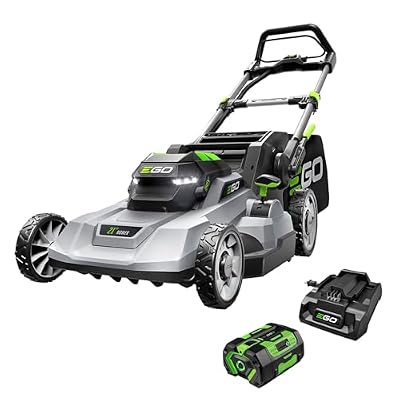
EGO POWER+ 21" Cordless Electric Lawn Mower with Battery, Charger - LM2114
Included for 'Best Electric Lawn Mowers for Every Yard' because the listing specifies Charger and LM2114, details this guide uses to compare options.
View on Amazon
EGO Power+ 21" Cordless Electric Lawn Mower, Self-Propelled - LM2134SP-2
Included for 'Best Electric Lawn Mowers for Every Yard' because the listing specifies Self-Propelled and LM2134SP-2, details this guide uses to compare options.
View on Amazon
EGO Power+ Electric Lawn Mower, Cordless Push, Includes 56V 4.0Ah Battery and Charger - LM2112
Included for 'Best Electric Lawn Mowers for Every Yard' because the listing specifies Cordless Push and Includes 56V 4.0Ah Battery and Charger, details this guide uses to compare options.
View on AmazonHow to match cutting width to your yard
Deck size affects both mowing time and maneuverability. A 17-inch deck needs more passes but fits between narrow gates, garden beds, and storage shelves. A 21-inch deck covers about 24% more width per pass than a 17-inch deck, assuming the same overlap.
Here is a simple estimate. A quarter-acre yard contains about 10,890 square feet. If you allow 25% for trees, beds, obstacles, and overlap, the mowing area is about 8,170 square feet. A 21-inch mower cuts a nominal 1.75 feet per pass, so it requires roughly 4,670 linear feet of travel. At an effective walking speed of 2.5 miles per hour, that is around 21 minutes of cutting before turning, emptying the bag, and maneuvering. Realistically, plan on 30 to 45 minutes.
For a yard close to ½ acre, a 21-inch mower may need 50 to 80 minutes, especially when the lawn is divided into sections. If your mower’s usable runtime is only 35 minutes, buy a second battery, choose a fast charger, or move to a higher-capacity platform rather than assuming the advertised acreage will apply.
Best choices by terrain and mowing style
Flat yards and narrow access
A lightweight push mower is usually the simplest choice. Models in the 14- to 18-inch range are easier to turn around trees and carry over a step. A compact deck also takes less room in a shed. The trade-off is more walking and a longer mowing time on open lawns.
Slopes and uneven ground
Self-propulsion is more useful than extra cutting width when the yard includes inclines. Look for variable-speed control, a brushless motor, and rear wheels around 10 inches in diameter. Self-propelled drive consumes battery power, so a 6.0Ah battery is a more sensible starting point than a small 2.0Ah pack.
Do not rely on the drive system to make a dangerous slope safe. Keep both hands on the controls, mow across a slope when the manufacturer permits it, and follow the manual’s limits. Avoid mowing wet inclines, where traction and stopping control can deteriorate.
Thick, tall, or wet grass
Higher-voltage systems, sharp blades, and adjustable cutting heights handle heavy growth better. EGO’s 56V range and Greenworks’ 80V range are strong candidates for demanding lawns, provided the battery capacity matches the yard. Even a powerful mower can bog down if you remove too much grass at once. Raise the deck for the first pass, then lower it on a second pass if necessary.
Mulching versus bagging
Mulching returns fine clippings to the lawn and avoids stopping to empty a bag, but it requires more motor effort in tall grass. Bagging produces a tidier finish and is useful when leaves are being collected, though a full bag adds weight and reduces runtime. Check whether the mower includes the mulch plug and bag; some configurations sell accessories separately.
Storage, charging, and ownership costs
Measure the mower with its handle folded, not just the deck. A 21-inch mower may need approximately 24 to 30 inches of floor width once the wheels and handle are included. Vertical storage is convenient, but only use it if the manufacturer specifically allows that position and the battery is removed.
Market pricing commonly falls into these ranges in 2026:
- Corded electric: approximately $120–$250.
- Compact cordless with battery and charger: approximately $250–$450.
- 21-inch cordless self-propelled: approximately $450–$800.
- High-voltage or premium self-propelled systems: approximately $600–$1,000, depending on battery size and included equipment.
The battery is often the most expensive replacement component. Store lithium-ion batteries indoors in a dry location, away from extreme heat and freezing conditions. Do not leave a battery permanently on the charger unless the manufacturer says that is acceptable. If the mower is used weekly for six months, a $600 mower costs about $23 per mowing before electricity, blade replacement, and battery depreciation. Cutting every other week reduces use but may increase strain because the grass is taller.
What wears out first
- Blade: Sharpen or replace it when the cut becomes ragged, the mower vibrates, or grass tips turn brown. Disconnect the battery before working underneath.
- Deck underside: Grass buildup restricts airflow and can reduce mulching performance. Remove clippings after mowing once the mower is powered off and secured.
- Wheels and drive components: Self-propelled models have more moving parts. Keep wheel axles clean and avoid forcing the drive through deep, wet grass.
- Battery: Runtime gradually declines with age and heat. Buying several tools from the same battery platform can make a replacement battery more economical.
- Handle controls: Repeatedly folding the handle or pulling cables tightly can damage switches and wiring. Fold it gently and store the mower without leaning heavily on the control bar.
Bottom line
Choose a 17-inch cordless mower for a compact, flat yard; a 21-inch 40V self-propelled mower for most suburban lawns; and a 56V or 80V model when thick grass, slopes, or a larger property justify extra battery capacity. Before buying, measure the actual mowing area, check the mower’s folded dimensions, compare included battery amp-hours, and confirm that the charging time fits your mowing schedule. A wider deck is not automatically better if it cannot pass through your gate or run long enough to finish the job.
Ready to decide? Our #1 pick for 2026 is the Greenworks 40V 17-Inch Cordless.
Live price & availability on Amazon.
Related Reviews & Guides


Best Professional Bartender Bags for Mobile Service
Best Irish Flutes for Traditional Playing and Beginners