
Last Updated: October 8, 2026
The best guitar amps for most players are the Boss Katana-50 Gen 3 for versatile home practice and small gigs, the Fender Mustang LT25 for affordable bedroom use, the Yamaha THR30II Wireless for compact desktop playing, and the Vox AC10C1 or Fender Tone Master Deluxe Reverb when live tube-style or full-stage performance matters most.
Quick answer: For most people in 2026, the best guitar amps for practice, recording, and gigs is the Fender Mustang LT25 — our #1 rated choice. See the full ranked comparison, alternatives and buying advice below.
Best guitar amps by playing situation
- Best all-rounder: Boss Katana-50 Gen 3 — 50 watts, a 12-inch speaker, built-in effects, power reduction, and enough projection for rehearsals and many small venues.
- Best budget practice amp: Fender Mustang LT25 — 25 watts, an 8-inch speaker, presets, and USB recording at a relatively low market price.
- Best compact wireless option: Yamaha THR30II Wireless — 30 watts, two 3.15-inch speakers, rechargeable battery operation, and stereo effects in a desktop-sized cabinet.
- Best simple British-style tone: Orange Crush 20 — 20 watts, a … 8-inch speaker, an analog signal path, and a practical headphone output.
- Best small tube amp for recording and intimate gigs: Vox AC10C1 — 10 watts and a 10-inch Celestion speaker, with classic chime and overdrive at manageable volume.
- Best larger live clean tone: Fender Tone Master Deluxe Reverb — 100 watts of solid-state power, a 12-inch speaker, extensive power attenuation, and a familiar Deluxe Reverb-style platform.
What wattage actually means
Wattage is not a direct volume score. A 15-watt tube amplifier can sound as loud as, or louder than, a 30-watt solid-state amplifier in some situations. Speaker efficiency, cabinet design, tone settings, and how much clean headroom you need matter just as much.

Fender Mustang LT25 Guitar Amplifier, 25-Watt Combo Amp with 8" Speaker
Included for 'Best Guitar Amps for Practice, Recording, and Gigs' because the listing specifies 25-Watt Combo Amp with 8" Speaker, details this guide uses to compare options.
View on Amazon
Positive Grid Spark 2 50W Smart Guitar Practice Amp & Bluetooth Speaker
Included for 'Best Guitar Amps for Practice, Recording, and Gigs' as a relevant option in this category; details come from the product listing.
View on Amazon
Fender Champion II 25 Watt Electric Guitar Combo Amp, Speaker, USB & Aux
Included for 'Best Guitar Amps for Practice, Recording, and Gigs' because the listing specifies Speaker and USB & Aux, details this guide uses to compare options.
View on Amazon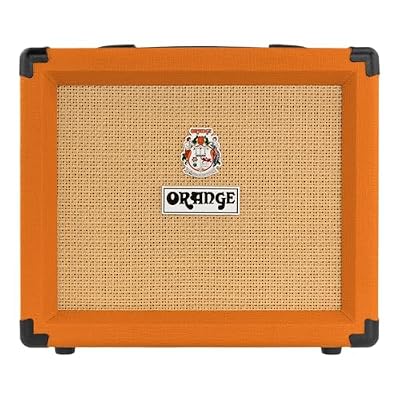
Orange Crush 20 20W 8" 2-Channel Guitar Amplifier and Speaker Combo, Orange
Included for 'Best Guitar Amps for Practice, Recording, and Gigs' because the listing specifies Orange, details this guide uses to compare options.
View on AmazonFor a bedroom, 1 to 10 watts is usually enough, especially when the amplifier includes a master volume or power scaling. A 20- to 50-watt modeling or solid-state amp is useful for rehearsals because it provides clean headroom without needing to run at maximum output. For a drummer-led band, a 30- to 50-watt amp with a 10- or 12-inch speaker is a safer minimum, while larger venues may require a powerful combo, a microphone, or a direct connection to the venue’s PA system.
The key distinction is clean headroom. If you want a clear jazz, country, funk, or pedal-platform sound, choose more power than you need and turn it down. If you want power-amp breakup and classic overdrive, a lower-powered tube amp may be more satisfying, but it may become too loud before it becomes quiet enough for an apartment.
Head-to-head comparison
| Amplifier | Power | Speaker setup | Approx. weight | Best use | Typical market range |
|---|---|---|---|---|---|
| Fender Mustang LT25 | 25 watts | 1 x 8-inch | About 8.8 lb | Low-cost practice, presets, USB recording | About $150–$220 |
| Boss Katana-50 Gen 3 | 50 watts, with lower-power settings | 1 x 12-inch | About 25 lb | Practice, pedals, rehearsals, small gigs | About $250–$350 |
| Yamaha THR30II Wireless | 30 watts when powered by its adapter | 2 x 3.15-inch | About 7.1 lb | Desktop playing, portability, wireless practice | About $450–$550 |
| Orange Crush 20 | 20 watts | 1 x 8-inch | About 15 lb | Simple rock tones and pedal use | About $180–$250 |
| Vox AC10C1 | 10 watts, tube | 1 x 10-inch Celestion | About 27 lb | Recording and small, controlled performances | About $600–$750 |
| Fender Tone Master Deluxe Reverb | 100 watts, solid-state modeling | 1 x 12-inch | About 23 lb | Large clean tones, gigs, direct output | About $1,000–$1,300 |
Clean and distorted tones: which design suits you?
Modeling amplifiers
Modeling amps such as the Mustang LT25 and Katana-50 Gen 3 create several amplifier voices digitally. They are the strongest choice when you play multiple genres or want delay, reverb, modulation, and distortion without buying separate pedals. The trade-off is menu navigation: a preset that sounds excellent at low volume may need its bass, treble, or gain adjusted when played loudly.
Solid-state and analog amps
The Orange Crush 20 uses a simpler control layout and delivers an immediate overdriven rock sound. It is easier to understand than a large preset library, and its clean channel works well with pedals. Its 8-inch speaker is convenient for a small room but does not move as much air as a 12-inch speaker, so the low end may feel less expansive during a rehearsal.
Tube amplifiers
The Vox AC10C1 produces touch-sensitive compression and upper-midrange chime that many players associate with classic British guitar sounds. Tube amps also have ongoing ownership considerations: valves eventually wear, the amplifier is heavier than many digital alternatives, and loud operation may be necessary to reach its most responsive overdrive. That makes it excellent for recording or a controlled small venue, but less convenient for quiet shared housing.
Speaker size and room suitability
| Playing environment | Useful specification | Why it works |
|---|---|---|
| Desk, bedroom, or apartment | 1–10 watts, or a larger amp with power scaling; 3–8-inch speakers | Lower acoustic output and less bass buildup |
| Small rehearsal room | 20–50 watts; 8–12-inch speaker | Enough projection while retaining manageable size |
| Small club with microphone or PA | 20–50 watts; preferably a 10- or 12-inch speaker | The microphone supplies room coverage while the amp provides stage monitoring |
| Large stage or loud band | 50 watts or more, or a direct-output amplifier with monitor support | More clean headroom and reliable connection to the sound system |
A 12-inch speaker generally gives a fuller low end and more authoritative projection than an 8-inch speaker. That does not automatically make it better for a bedroom: a larger speaker can make walls, floors, and furniture vibrate at low volume. If you mainly record with headphones, speaker size matters less than the quality of the headphone output, USB interface, or direct recording connection.
Connectivity and effects
For silent practice, look for a headphone output that mutes the speaker. A dedicated line out or USB connection is useful for recording without placing a microphone in front of the cabinet. The Katana-50 Gen 3 and Mustang LT25 offer USB-based recording features, while the Tone Master Deluxe Reverb includes direct-output features designed for stage and recording workflows.
Bluetooth is convenient for playing along with backing tracks, but Bluetooth audio usually has noticeable latency for playing the guitar itself. Wireless guitar systems are different: the Yamaha THR30II Wireless is designed to receive a compatible wireless guitar transmitter, making it particularly tidy for casual practice. Before buying, check whether the transmitter is included in the particular package.
Built-in effects are most valuable when you are starting out or want a compact setup. If you already own pedals, prioritize a good clean channel, an effects loop, and a footswitch option. An effects loop places time-based effects such as delay and reverb after the preamp distortion, which can sound clearer than running everything into the input.
A practical decision matrix
| Your priority | Recommended type | What to compromise on |
|---|---|---|
| Under roughly $250 and learning several styles | Modeling combo such as the Fender Mustang LT25 | Smaller speaker and less rehearsal headroom |
| One amp for home, lessons, and occasional gigs | 50-watt modeling combo with a 12-inch speaker, such as the Boss Katana-50 Gen 3 | More weight than a desktop amp |
| Minimal desk space and wireless convenience | Yamaha THR30II Wireless | Less physical low-end impact and limited large-room projection |
| Pedals and straightforward rock controls | Orange Crush 20 or a similar analog solid-state combo | Fewer built-in effects and presets |
| Responsive tube overdrive for recording | 10- to 15-watt tube combo | Weight, heat, maintenance, and limited clean volume |
| Large clean sound with direct stage output | High-powered digital or solid-state combo | Higher purchase price and less traditional tube sag |
Ownership costs and common mistakes
Calculate value by use rather than wattage. An amp costing $300 and used three times a week for three years provides about 468 sessions, or roughly $0.64 per session before resale. A $700 tube amp used once a week for the same period provides about 156 sessions, or $4.49 per session. The more expensive amp may still be the right choice if its tone motivates you to play, but frequency of use is an important part of the decision.
- Do not buy only for maximum watts. Excess power can make home volume control frustrating.
- Do not ignore the speaker. A good 12-inch speaker may be more useful at rehearsal than a higher wattage rating through a tiny speaker.
- Protect the controls and grille. Dust can enter pots and switches, while impacts can damage speaker cones and input jacks.
- Use the correct cable. A speaker cable and an instrument cable are not interchangeable for tube amplifier connections; follow the manufacturer’s instructions.
- Allow tube amps to cool before moving them. Valves and internal components are more vulnerable when hot.
- Expect consumables. Tube amps may eventually need replacement valves, while rechargeable wireless systems lose battery capacity over years.
Final recommendation
Choose the Fender Mustang LT25 if price and simple home recording matter most. Choose the Boss Katana-50 Gen 3 if you want one flexible amplifier that can grow from practice into rehearsals and small gigs. Choose the Yamaha THR30II Wireless for a neat, portable desktop setup, and the Orange Crush 20 for uncomplicated pedal-friendly rock tones. If tube response is the central reason you are buying, the Vox AC10C1 is the more focused recording and small-room choice; for larger clean stages, a direct-output model such as the Fender Tone Master Deluxe Reverb is more practical than trying to make a low-powered bedroom amp cover the whole room.
Ready to decide? Our #1 pick for 2026 is the Fender Mustang LT25.
Live price & availability on Amazon.
Related Reviews & Guides



Best Laptops for College Students

7 Best Camping Chairs with 500 lb Capacity (or Close)