
Last Updated: October 8, 2026
- Best Charcoal Chimney Starters for Fast Lighting
- Quick comparison of leading charcoal chimney types
- Best overall: Weber Rapidfire Chimney Starter
- Best for small grills and limited storage: a compact chimney
- Best for large cooks: a 7–8-quart chimney
- What to compare before buying
- Decision guide by situation
- How much charcoal should you light?
- Safe lighting and maintenance
- Ownership realities
Quick answer: For most people in 2026, the best charcoal chimney starters for fast lighting is the Weber Rapidfire Chimney Starter — our #1 rated choice. See the full ranked comparison, alternatives and buying advice below.
Best Charcoal Chimney Starters for Fast Lighting
The best charcoal chimney starter for most grillers is the Weber Rapidfire: its roughly 6-quart capacity, large ventilation openings, sturdy cone shape, and heat-shielded handle provide a reliable balance of speed and control. For smaller grills or occasional use, a compact 4–5-quart chimney is easier to store; for large cookouts, choose a heavy-gauge steel model holding about 100 briquettes or more.
A chimney starter is a metal cylinder with vents at the bottom and a grate above a space for newspaper or a firelighter. It uses rising heat to ignite charcoal from below, avoiding lighter fluid and producing a usable bed of coals in roughly 15–25 minutes. The differences between models are less about the basic concept and more about capacity, airflow, steel durability, and how safely you can pour the hot charcoal.

Weber® Rapidfire Chimney Starter, Standard, Silver
Included for 'Best Charcoal Chimney Starters for Fast Lighting' because the listing specifies Standard and Silver, details this guide uses to compare options.
View on Amazon
Kingsford Heavy Duty Charcoal Chimney Starter, Large Capacity
Included for 'Best Charcoal Chimney Starters for Fast Lighting' because the listing specifies Large Capacity, details this guide uses to compare options.
View on Amazon
Kingsford Compact Charcoal Chimney Starter for Grills and BBQs
Included for 'Best Charcoal Chimney Starters for Fast Lighting' as a relevant option in this category; details come from the product listing.
View on Amazon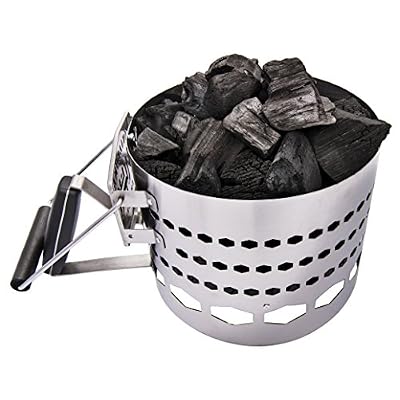
Oklahoma Joe's Halftime XL Charcoal Starter - 9848125R04
Included for 'Best Charcoal Chimney Starters for Fast Lighting' because the listing specifies 9848125R04, details this guide uses to compare options.
View on AmazonQuick comparison of leading charcoal chimney types
| Model or type | Approx. capacity | Typical charcoal load | Handle and shield design | Best for |
|---|---|---|---|---|
| Weber Rapidfire Chimney Starter | About 6 quarts; approximately 12 x 8 x 7.5 inches | About 80–100 briquettes, depending on size | Two-handle arrangement with a large heat shield | Most two- to four-person grilling and general use |
| Compact 4–5-quart chimney | About 4–5 quarts; approximately 10–11 inches tall | About 50–70 briquettes | Usually a single plastic or wood-grip handle with a smaller shield | Small grills, balconies, and low-volume cooking |
| Large 7–8-quart chimney | About 7–8 quarts; approximately 13–15 inches tall | About 100–150 briquettes | Long handle plus a broad metal heat shield is preferable | Large kettles, smoking sessions, and groups |
| Heavy-gauge stainless-steel chimney | Usually 5–7 quarts | About 70–120 briquettes | Metal handle, secondary grip, and generous shield on better models | Frequent use and longer ownership |
Capacity figures are useful comparisons rather than exact measurements. Briquettes vary in shape and lump charcoal contains irregular pieces, so the same chimney may hold noticeably different amounts from one fill to the next.
Best overall: Weber Rapidfire Chimney Starter
The Weber Rapidfire remains the safest all-purpose recommendation because its capacity is large enough for a full kettle grill without becoming awkward to lift. Its lower vents encourage a strong draft, while the raised charcoal grate leaves space for a newspaper sheet or natural firelighter underneath. The second handle gives better control when tipping the chimney, and the heat shield helps protect your hand from the hot cylinder.
Its practical load is roughly 80 to 100 standard briquettes. That is enough for a two-zone arrangement in a medium kettle or a substantial direct-heat grilling session. Filling it to the top is not always necessary: a half-full chimney may provide around 40–50 briquettes, which is often sufficient for burgers, sausages, or vegetables.
The main drawback is storage. A full-size chimney occupies more vertical space than compact models, and its galvanized or coated steel can eventually discolor and develop surface rust if left wet. Drying it after use matters more than keeping it cosmetically perfect.
Best for small grills and limited storage: a compact chimney
A 4–5-quart chimney is the better choice when your grill is small, your cooking sessions are short, or cabinet space is limited. It commonly lights 50–70 briquettes, enough for a small kettle, hibachi-style grill, or a single meal for two to three people. It also weighs less when full, making controlled pouring easier.
The trade-off is that compact models often have a shorter body and smaller handle-to-cylinder distance. That can place your hand closer to the heat, especially when the shield is narrow. Look for a handle that stays at least several inches away from the metal body, a broad shield between your fingers and the chimney, and a secondary grip near the front.
For occasional use, a compact galvanized-steel chimney is usually adequate. For frequent use, choose thicker steel or stainless steel rather than the lightest inexpensive version. Thin metal heats quickly but can warp around the lower grate and vent holes after repeated high-temperature cycles.
Best for large cooks: a 7–8-quart chimney
A large chimney is useful when you regularly cook for a crowd, fill a wide kettle, or need enough coal for a long indirect cook. Its 100–150-briquette capacity can save a second lighting cycle. The additional size, however, creates more weight and a larger column of burning charcoal.
For this category, the handle design matters as much as capacity. Choose a long primary handle, a secondary support handle, and a heat shield that covers the gap behind the grip. A large chimney without a secure second grip can become difficult to control when full. Never assume the handle is cool simply because it is made from plastic; radiant heat can transfer through screws and mounting brackets.
What to compare before buying
Capacity and charcoal layout
Match the chimney to the amount of fuel your grill needs, not to the largest number printed on the packaging. A 6-quart chimney is the versatile middle ground. A 4-quart model reduces waste for quick meals, while an 8-quart model is justified if you routinely cook for six or more people or use a large smoker.
Airflow
Look for multiple lower vents distributed around the cylinder and upper vents that allow hot gases to escape. Openings that are too small slow ignition; openings that are poorly positioned can create uneven burning. The charcoal grate should sit above the bottom vents rather than directly over them, leaving a clear air channel below the fuel.
Steel thickness and construction
Heavier steel generally resists warping, but weight alone does not prove quality. Check whether the charcoal grate is firmly attached, whether the vent holes have clean edges, and whether the handle mounting hardware feels secure. Stainless steel offers better corrosion resistance, while galvanized or coated steel can be perfectly serviceable if it is kept dry.
Heat protection
A heat shield should sit between the hot body and your hand, not merely decorate the handle area. A secondary grip is particularly valuable on large models because it lets you steady the chimney while pouring. Avoid models with an exposed metal handle unless you use a suitable heat-resistant grill glove and understand that the handle may still become hot.
Decision guide by situation
| Your situation | Recommended choice | Why |
|---|---|---|
| First chimney, medium kettle grill | 6-quart full-size model | Enough capacity for most meals without excessive weight |
| Small grill or limited storage | 4–5-quart compact model | Uses less space and is easier to pour when partially full |
| Weekly grilling | Thicker steel or stainless-steel model | Better resistance to repeated heating and cooling |
| Large family meals or smoking | 7–8-quart model with two handles | Lights enough charcoal in one cycle and improves control |
| Lowest purchase cost | Basic 5–6-quart galvanized model | Provides the chimney effect without premium materials |
How much charcoal should you light?
Start with the cooking method. For a small direct-heat meal, light about half a 6-quart chimney, or approximately 40–50 briquettes. For a full kettle or two-zone cooking, use 70–100 briquettes. A large smoker may need only a smaller number of lit coals added to unlit fuel, depending on the recipe and target temperature.
As a rough cost calculation, suppose one bag contains 160 briquettes and costs $12–$18. A 50-briquette half-load uses about 31% of the bag, costing approximately $3.75–$5.65 in charcoal. Lighting only what the grill requires reduces both fuel waste and the time spent managing excess heat.
Safe lighting and maintenance
- Place the chimney on a noncombustible surface away from siding, dry grass, and overhanging materials.
- Put one or two natural firelighters or loosely crumpled sheets of newspaper beneath the charcoal grate. Do not pack the paper tightly; airflow is part of the ignition system.
- Fill the chimney to the desired level, leaving enough room to lift it securely.
- Light from more than one point and wait until the upper coals show gray edges and visible flame has reduced, usually 15–25 minutes.
- Use heat-resistant gloves, grip both handles if available, and pour slowly into the grill.
- After cooling completely, empty ash, brush loose residue from the vents, and store the chimney under cover.
Do not use a chimney inside an enclosed space, on a wooden deck without appropriate protection, or with lighter fluid poured into the cylinder. The most common failure is blocking the lower vents with packed paper or ash, which starves the fire and makes a good chimney appear defective.
Ownership realities
The lower charcoal grate usually wears first because it receives the most direct heat and supports the fuel. Vent edges may distort on thin models, and wooden handles can split if repeatedly left outdoors. Replace a chimney when the grate is unstable, the cylinder has sharp corroded edges, or the handle mounting is loose. Surface discoloration is normal; structural warping is not.
For most households, choose a 6-quart chimney with a secondary handle and broad heat shield. Move down to a compact model when storage and small fuel loads matter more than speed, or up to a heavy 7–8-quart version when one lighting cycle must cover a large grill. Those criteria matter more than a novelty feature or the lowest advertised price.
Ready to decide? Our #1 pick for 2026 is the Weber Rapidfire Chimney Starter.
Live price & availability on Amazon.
Related Reviews & Guides


Best Professional Tire Changer Machines for Auto Shops
Best Electric Lawn Mowers for Every Yard