
Last Updated: October 8, 2026
The best professional bartender bags are structured, water-resistant tool bags with at least 10–15 litres of usable space, reinforced carry points, and a layout that keeps a shaker, strainer, jigger, bar spoon, muddler, opener, garnish tools, and towels separated rather than piled together.
Quick answer: For most people in 2026, the best professional bartender bags for mobile service is the Occasional home events or a tight budget — our #1 rated choice. See the full ranked comparison, alternatives and buying advice below.
Quick picks by mobile-service situation
| Situation | Best bag type | Look for | Typical market range |
|---|---|---|---|
| Occasional home events or a tight budget | Compact bartender tool roll or small soft-sided kit | 8–12 tool slots, wipe-clean lining, removable shoulder strap | $35–$75 |
| Weekly private parties | Structured bartender tote or compact tool case | 12–18 litres, padded base, bottle-safe dividers, reinforced handles | $70–$140 |
| Frequent freelance or catering work | Professional bartender bag with modular compartments | Waterproof fabric, metal hardware, 18–25 litres, luggage sleeve | $120–$220 |
| Airline, train, or public-transit travel | Low-profile backpack or rolling tool case | Even weight distribution, lockable zippers, compact depth, padded straps | $100–$250 |
Best professional bartender bags compared
Best all-rounder: a structured bartender tote
A structured tote is the most practical choice for most mobile bartenders. It offers faster access than a backpack and more protection than an unlined canvas bag. Choose one with a wide opening, a rigid or semi-rigid base, and interior pockets that stand upright when the bag is only partly full.

CURMIO Bartender Kits Bag, Portable Travel Case for Bar Tools Set, Black
Included for 'Best Professional Bartender Bags for Mobile Service' because the listing specifies Portable Travel Case for Bar Tools Set and Black, details this guide uses to compare options.
View on Amazon
Barillio Bartender Kit Bag with Cocktail Shaker Set - Waxed Canvas, Traveling Bar Tools Bag with 17-Pc Cocktail Kit - Travel Mixology Bartending Kits - Mobile Bar Roll with Strap & Accessories
Included for 'Best Professional Bartender Bags for Mobile Service' because the listing specifies Waxed Canvas and Traveling Bar Tools Bag with 17-Pc Cocktail Kit, details this guide uses to compare options.
View on Amazon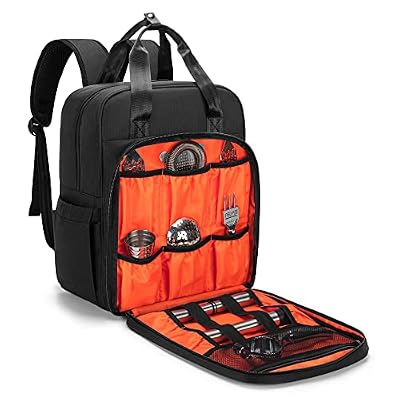
CURMIO Bartender Kits Backpack with Padded Compartments for Bar Tools Set
Included for 'Best Professional Bartender Bags for Mobile Service' as a relevant option in this category; details come from the product listing.
View on Amazon
Skureay Bartender Bag, Bar Tools Travel Bag with Padded Compartments
Included for 'Best Professional Bartender Bags for Mobile Service' because the listing specifies Bar Tools Travel Bag with Padded Compartments, details this guide uses to compare options.
View on AmazonThis format works especially well for a standard Boston shaker, Hawthorne strainer, fine strainer, jigger, bar spoon, muddler, citrus press, bottle opener, wine key, peeler, channel knife, and two towels. A capacity of about 15–20 litres is usually enough for tools and small service accessories without encouraging overpacking.
The drawback is uneven weight. A tote carried on one shoulder can dig into the neck or roll outward while walking. A removable padded shoulder strap and handles long enough to clear the upper arm make a meaningful difference. If you wear plus sizes, check the strap’s usable length rather than assuming “adjustable” means body-inclusive. A useful target is 34–50 inches of adjustment, with a strap pad at least 2 inches wide.
Best for maximum organization: a professional tool case
A case with zippered sections and elastic loops is the strongest option when you want every tool to have a fixed home. It is particularly useful for working several events in a row, because missing equipment is easier to spot during a pre-shift check.
Look for a center compartment at least 10 inches long and 7 inches wide so a standard 28-ounce shaker tin can lie flat or stand diagonally. Narrow vertical sleeves should be around 1.25–1.75 inches wide for strainers, jiggers, peelers, and openers. A larger open compartment is still necessary for towels, pour spouts, speed openers, and a citrus press.
Cases protect polished tools better than soft rolls, but they can become bulky. Avoid a case deeper than about 8 inches unless you regularly carry bottles or heavy equipment. Excess depth causes tools to stack, which defeats the advantage of compartmental organization.
Best for public transit: a bartender backpack
A backpack is the most portable format when you walk, cycle, or use trains and buses. Two shoulder straps distribute the load and leave your hands free for a rolling cooler or supply crate. Choose a bag with a full front opening or suitcase-style zipper; a narrow top-loading backpack makes it frustrating to find a jigger at a busy bar.
A good target is 12–18 litres and less than 8 inches deep when packed. Padded back panels reduce the discomfort of metal tools pressing into your body. Sternum straps are useful for stability, and a removable waist strap can prevent the bag from swinging on stairs. Wide, adjustable straps are preferable to thin fashion-style straps, particularly when the bag may weigh 10–15 pounds after packing.
Best for a minimalist setup: a bartender tool roll
A roll is lightweight, inexpensive, and easy to store. It is ideal if the venue supplies shakers, glassware, ice tools, and garnishes and you only need personal hand tools. Canvas, waxed cotton, or coated polyester rolls typically hold eight to twelve tools.
The limitation is protection. A rolled bag does not provide much padding for a shaker or glass bottle, and tools may slide out if the closure is loose. Use a roll inside a waterproof tote rather than treating it as a complete mobile-service bag. Make sure its pockets are deep enough to retain a bar spoon and muddler when the roll is carried vertically.
Features that matter more than branding
- Waterproof construction: Coated polyester, TPU-coated fabric, or waxed canvas handles splashes better than untreated cotton. “Water-resistant” usually means light rain protection, not immersion. A waterproof base is especially valuable because bags often rest on wet floors.
- Reinforced handles: Look for webbing that continues around the bottom or is stitched through multiple panels. Box-X stitching at the handle attachment is preferable to a single row of decorative stitching.
- Compartment geometry: Separate long tools from bulky tools. A bag with many tiny pockets may look organized but fail to fit a shaker tin or citrus press.
- Metal hardware: Zinc alloy or coated metal clips generally tolerate repeated loading better than thin plastic clips. Oversized zipper pulls are easier to operate with wet hands.
- Wipe-clean interior: Nylon, polyester lining, or laminated fabric is easier to clean than raw canvas. A light-colored lining also makes small tools easier to find.
- Stable base: Feet or a padded base help prevent the bag from tipping and keep tools away from dirty floors.
A capacity check before you buy
Pack your intended kit on a table and measure the occupied area rather than relying on the advertised litre figure. As a practical example, a shaker set may require approximately 11 × 4 × 4 inches, while a jigger, strainer, spoon, muddler, opener, peeler, and towels occupy another 500–700 cubic inches once gaps are included.
That is roughly 8–10 litres of packed volume before adding spare tools, personal items, or cleaning supplies. Allow 25–30 percent unused space so zippers close without force and wet towels do not press against metal tools. For a 10-litre load, this means choosing a bag rated around 13 litres; for a 15-litre load, choose approximately 19–20 litres.
Do not use the full listed capacity as a weight target. A compact professional kit can easily reach 8–12 pounds because stainless-steel tools are dense. If the bag feels uncomfortable at home, it will feel worse after a long shift.
Recommended layout for a mobile bartender
- Main compartment: Shaker tins, citrus press, backup tools, and a small roll of bar towels.
- Long sleeves: Bar spoon, muddler, tweezers, channel knife, and reusable straws.
- Flat zip pocket: Wine key, bottle opener, spare lighter if permitted, business cards, and venue notes.
- Protected pocket: Jigger and strainers, with a cloth between polished surfaces to reduce scratches.
- Exterior pocket: Clean towel or gloves only. Avoid putting wet or sticky tools against the outside fabric.
Keep liquids, bitters, and syrups in a sealed secondary pouch. A leaking bottle can soak the lining and transfer sugar into zipper teeth, where it becomes difficult to remove.
Ownership realities: what wears out first
Zippers and handle stitching usually fail before the fabric does. Do not overload a compartment by forcing a shaker through a narrow opening. Instead, place bulky metalware in the main section and reserve elastic loops for slim tools. Inspect the handle attachment every few weeks for pulled threads, fraying webbing, or a base that no longer sits flat.
After each event, empty the bag completely, shake out citrus pulp and ice fragments, and wipe the interior with mild soapy water. Leave every compartment open until dry. Never store a damp towel inside overnight. Waxed canvas may need periodic rewaxing according to its manufacturer’s instructions, while coated synthetics should not be scrubbed aggressively because abrasion can damage the waterproof coating.
Pack a spare bar spoon, wine key, and bottle opener if you work professionally. These small tools are inexpensive compared with the disruption caused by losing one during service. Keep a separate clean-tool pouch so sanitized equipment does not touch the bag’s exterior or the venue floor.
Final buying recommendation
For most mobile bartenders, the best professional bartender bags are structured 15–20-litre totes or cases with coated fabric, a waterproof base, reinforced handles, one padded shoulder strap, and a mix of open space and dedicated tool sleeves. Choose a backpack when walking distance and hands-free carrying matter most; choose a tool roll only when the venue supplies bulky equipment. Prioritize fit, access, and washable construction over decorative pockets, because a comfortable bag that dries quickly will serve longer than a stylish bag that traps spills and strains its handles.
Ready to decide? Our #1 pick for 2026 is the Occasional home events or a tight budget.
Live price & availability on Amazon.
Related Reviews & Guides




Best Ceiling Fans with Lights for Bedrooms
Best Shiatsu Foot Massagers for Circulation