
Last Updated: October 8, 2026
Quick answer: For most people in 2026, the best professional automotive diagnostic scanners is the Autel MaxiSys MS909 family — our #1 rated choice. See the full ranked comparison, alternatives and buying advice below.
Best Professional Automotive Diagnostic Scanners: Choose by Shop Needs, Not Feature Count
The best professional automotive diagnostic scanner for most independent repair shops is a current, vehicle-specific-capable tablet from Autel or Launch, chosen according to the makes you service and the cost of keeping its software current. For mixed fleets, prioritize broad system access and dependable bidirectional controls; for a shop focused on one manufacturer, a compatible OEM tool may deliver deeper diagnostics for less guesswork.
Before buying, confirm coverage for your actual vehicles, not just a headline claim such as “all systems.” Check whether the tool can read and clear codes across relevant modules, run active tests, perform required service resets, and access security-gated functions where applicable. Those capabilities vary by model year, market, subscription, and manufacturer authorization.
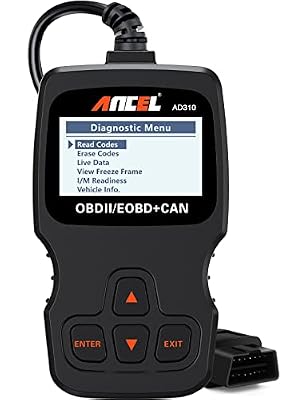
ANCEL AD310 Classic Enhanced Universal OBD II Scanner Car Engine Fault Code Reader CAN Diagnostic Scan Tool, Read and Clear Error Codes for 1996 or Newer OBD2 Protocol Vehicle (Black)
Included for 'Best Professional Automotive Diagnostic Scanners' as a relevant option in this category; details come from the product listing.
View on Amazon
BLCKTEC 460T OBD2 Scanner Car Code Reader Engine ABS SRS Transmission Diagnostic Tool, 12 Reset Services, Oil/TPMS/EPB/BMS/SAS/DPF/Throttle Reset, ABS Bleeding, Battery Test, Auto VIN, Free Update
Included for 'Best Professional Automotive Diagnostic Scanners' because the listing specifies 12 Reset Services and Oil/TPMS/EPB/BMS/SAS/DPF/Throttle Reset, details this guide uses to compare options.
View on Amazon
FOXWELL NT301 OBD2 Scanner Live Data Professional Mechanic OBDII Diagnostic Code Reader Tool for Check Engine Light
Included for 'Best Professional Automotive Diagnostic Scanners' as a relevant option in this category; details come from the product listing.
View on Amazon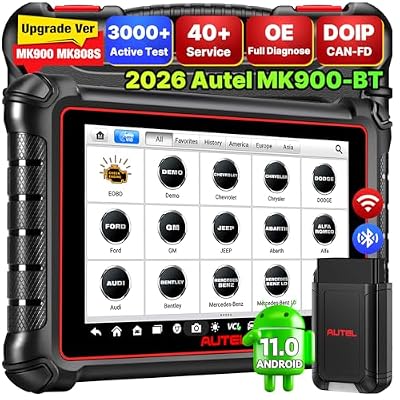
Autel Scanner MaxiCOM MK900BT Bidirectional Tool, 40+ Service, CAN-FD& DOIP
Included for 'Best Professional Automotive Diagnostic Scanners' because the listing specifies 40+ Service and CAN-FD& DOIP, details this guide uses to compare options.
View on AmazonProfessional scanner comparison
These are established product families, but exact specifications, included software, and supported functions can differ by model and region. Treat the figures below as practical buying ranges, not a guarantee for every configuration; check the current manufacturer listing before ordering.
| Tool or family | Typical screen | Typical weight | Best fit | Ownership point to check |
|---|---|---|---|---|
| Autel MaxiSys MS909 family | About 9.7 in | About 1.5–2.0 kg | General repair, broad system diagnostics, active tests | Update term, renewal price, and included VCI hardware |
| Autel MaxiSys Ultra family | About 12.9 in | About 3–4 kg | High-volume shops wanting a larger display and extensive guided functions | Higher upfront cost; confirm which advanced functions are licensed |
| Launch X-431 V+ / PRO family | About 10 in | About 1–2 kg | Mixed-make shops seeking broad coverage and active tests | Update package and regional vehicle coverage can vary by bundle |
| Bosch ADS 625 family | About 10 in | About 1–2 kg | Shops that value established support channels and guided diagnostics | Verify subscriptions, vehicle coverage, and required accessories |
| OEM diagnostic tool | Varies | Varies | Dealer work or a shop specializing in one make | Computer requirements, licensing, interface, and per-use fees |
Screen and weight figures are approximate product-family ranges; accessories and revisions affect them. Prices also vary widely: professional aftermarket tablets commonly run from several hundred dollars to several thousand, while OEM access may combine hardware, software subscriptions, and pay-per-use charges.
Which scanner fits your shop?
| Your situation | Prioritize | Likely direction |
|---|---|---|
| One or two technicians, occasional diagnostics | Reliable all-system scanning, simple updates, manageable upfront cost | Midrange Launch X-431 or Autel MaxiSys package |
| Independent shop handling many makes daily | Bidirectional tests, broad module access, support, fast workflow | Higher-tier Autel, Launch, or Bosch platform |
| Mostly one manufacturer | Enhanced OEM data, programming access, manufacturer procedures | OEM tool or subscription, possibly alongside an aftermarket scanner |
| Older vehicles and basic service work | OBD-II readiness, emissions data, ABS and airbag coverage as needed | Lower-cost professional scan tool; avoid paying for unused programming features |
| Small workspace or mobile service | Portable tablet, durable case, long cable or wireless VCI, vehicle power options | Compact midrange unit rather than a large flagship tablet |
Five checks that matter more than the headline feature list
1. Vehicle coverage: match the tool to your repair orders
Coverage is not a single yes-or-no specification. A scanner may communicate with a vehicle yet lack access to a particular module or function. Make a list of the makes, model years, and common jobs that generate revenue in your shop. Then verify coverage for engine, transmission, ABS, airbag, body, and other modules you routinely diagnose. For newer vehicles, confirm support for the relevant communication protocols and whether a secure gateway or manufacturer account is needed.
2. Bidirectional controls: useful, but not a substitute for diagnosis
Bidirectional control lets a technician command a supported component—such as a cooling fan, window, or solenoid—to operate. This can help isolate a fault more efficiently than simply reading codes. Ask whether active tests are supported on your target vehicles and modules; “bidirectional” does not mean every component can be commanded on every car. Follow service procedures, since an incorrect command can create a fault or safety risk.
3. Module access and special functions
Resetting an oil reminder is different from calibrating a steering-angle sensor, registering a battery, or carrying out a relearn. List the service and calibration procedures your shop actually performs. Confirm that they are included, available for your vehicle mix, and not restricted to a separate subscription or higher hardware tier. Programming and coding deserve special scrutiny: they may require stable power, additional interfaces, manufacturer credentials, or a separate OEM subscription.
4. Update costs and what happens when you stop paying
Compare the included update period and renewal price, not just the purchase price. Ask whether an expired subscription disables existing diagnostics or only stops new coverage and features. Also check how often the manufacturer releases updates, whether technical support is included, and whether the package is tied to one region. A low-cost tool can become expensive if a renewal is necessary to keep up with newer vehicles.
5. Hardware compatibility and shop workflow
Confirm whether the tablet works only with its bundled vehicle communication interface (VCI), whether replacement VCIs are available, and which connector adapters are included. If your shop already owns a suitable interface, do not assume it will work with a new tablet. Check Wi-Fi requirements, storage, charging options, cable length, and whether reports can be saved or shared. A scanner that cannot connect reliably in your service bays can waste more time than a missing feature.
Calculate the ownership cost before choosing
Compare tools over the period you expect to keep them. For example, suppose Tool A costs $1,200 and its annual updates cost $400 after the first included year. Tool B costs $1,700 and renewals are $250. Over four years, assuming three paid renewals, Tool A totals $2,400 ($1,200 + 3 × $400), while Tool B totals $2,450 ($1,700 + 3 × $250). The cheaper purchase is only $50 less over that period. If Tool B saves even a few minutes on regular jobs, the price difference may be outweighed; if its features are unnecessary, Tool A may be the better value.
Use your own renewal quotes and expected ownership period. Add any VCI replacement, adapter, OEM subscription, or training costs, and ask what functionality remains if you let updates lapse.
Keeping the investment useful
- Keep the tablet and VCI in a protective case; drops and damaged connector pins are avoidable causes of downtime.
- Inspect cables and connectors for looseness, bent pins, and strain before blaming the vehicle or software.
- Use a stable battery-support setup for programming or procedures that require uninterrupted voltage; a scan tool is not a substitute for a suitable power supply.
- Keep software current when needed for a job, but confirm update terms before starting a long update or changing account ownership.
- Save diagnostic reports and note vehicle details, codes, and test results so intermittent faults can be compared across visits.
For most mixed-make independent shops, the sensible choice is a mid- to high-tier Autel MaxiSys, Launch X-431, or Bosch ADS configuration whose demonstrated coverage matches the shop’s work. Choose an OEM platform when depth on a specific make matters more than broad coverage. In either case, compare verified functions and total ownership cost—not the longest feature list.
Ready to decide? Our #1 pick for 2026 is the Autel MaxiSys MS909 family.
Live price & availability on Amazon.
Related Reviews & Guides



Best 55-Inch OLED TVs for Every Viewing Setup
Best Gaming PCs Under Any Budget: What to Look For